
Prime Minister Mark Carney says he “should have been clearer” about the terms of the revenue-sharing deal with the United States for the soon-to-be-opened Gordie Howe International Bridge, after statements he made earlier this month appeared to contradict the text of the recently released proposal.
Earlier this month, Carney said that revenue from the six-lane toll bridge between Detroit and Windsor would only be shared after Canada recovered its costs of financing the bridge. He said on July 23 that a recently reached proposed agreement in principle between Canada and the United States calls for revenue sharing before Canada recovers those costs.
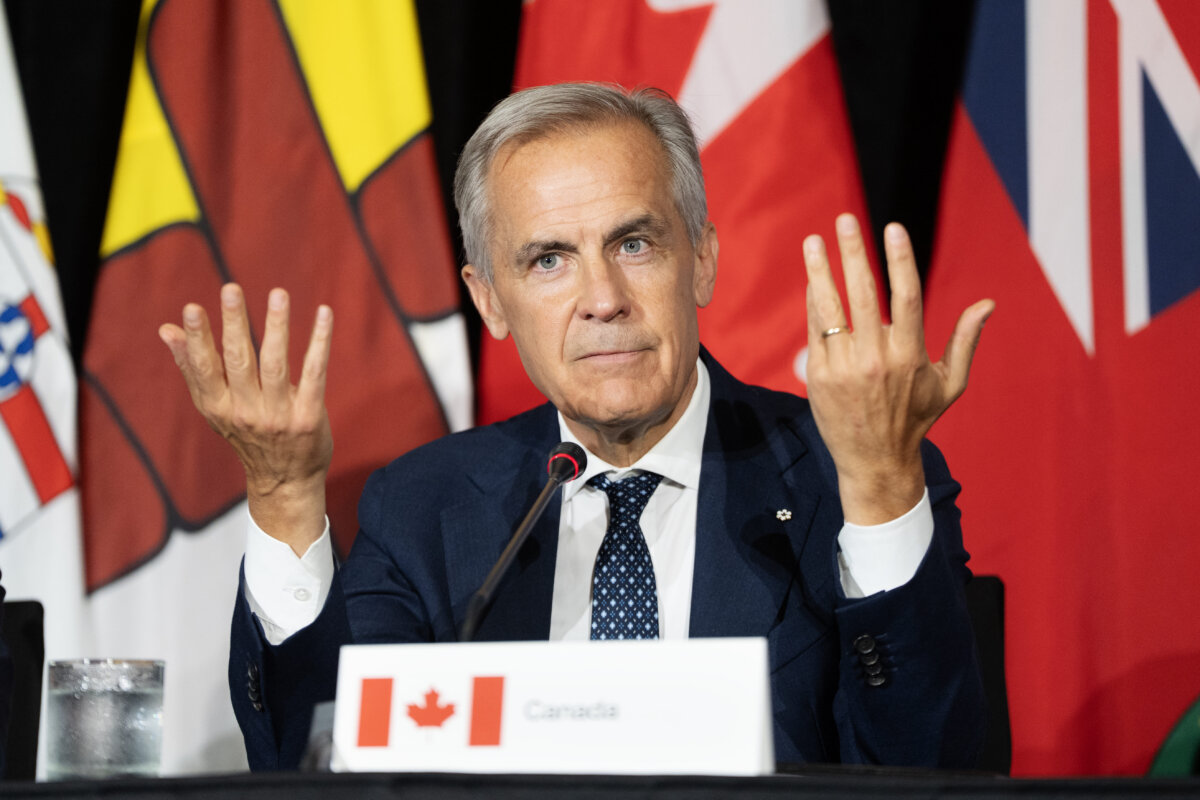
“I should have been clearer,” Carney said at a July 23 press conference after a meeting with provincial and territorial premiers in Charlottetown, P.E.I.
“Could I have explained it better on a Sunday morning at Stampede? Yeah, with a cowboy hat on? Yes, I could have explained it better.”
The bridge was financed by Canada at an approximate cost of $6.4 billion and is scheduled to open July 27.
Ottawa announced the proposed agreement in principle regarding the bridge on July 10. However, it was only released on July 21 after days of pressure from the Conservatives and questions from the media.
The proposal calls for revenue sharing for 15 years from the start of operations, and defines net bridge and crossing-related revenue as all revenues collected from the crossing minus the operating costs incurred by the bridge.
It does not mention Canada recouping interest costs or debt before dividing bridge toll revenue with the United States.
The proposed agreement in principle will operate separately from the original Canada-Michigan Crossing Agreement signed in 2012. Under the original agreement, Canada agreed to fund the construction cost of the bridge and was entitled to collect all toll revenues until it had recovered its investment, a period which is projected to take decades.
Carney said his earlier comments had conflated the two separate agreements.
“There is no splitting of tolls under that agreement, which is what I was referring to, perhaps imperfectly … until all of the debt is repaid,” Carney said July 23 in regard to the original Canada–Michigan agreement.
The new agreement in principle requires Canada to make separate annual payments to a U.S. government-controlled fund called the United States-Canada Economic Development Fund.
Payments will be equal to 50 percent of the bridge’s net revenue during its first 15 years of operation.
‘A Good Deal’
Carney said the new agreement in principle is “a good deal” for the country and said the present value of the revenue-sharing agreement is less than 5 percent of the bridge’s development cost.
“Very marginal because takes time for traffic to ramp up. There’s various costs. There’s various sharing,” Carney said July 23.
“It gets fed back in, and to put it in order of magnitude, it’s less than 5 percent in present value of the overall cost of developing the bridge.”
In addition to revenue sharing with the United States from the start, the new agreement in principle requires Canada to ask for U.S. consent if it wants to hike tolls by more than 10 percent in a single year and the resulting toll would be higher than those charged at similar regional border crossings.
Canada also needs American approval if it wants to reduce tolls below what is charged at similar regional border crossings.
The agreement notes that the United States must respond within 30 days to verify consent or express opposition. Otherwise, if there is a lack of an American response in that time period, consent will be deemed granted.
Reactions
The Conservatives say the new terms are part of a “wide string of concessions” made by the Liberal government to the United States and accuse the government of not being transparent about the U.S.-Canada deal on the bridge.
Tory shadow minister for Canada–U.S. relations Shuvaloy Majumdar said July 20 that the Liberals have been “flip-flopping between net revenue and net profit and deal-sharing,” and unfairly burdening MPs and the public with trying to piece together the deal on their own.
“There is no transparency,” Majumdar told media July 20 ahead of the government’s July 21 release of the agreement in principle.
Ontario Premier Doug Ford credited Carney for doing an “excellent job” in securing the proposed agreement in principle and said the bridge will bring many economic benefits to the Ontario economy.
“Michigan is Ontario’s number one trading partner with over $70 billion of two-way trade. It’s critical for the auto sector. It’s critical for auto part manufacturers, and it’s critical for all manufacturers that this bridge gets open,” Ford added.
The bridge had been scheduled to open in mid-June but the ribbon-cutting was postponed due to what Carney at the time called “a series of technical aspects” and unspecified “outstanding issues.”
A Canada-only celebration has been scheduled ahead of the July 27 opening following U.S. President Donald Trump’s proclamations on July 20 of 50 percent tariffs on about $28 billion in Canadian goods. The tariffs are set to go into effect Aug. 19.
“In light of trade action threatened by the United States earlier this week, it would be inappropriate to proceed with a celebratory event between the two countries,” Jenna Ghassabeh, director of communications for Housing and Infrastructure Minister Gregor Robertson, said in a statement.
 Friends Read Free
Copy
Facebook
Tweet
Friends Read Free
Copy
Facebook
Tweet