
COTTONWOOD, Ariz.—Kelsey Jacobs answers each call not knowing who will be on the line or what crisis awaits.
It could be someone having a heart attack, a suicidal person, a vehicle rollover, a drug overdose, or just an accidental call.
A 911 dispatcher at the Cottonwood Regional Communications Center, Jacobs, 31, said that the job is naturally stressful and that for dispatchers who struggle to cope, burnout is “a huge factor.”
“What keeps me here is the job and being able to help people and make a difference,” Jacobs told The Epoch Times.
Other dispatchers and experts agree that burnout is a major challenge for 911 call handlers. This echoes the findings of a recent nationwide survey by emergency communication provider Carbyne and the National Emergency Number Association (NENA), a nonprofit focused on 911 operations.
Burnout leads to staff absences and people quitting, which then leads to understaffing, overtime, and more burnout.
For dispatch units, the relentless churn of staff is a crisis they cannot afford. Training takes six to 11 months. Yet there is no break from the flood of 240 million emergency calls each year while units grapple with chronic understaffing, according to NENA.
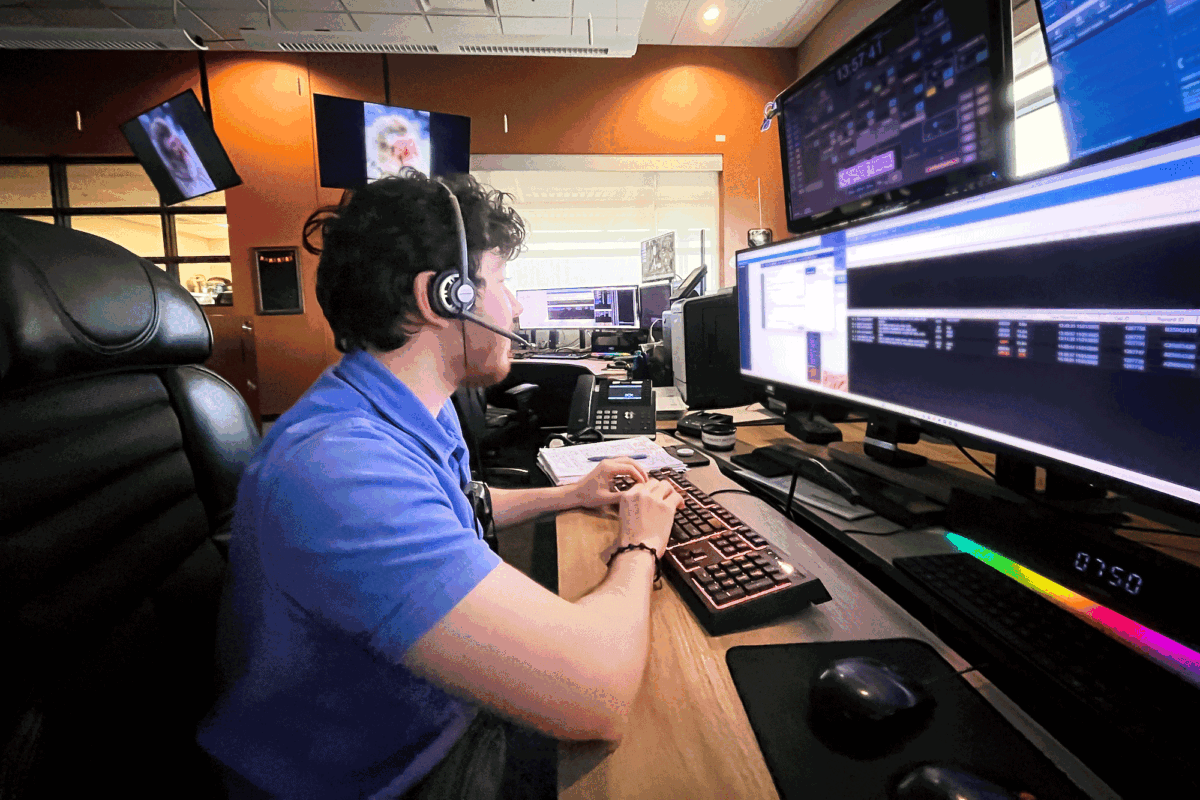
Inside the Cottonwood center, 20 dispatchers work around the clock in rotating teams of six. They sit at consoles, each of which has several computer monitors.
“We are the linchpin, the catalyst for everything else,” Alexis James, who manages the Cottonwood Public Safety Regional Communications Center, told The Epoch Times.
“People don’t understand the full scope of what we do,” James said.
The team has three communications supervisors and four lead dispatchers and trainers. Every communications specialist is certified as an emergency medical dispatcher by the International Academies of Emergency Dispatch (IAED), a Utah-based organization that sets standards for emergency dispatch and response services worldwide.
At the Cottonwood facility, each dispatcher completes at least six months of job training and 40 hours of classes on public safety communication to handle any emergency.
Their shifts pass quickly or slowly, depending on call volume and type: a missing pet, a power outage, a medical crisis, or a natural disaster that requires quick decision-making.
Jacobs has worked at the Cottonwood facility since 2016, inspired by the challenge of the job, the promise of good benefits, and the chance to serve her community.
Self-care is critical, she said.
“I try to teach my trainees, as soon as they get in: ‘You’ve got to find an avenue,’” Jacobs said. “We have different programs. If you need help, if you need to talk to us, we’re here. Find an outlet to relieve that stress.”
Jacobs, who is a new mother, appreciates having a private child care room close to the dispatch consoles as part of the center’s wellness program.
The workplace also offers a quiet room where dispatchers can relax after a long shift, as well as access to a gym, kitchen facilities, and a recreation center with a swimming pool.
“I think some agencies can lead people down the [path to] burnout,” Jacobs said. “They don’t look at their people as a whole. They look at it as if we’ve got to fill shifts.”
She credits her center’s good retention rates with quality staff care.
“Our leaders truly care about us as people,” she said.
Dispatchers Wanted
Right now, the Cottonwood dispatch center is operating two staff members short of its full team of 22.
Many other centers nationwide have much higher staffing shortages, putting more pressure on staff.
The third annual “Pulse of 911” report from NENA and Carbyne surveyed 1,379 respondents across dispatch centers nationwide and found that burnout has become the top workforce challenge.
The report, published in June, found high turnover, frequent absences, and a 22 percent rate of training failure.
The survey also highlighted positive changes, including greater interest in artificial intelligence tools, better support for dispatcher health, and the fact that the number of centers with open positions fell to 74 percent this year from 82 percent in 2024.
A NENA spokesperson told The Epoch Times that most centers are understaffed. Although the vacancy rate has fallen since the COVID-19 pandemic, it remains significant in most centers.
“That means everyone else has to do overtime [to fill the gaps in coverage],” the spokesperson said.
The nation’s 105,200 dispatchers earn a median annual salary of $50,730, according to the Bureau of Labor Statistics, with 10,700 new public safety telecommunications jobs set to open each year over the next decade—a 3 percent annual increase.
IAED Director of Government Affairs Ty Wooten acknowledged many key points in the Carbyne and NENA report, noting that burnout remains a significant problem.
Hiring is also a challenge because of the job’s stressful nature and other factors such as pay, work schedules, and benefits, he said.
“When you’re struggling to fill the seats, that means there are openings, which means that there’s more overtime,” he said.
Wooten said this often causes dispatchers to burn out more quickly, making it difficult to break the turnover cycle.
He also said a lack of recognition for the work adds to burnout and other issues.
“We’re the unseen people under the headset,” Wooten said. “We don’t get the same kind of recognition that other parts of public safety do, which, in itself, is a little bit difficult.”
“We’re answering the calls on people’s worst days,” he said. “We continue to do that day in and day out. The stress of that continual assault is difficult to deal with.”
Staffing Concerns
In June 2023, the IAED published a study titled “America’s 911 Workforce in Crisis.”
The report found that more than one-third of the country’s 5,400 call centers lacked sufficient staff as call volumes increased.
Of the 774 emergency 911 call centers included in the study, 36 percent had vacancy rates higher than 30 percent and 161 centers reported rates higher than 40 percent.
The highest vacancy rate in 2022 was 83 percent for one center, while the average was about 25 percent.
The study also found that 36 percent of call centers had fewer filled positions in 2022 compared with 2019.
Thirteen centers said 71 percent or more of their jobs were unfilled. Ninety-two centers had vacancy rates between 51 percent and 70 percent and 202 centers reported rates between 31 percent and 50 percent.
Almost everyone surveyed said they lost employees in 2022, with 3,952 people leaving from 774 centers in one year.
Emergency call takers and dispatchers with at least one year of experience said they left their jobs because of stress or to get better work hours, more advancement opportunities, or higher pay.
Training Is Key
At the Cottonwood center, Brittany Jacobs, a communications specialist and Kelsey Jacobs’s sister-in-law, said training is the foundation of effective dispatching.
Training is conducted in-house, and professional development is ongoing. Trainees need discipline, emotional fortitude, and strong multitasking skills to handle the complex systems and job demands, she said.
“We’re almost like the mitochondria of a cell,” Brittany Jacobs told The Epoch Times. “We house so much information. It takes a lot to train somebody. You have to be determined to make it through. There will be good days and bad days. On bad days, you can’t just give up and not come back the next day to do better.”
Andrew Pierce, 32, another communications specialist at the Cottonwood facility, said it is not hard to find applicants. The real task is finding people with the right skills, qualities, and determination to succeed, he said.
“Sometimes, I’ll have 20 applicants, and half of them don’t respond to my emails,” Pierce said. “The other half scheduled [an interview] and they didn’t show up. Some might get halfway through the hiring process. Half will make it to the end, which winds up being maybe two.”
Burnout is a constant concern, he said, but most employees leave because they move away or their lifestyles change.
“Everything’s pretty much moving,” Pierce said. “It’s becoming more high-tech, so people have to be more computer-savvy, I would think. In a lot of ways, technology makes things easier.”
Technology Advances
Emergency call centers for police, fire, and medical response have come a long way since people used to call 911 from a landline phone, according to NENA’s spokesperson.
Back then, someone would pick up the phone, jot down notes on a pad of paper, and then use a walkie-talkie to send out first responders, the spokesperson said.
The spokesperson noted that most 911 telecommunicators now work with multiple video screens at once, smart screens with multiple camera feeds, and different software to more accurately locate calls.
Improvements in communication and location technology, such as AI and the option to send photos and texts, support the move to next-generation 911 systems.
Wooten said the role of AI will grow. Nevertheless, he said, although AI can handle many calls and connect people to the right professionals, it cannot replace the important human touch.
“If we can train on AI to keep our skills high, simulation is another big aspect we’re going to see in the 911 centers,” Wooten said.
In the “Pulse of 911” study, 86 percent of dispatchers said they felt at least somewhat comfortable with AI assistance with taking calls.
“AI won’t replace dispatchers,” Carbyne CEO Amir Elichai said. “It will give them a fighting chance in high-pressure environments.”
The study also found that the percentage of 911 call centers with technology outages increased to 88 percent in 2025 from 75 percent in 2024.
Nine percent reported that telephone denial-of-service or other cyberattacks caused these issues, indicating that more needs to be done to address system vulnerabilities.
“There’s no question: The fragility of current emergency communications infrastructure is putting lives at risk,” Elichai said.
“What’s clear from this year’s report is that 911 professionals are doing everything they can, but they need modern, resilient systems to back them up.”
 Friends Read Free
Copy
Facebook
Tweet
Friends Read Free
Copy
Facebook
Tweet