



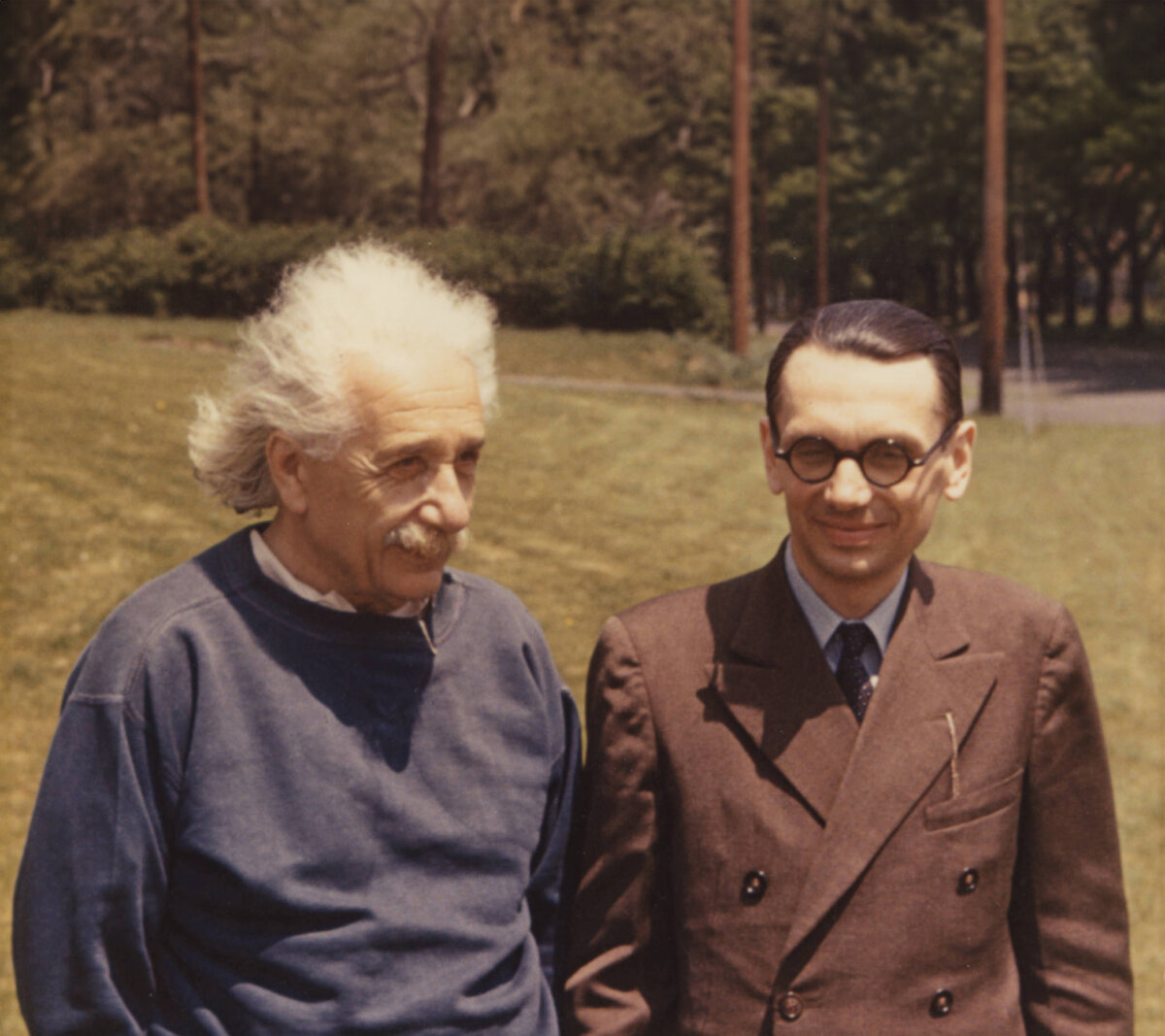
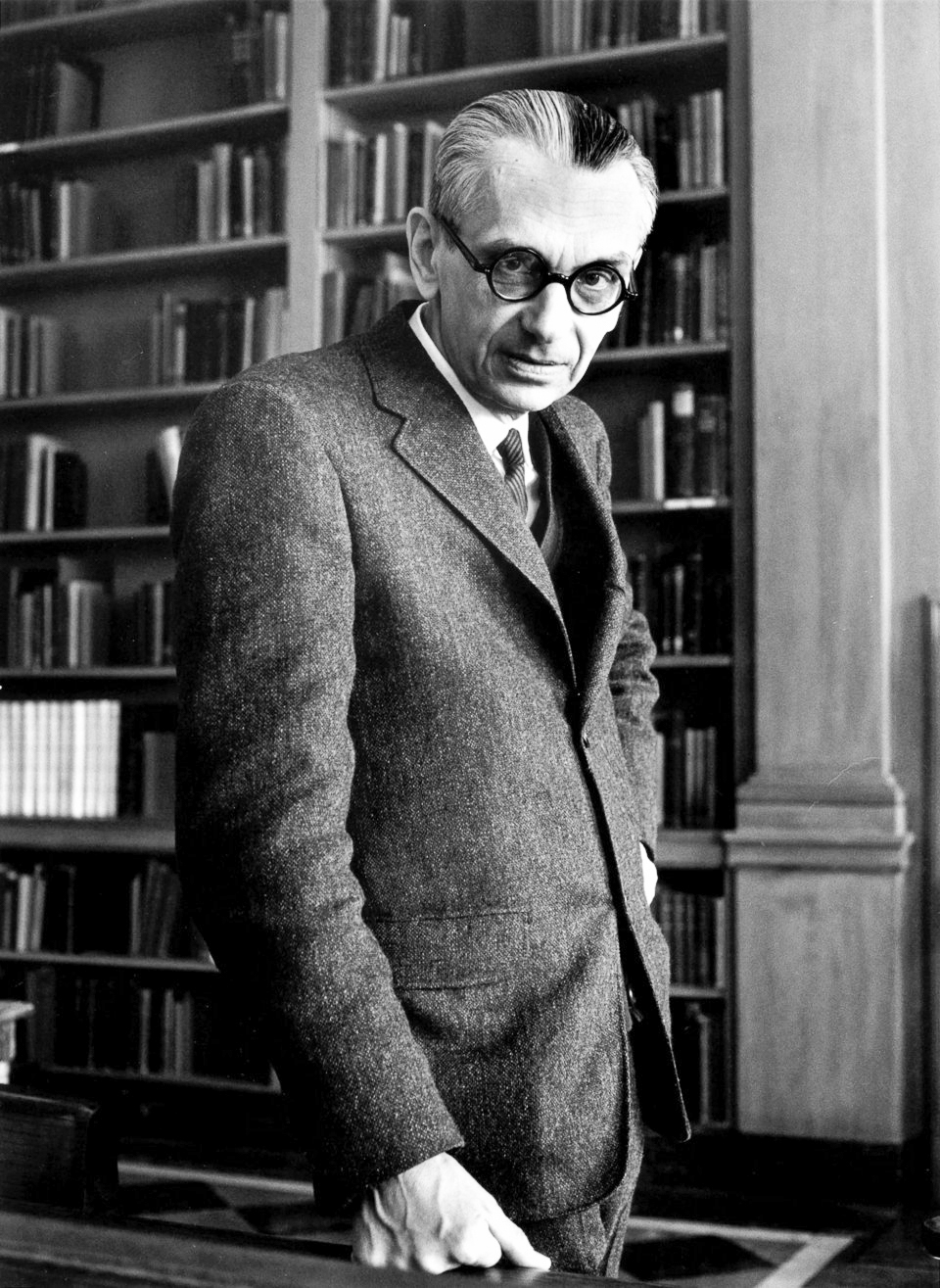
Princeton was a center of attraction for many renowned researchers in the 1940s and 1950s. Two of them stood out in particular, and were always seen together: Albert Einstein and the man known as his closest friend at the time: Austrian mathematician Kurt Godel.
Both had fled Europe during the Nazi occupation and worked together at the Institute for Advanced Study in Princeton, New Jersey. Every day, they walked home together, conversing animatedly in German on politics, physics, philosophy, and life.
Einstein said that his own work at the time did not amount to much and that he came into the office “just to have the privilege of being permitted to walk home with Kurt Godel,” Stephen Budiansky wrote in his biography of Godel. Like many others, Einstein considered Godel the “greatest logician since Aristotle.”
But Godel, who suffered from a lack of confidence his entire life, was puzzled by Einstein’s affection. “I have often pondered why Einstein took pleasure in his conversations with me, and I believe one of the causes is to be found in the fact that I frequently was of the contrary opinion and made no secret about it,” quoted Budiansky.
Godel was versed in the theory of relativity and dedicated a significant portion of his time to developing mathematical tools associated with it. He even created a theoretical model for the possibility of time travel.
He made his big breakthrough just one year after completing his doctorate studies at the University of Vienna. At the time, the renowned mathematician David Hilbert, along with earlier foundational work by Bertrand Russell and others, was spearheading a project to find a logical system with a finite number of mathematical axioms by means of which one could prove every theorem within that system. Using non-mathematical language, they sought to prove that anything that can be mathematically proven by axioms and rules of inference is true, and everything that is true within that system is provable. In other words, they claimed that mathematics is a perfect and complete system.
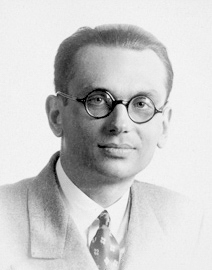
This endeavor by the foremost mathematicians of the period was crushed in 1931, when an entirely anonymous 25-year-old Godel published a paper in which he formulated two mathematical theorems proving that such a system cannot exist. His paper proved that there will always be truths that cannot be proven by mathematical axioms and rules of inference, and therefore, any such system must necessarily be incomplete. There will always be certain truths in the system that require, as Godel put it, “some methods of proof that transcend the system.”
The “Incompleteness Theorems,” as they came to be known, caused great distress throughout the mathematical community.
The proven limitations of mathematics tempted philosophers—postmodernists in particular—to conclude that if not everything can be proven, then there is no one single truth. But this is a logical fallacy, Godel argued, for one must distinguish between the ability to prove truth and the very existence of that truth. He claimed that while some truths, or mathematical axioms, cannot be mathematically proven, they can still be uncovered through intuition: “The axioms, too, are part of mathematical truth, but of a kind that defies formalism altogether, accessible only via human intuition,” quoted Budiansky.
In 1951, Godel received the inaugural Albert Einstein Award. In a congratulatory address, mathematician John von Neumann described Godel’s achievements in logic and mathematics as so momentous that “they will remain visible far in space and time.”
Despite these widely celebrated mathematical achievements, Godel did not share his views on philosophical and religious matters publicly. Toward the end of his life, he circulated a philosophical proof for the existence of God, but only among close friends. And one profound view of his remained hidden and came to light only after his passing: his belief in life after death.
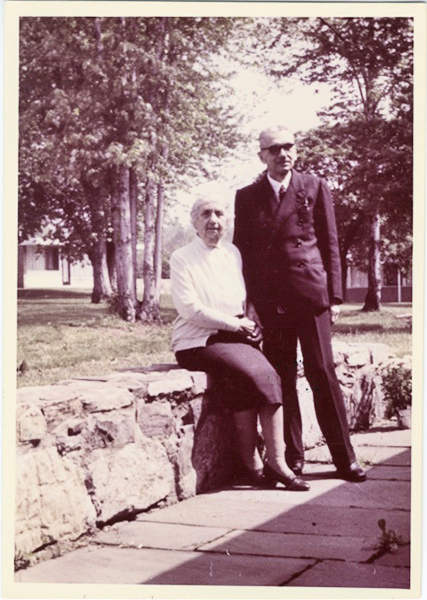
In private correspondence with his mother Marianne Godel, Godel touched briefly on many deep philosophical questions. “At first sight, this whole set of views that I expounded you to indeed seem highly implausible,” he wrote, “but I believe that if one reflects on it more carefully, it will show itself to be entirely plausible and reasonable.”
Letters to Mother
In July 1961, Godel wrote to his 81-year-old mother in Austria: “You pose in your last letter the momentous question if I believe that we shall meet in the hereafter.” Their correspondence continued over the course of three months from July to October 1961. Marianne Godel passed away five years later.
Unlike Godel’s letters to his mother, Marianne Godel’s letters to her son have not been preserved, leaving us with only assumptions of her questions that made Godel continue to evolve his perspective on the matter.
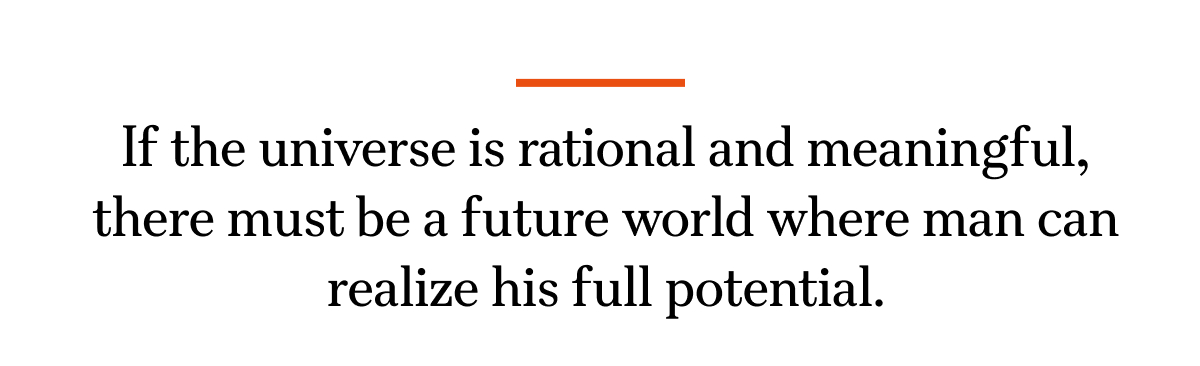
In his first letter to his mother, he summarized his ideas on why he believed there must be life after death. “If the world is set up rationally and has a meaning, then that must be so. For what kind of a sense would there be in bringing forth a creature (man), who has such a broad field of possibilities of his own development and of relationships, and then not allow him to achieve 1/1000 of it.”
To drive his point home, Godel presented a metaphor: Such an act (as presented above) can be likened to a man spending incredible effort and money on laying the foundations to a house, then leaving those foundations to go to ruin again. Godel believed that such waste is impossible in a rational world.
But Godel himself asked, “Does one have a reason to assume that the world is set up rationally?” He provided an answer: “I believe so. For it is certainly not chaotic and arbitrary, but rather, as science shows, the greatest regularity and order reign in everything. Order is but a form of rationality.”
Godel continued in his fourth letter to his mother, “From this it follows immediately that our earthly existence—since it as such has at most a very doubtful meaning—can be a means to an end for another existence.”
To put it in less philosophical terms, as did associate professor Alexander Englert at the University of Richmond: Godel claimed that the world is built in a rational manner. Science demonstrates the regularity and order of the world through facts, theories, and attempts that can be replicated anywhere, anytime. And if the world is rational, then mankind in it must share the same rational structure. But human life is irrational for the following reason: A man has great potential, but he can never realize it during his lifetime. Logic maintains that man must realize his full potential in a future world.
Humans Are Imperfect for a Reason
Did Marianne Godel find Godel’s brief explanation sufficient?
One can only surmise that she raised additional questions from Godel’s reply to her on the same subject. “When you write that you pray to creation, you probably mean that the world is beautiful all over where human beings cannot reach.” One can speculate that in her letter, Marianne Godel referred to her son’s claim that a person cannot realize their potential in their lifetime. Humans are imperfect and therefore spoil creation.
Godel argued that because humans in this world are imperfect, this raises the possibility that another world exists. The purpose of human existence in this world, according to Godel, is to learn how to improve oneself and thereby achieve a better existence and give meaning to one’s life. And this process of self-improvement is entwined with mistakes, failures, and suffering, as he wrote: “Only the human being [unlike animals and plants] can come into a better existence through learning, that is, give his life more meaning. One, and often the only, method to learn arises from doing something false the first time.”
The purpose of learning in the current world, according to Englert’s interpretation of Godel, is not to improve various technical skills, but to become wiser. Through observing one’s mistakes, errors, and evil tendencies and through repeated attempts to improve and make fewer mistakes, a person gives meaning to their life. But the unavoidable mistakes and failures in the learning process, per Godel, render the person unable to realize their full potential within their lifetime in this world.
Herein lies the question that Godel himself raised: Why did God not create humans so that they do everything correctly from the start, without mistakes and without the need for learning? Godel’s own answer is interesting. “The only reason that this question appears justified to us could very well be the incredible state of ignorance about ourselves in which we still find ourselves today,” Godel wrote. “We not only don’t even know whence and why we are here, but also don’t know what we are (namely, in essence and seen from within).”
He went on to explain that perhaps the ignorance in which we are immersed is related to the prejudices that many people hold against religion. “I believe there is much more sense in religion than people are accustomed to think,” he remarked. But today, most people are infused from a young age with prejudice against religion.
The Materialist Error
Godel did not mention in his letters to his mother the mathematical theory he developed, but according to Englert, Godel’s belief in life after death also stems from those theorems, which, in addition to proving the incompleteness of mathematics, also prove the error of the materialist worldview.
According to the materialist worldview, every truth must be grounded in physical facts. Therefore, the soul, for example, cannot exist because it has no proven physical basis. “In an unpublished paper from around 1961, Godel asserted that ‘death appears to [materialism] to be final and complete annihilation,'” Englert wrote. But Godel believed that the “materialist worldview was false” and that “his incompleteness theorems showed it to be highly unlikely.” Just as there are mathematical truths that can only be explained outside the boundaries of mathematics, through intuition, so too there may be truths—for example, life of the soul after the death of the physical body—that have no proven material explanation.
Admittedly, Godel’s mathematical theory does not prove that life after death exists, but as Englert explains, Godel believed that it dealt a serious blow to the materialist worldview.
If the soul cannot be reduced to the physical components of the brain, and if in mathematics there are phenomena that can only be explained by means of explanations outside the formal framework of mathematics—for example, through intuition—then one must seek an alternative worldview to the materialist one, one that cannot be examined through the senses. Such a worldview, Godel argued, can contain the possibility of life after death in another future world.
‘Raw Material for Learning’
What is the primary purpose of life after death, according to Godel? It is to deepen the learning process that has begun in the current world.
The learning process in the future world, Godel explained, will unfold as follows: “[We] remember our experiences from this world and come to understand them really for the first time, so that our this-worldly experiences are—so to speak—only the raw material for learning.”
To illustrate his intention, Godel offered an example: “For what could a cancer patient learn from his pain here? On the other hand, it is entirely conceivable that it will become clear to him in the next world what failing on his part (not as regards his bodily care, but perhaps in some completely different respect) caused this illness.” In simpler terms, a person will understand how thoughts, feelings, and conceptions they hold about themselves and the world caused their illness and affected additional aspects of their life—at work, in their relationships with other people, and within the family.
Godel added that though science and conventional wisdom of our time have no knowledge of such connections, he himself is certain of their existence.
An additional necessary condition for learning in the future world, according to Godel, is that our understanding in the future world will be far better than the understanding we have in the current world. We will understand everything of importance with absolute certainty, without any mistakes or errors.
Godel was certain that all the views he presented to his mother, which began as a philosophical inference, would ultimately be confirmed by facts, as had occurred in the past in other fields, as he wrote, “When 2500 years ago, the doctrine that bodies consist of atoms was first put forward, this must have seemed just as fantastic and unfounded then as the religious doctrines appear to many people today. For at that time, literally not a single observational fact was known, which could have instigated the development of the atomic theory; but this occurred on purely philosophical grounds. Nevertheless this theory has today brilliantly confirmed itself and has become the foundation for a very large part of modern science.”
