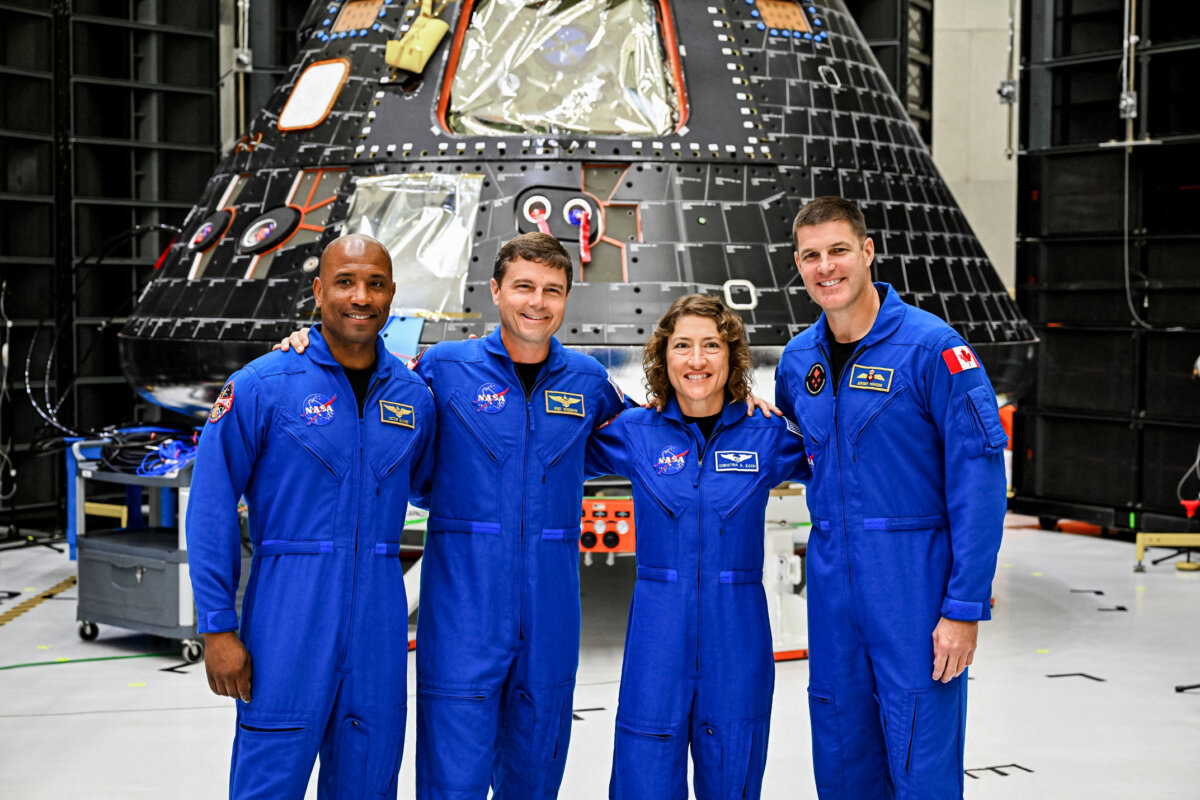

HOUSTON–They call her Integrity.
The Orion spacecraft assigned to NASA’s Artemis II mission has finally been given a name.
She will carry NASA astronauts Reid Wiseman, Victor Glover, and Christina Koch, as well as Canadian astronaut Jeremy Hansen, on the first manned flight around the moon in more than 50 years. And that flight could occur as early as February 2026.
While she is prepped to be stacked on the top of NASA’s behemoth Space Launch System rocket at Kennedy Space Center in Florida, Integrity’s crew, as well as her mission’s directors, managers, and support staff, spent two days at Johnson Space Center in Houston giving The Epoch Times and other members of the media a glimpse into the mission.
The mission has a chance to break some Apollo-era records and features several groundbreaking scientific experiments dedicated to understanding how deep space affects human beings.
The astronauts and ground personnel highlighted that Artemis II is first and foremost a test flight, the success of which will be determined by the success of Artemis III.
A Test Flight
Artemis II is scheduled to launch from Kennedy Space Center in Florida next spring.
“The crew’s ready. They’re completing their final training. We’ve got our final training here in the control center,” Artemis II flight director Jeff Radigan told The Epoch Times on Sept. 24.
“We’ll all be ready to go. And so it’s just, you know, making sure [of] all the final checks, and we get to [the] launchpad and are able to get up.”
According to Lakiesha Hawkins, acting deputy associate administrator for the Exploration Systems Development Mission Directorate, NASA’s goal was to launch by April 2026 at the latest. However, the launch window could open as early as Feb. 5, 2026.
Once that window opens, she said there will be “launch periods” of four to eight days available each month. If they decide to launch in one of those early periods, it will most likely be an evening launch.
Glover provided a detailed outline of the first two days of the mission to members of the press on Sept. 24.
Day 1 of the mission begins seven hours before launch, as the crew and ground teams make final preparations. Artemis II will launch atop the most powerful rocket in operation, delivering 8.8 million pounds of thrust.
After separating from the solid rocket boosters and the main stage, Integrity will reach orbit thanks to the upper stage booster.
Once in orbit and the upper stage engine stops firing, the crew will begin tests of the critical systems, including setting up the onboard toilet and water system.
Glover said he and his crew will complete one orbit over the span of 90 minutes, traveling about the same speed as the International Space Station, and then fire the upper stage again to reach a high Earth orbit of nearly 40,000 miles above the surface.
At that highest point of their orbit, known as the “apogee,” Integrity and her service module, made by the European Space Agency, will separate from the booster. Wiseman and Glover will then fly Integrity manually, using the discarded booster as a target for a rendezvous demonstration.
“We’re going to make sure that the flying qualities of the Orion spacecraft are suitable for the more complex missions where we’re going to dock to a lander or to the gateway, the orbiting space station around the moon,” he said. “And then once we’re done with that, we’re going to continue to reconfigure the capsule to make sure that it’s ready for us to live and to work for the next nine days.”
The crew will then take a nap, wake up in the middle of the night to fire the service module engine, and go back to sleep.

Radigan explained that Integrity will swing around the Earth, dropping in altitude from nearly 40,000 miles to a low point, or perigee, of just 100 nautical miles.
It is at that point, if given the go-ahead, the crew will fire the engine and set off on its translunar injection, the combination of course and speed that will take them away from the Earth and toward the moon.
Only after that, Glover said, will he and his crewmates get a normal sleep period and bring the first “day” to a close.
Crossing the vast channel of deep space between the Earth and the moon will take four days, during which time more checkouts of Integrity’s systems and course-correction burns will be executed.
“It’s a test flight, so we’re going to put the vehicle through its paces and check all the systems, ensuring that everything is ready to go,” Radigan said.
That checkout flight will then be interrupted on Day 6 by the lunar flyby. Radigan said that, depending on the position of the moon, the crew will pass by the moon at a distance of 5,000 to 9,000 nautical miles. He and other officials said it would appear out the window about the size of a basketball held at arm’s length.
The crew will have three hours to observe the moon and take pictures, entering a 45-minute radio blackout as they travel around the moon.
They will be on what is called a “free return trajectory,” which utilizes the moon’s gravity to do a U-turn and head back to Earth without needing to use fuel.
The journey home will feature more check-outs of the system, as well as the breaking down and stowing of all the aspects of their living quarters that they set up on day one in preparation for re-entry.
A few course correction burns are expected throughout that return trip, followed by one final burn that puts Integrity at the right angle for reentry. She will then disconnect from her service module and turn around to face her heat shield toward the atmosphere.
Astronauts suggested that Artemis II could hit the atmosphere at about 28,900 miles per hour, 39 times the speed of sound. Their reentry course will slow them all the way down to 15 miles per hour, at which point Integrity’s main parachutes will drop her in the Pacific Ocean off the coast of Southern California.
Testing Life in the Capsule
Artemis II is not just a test flight in terms of flight controls. It is a flight test of every aspect of how the crew will live and work inside the Orion capsule.
Assigned to the Intravehicular Activity console in Mission Control, Michael Doll told The Epoch Times that his team is responsible for “all the stuff inside the vehicle.” They will also be tasked with keeping Wiseman, Glover, Koch, and Hansen on schedule when it comes to various procedures, such as setting up, breaking down, and stowing all equipment onboard—from the radiation monitors to the toilet.
“Pretty much anything that the crew touches or interfaces with on a daily basis, that’s our systems,” he said.
Doll said he has worked directly with the backup and prime crew members in the simulators, as well as NASA’s cargo contractors, to ensure that everything inside the capsule is set up as conveniently and efficiently as possible.
During the flight, Doll said the astronauts will test emergency scenario procedures such as donning their pressurized flight suits and taking action to protect themselves against bursts of solar radiation.
NASA requires astronauts to exercise while on any mission lasting more than nine days. While Artemis II barely tops that limit, the crew will be testing a brand new piece of exercise equipment, one at a time, called a flywheel, as well as methods to ensure the other three crew members can optimize their time as much as possible.
But the intravehicular activity that will potentially gain the most attention will be when the crew observes the moon.
Seeing What No Human Eye Has Seen
Wiseman, Glover, Koch, and Hansen will have a three-hour window to observe the moon on Day 6 of their mission.
It is the hope of Kelsey Young, Artemis II lunar science lead, and the entire lunar science ground team that the crew will see parts of the 60 percent of the lunar surface that no human eye has ever seen.
During Integrity’s flyby, the Artemis II science team will be in a specially designed support room with an interactive map of the moon. There, they will listen in on the crew’s observations and relay questions and direction through their representative on mission control to the flight director and the flight controller responsible for talking to the crew, called CAPCOM.

Scores of potential targets have already been selected, including the Tsiolkovsky Crater, the Orientale Basin, and the Apollo Basin.
Much of the scientists’ focus will be on the far side of the moon, which the Apollo missions avoided so they could land on the illuminated near side. However, the scientists also hope to see as much of the lunar south pole as possible ahead of Artemis III’s landing there.
While unmanned spacecraft have been able to fully map the surface of the moon, mission leaders stressed that there was no greater tool for observation than the human eye.
The lunar scientists told The Epoch Times that the more illuminated the far side, the better. However, they are at the mercy of all other mission factors, and they will not know for sure what part of the moon will be visible until after Artemis II performs its translunar injection.
Once underway, the science team will have four days to determine any specific targets and request the crew make attitude adjustments to ensure the best possible view of any targets.
They also have contingency objectives depending upon the phase of the moon and how the sun’s light hits the surface. Priority observations could change from documenting different shades of color to capturing newly defined outlines of craters or even include the recording of meteoroid impacts that stand out from darkened regions.
The astronauts have invested weeks in geology training, and the scientists are confident that their verbal descriptions, sketches, and photographs of what they see on the lunar surface could provide considerable insights. Colors, for example, could suggest the presence of certain minerals, and defined outlines of topographical features could provide insights that have yet to be picked up by previous photography.
But this lunar geological observation is only one of four scientific missions launching aboard Artemis II.
Astronauts and Test Subjects
Wiseman, Glover, Koch, and Hansen will be not only astronauts but also test subjects for multiple human science experiments seeking to better understand how deep space affects the human body.
One of those experiments is called AVATAR. Short for “A Virtual Astronaut Tissue Analog Response,” this program will carry blood-forming stem and progenitor cells, which originate in the bone marrow, in chips roughly the size of a thumb drive that mimic how different tissues such as in the brain, heart, liver, and other organs would respond to the environmental stressors found in deep space, like radiation exposure.
Each of these “organ chips” carries cells taken from the crew and can be used to help curate medical and pharmaceutical treatments specific to each astronaut.
“We’re doing a bio-immunity-markers type of study,” said Koch, who gained experience with the AVATAR program when she was last on the International Space Station (ISS). “A fascinating thing about the space environment is it actually changes the immune systems of our bodies, and that’s really important to us and our friends. Many of us have experienced those things when we went to the ISS, and we’re going to really have to have a handle on that for long-duration missions.”
Another is called ARCHeR, which stands for Artemis Research for Crew Health & Readiness, which focuses on the astronauts’ well-being, sleep patterns, and activity during the Artemis missions.
“We’re learning how humans, how we really get through these tough, deep space exploration missions,” Koch said. “We learn about cognition, we learn about sleep, hygiene, we learn how we can maximally perform when we go on these, you know, these environments.”
The third is operated by NASA’s Human Research Program, called Standard Measures. Already collecting data from missions to the International Space Station, Standard Measures will use Artemis to expand its database to deep space travel.
NASA officials explained that the standard measures would include psychological assessments, head height measurements, and body movements before and after the mission, blood draws to examine nutritional status, cardiovascular health, and the immune system.
“It basically encompasses everything you can possibly think about to measure about the human body, and puts it in a repository,” Koch said. “So things we haven’t even thought of yet, questions we haven’t even thought that we need to answer yet, and maybe methods for answering those questions that haven’t even been invented yet can still be applied to all of the people that have flown in space in the future by having this repository of information.”

When Artemis II launches into space, it will also deploy four cube satellites into orbit that will focus on several topics, including radiation and future communication systems.
As soon as the astronauts return, they will be required to perform physical tasks to help understand the effects of the transition from microgravity to a gravitational environment like the moon or Mars has on the human body.
“It’s even more important when we think about traveling to farther away destinations like Mars, where they’ll be in transit for many months before we expect them to operate on the surface,” said Jacob Bleacher, NASA’s chief exploration scientist. “So this really is our first, one of our first chances ever to start studying … the human response to that gravity transition. We plan to take full advantage of that.”
Looking Ahead: Artemis III and Beyond
Along with the groundbreaking science and first manned flight of the Orion spacecraft, Artemis II has a lot of firsts and has the potential to break Apollo 13’s record distance away from Earth and Apollo 10’s speed record. The fact that it is the first manned flight around the moon in more than 50 years is significant in itself.
However, its commander told members of the press that he hopes his mission will be the first domino that triggers a chain reaction of humanity’s expansion into deep space.
“I hope we’re forgotten,” he said on Sept. 24. ”If we are forgotten, then Artemis has been successful. We have humans on Mars. We have humans out on the moons of Saturn. We are expanding into the solar system.”
Glover affirmed that sentiment but focused on the more immediate future and Artemis III.

“Our mission success is built on handing off a starting point to Artemis III that sets our country and our partners up to go back to the surface of the moon,” he said.
Following the success of Artemis II in Spring 2026, Artemis III is set to be the first manned lunar landing since Apollo 17 more than 50 years ago. Targeting a launch in mid-2027, the 30-day mission to the lunar south pole still does not have a confirmed crew and remains contingent upon SpaceX’s ability to deliver the Human Landing System by then.
After that, Artemis IV’s mission will be to connect and install the two pieces of the Gateway space station in lunar orbit.
Those missions, as well as all future Artemis missions, rely on the Orion spacecraft, which means that they all rely on the success of Integrity and Artemis II.
 Friends Read Free
Copy
Facebook
Tweet
Friends Read Free
Copy
Facebook
Tweet