
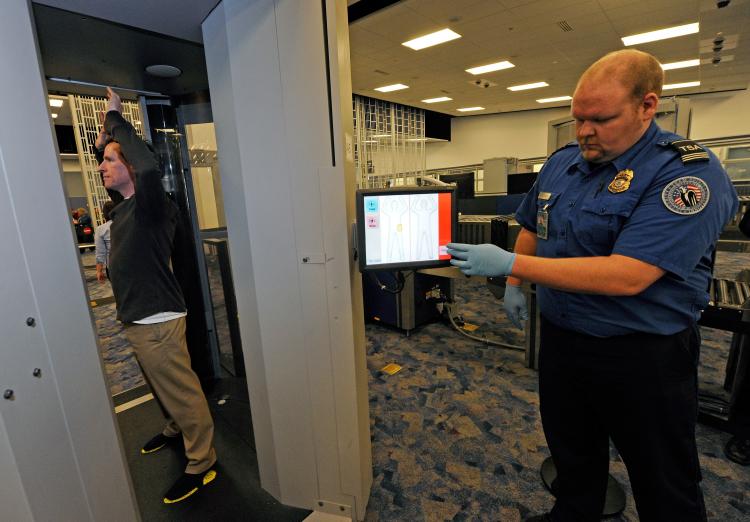
The Department of Homeland Security (DHS), and specifically the Transportation Safety Administration (TSA) continues to use 1,800 whole body imaging scanners in airports around the country.
Concerns about the imaging scanners mostly center on health issues and privacy.
For health, the government deemed the imaging machines safe, due to the low amounts of radiation concentrated on the surface of the body, using new terahertz (THz) radiation, or “T-Rays.” Some in the medical profession supported the safety of these scanners, based mostly on the lower radiation argument.
But as mentioned previously, Boian Alexandrov, a DNA researcher with Los Alamos National Laboratory's Center for Non Linear Studies, caused a stir when he found that THz waves had a resonant effect on double-stranded DNA.
“Based on our results we argue that a specific terahertz radiation exposure may significantly affect the natural dynamics of DNA, and thereby influence intricate molecular processes involved in gene expression and DNA replication,” wrote Alexandrov in his report DNA Breathing Dynamics in the Presence of a Terahertz Field.
Maybe you frequent flyers should consider this, opting for a pat down next time instead (just to change things up). I'm not necessarily asserting that airport scanners are harmful. The jury's still out, and independent research is needed to continue exploring the impact of THz waves on human DNA, and the whether there's a real possibility for genetic mutations.
Privacy
President of the Electronic Privacy Information Center (EPIC) Marc Rotenberg has been invited to testify on March 16 before the Subcommittee on National Security, part of the House Committee on Oversight and Government Reform.
“The hearing is expected to explore the privacy impact, health concerns, and questions of effectiveness that have been raised about the [body scanner] program,” stated a notice on EPIC's website.
Article continues on next page…
 Friends Read Free
Copy
Facebook
Tweet
Friends Read Free
Copy
Facebook
Tweet