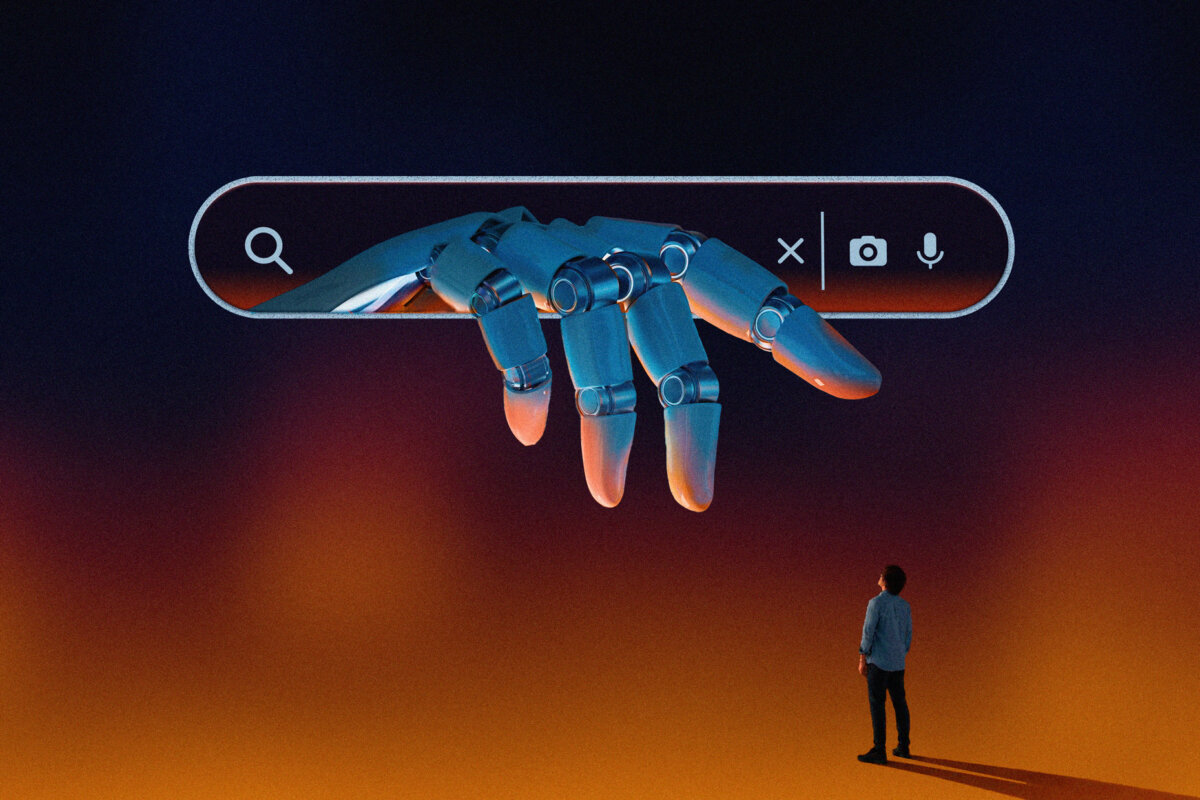

A never-ending flood of content generated by artificial intelligence (AI) is reshaping the internet and the way people engage with information faster than ever.
From news summaries to social media posts to academic research, the sheer volume of machine-assisted materials has been correlated with a spike in “cognitive offloading”—a phenomenon in which people outsource critical thinking and verification to automated systems.
A 2025 analysis of how AI tools affect cognitive offloading showed a “significant negative correlation” between frequent use of AI tools and the ability to think critically in people across age groups and educational backgrounds. The researchers at the SBS Swiss Business School found that younger age groups exhibited a higher amount of dependence on AI models and lower critical thinking scores.
Possibly more troubling is a Pangram/YouGov study in May that found that only 55 percent of participants, all of whom were Gen Zers (aged 18 to 28), were able to identify fake or misleading AI-generated material. That number is even lower in older age groups.
“AI-generated posts and comments can distort public perception, especially when volume is mistaken for credibility,” Javi Pérez, an editor of AI-assisted consumer education websites, told The Epoch Times.
“If a user sees dozens of similar posts about a product, trend, political claim, health issue, or financial topic, they may assume there is broad agreement.”
‘Confident Sameness’
Pérez said consumers need to beware as AI content increases the volume of what he called “confident sameness” online.
“Many articles and posts now repeat similar structures, similar advice, and similar phrasing. For casual readers, this can create the impression that a topic has more consensus or certainty than it really does, because they keep seeing the same ideas repeated across many sources,” Pérez said.
“The risk is that people stop knowing which content has been checked. In fields like finance, health, law, education, or news, readers need to know whether claims were reviewed against primary sources, updated recently, and edited by someone accountable.”
AI strategy consultant Armand Cucciniello III told The Epoch Times that AI-generated content is changing not only how we consume information, but also how quickly we process and trust it.
“We’re moving from deliberate reading toward rapid skimming of polished summaries, commentary, short-form videos, and AI-assisted content designed for speed and engagement,” he said.
As someone who has worked in the “U.S. national security landscape,” Cucciniello said one of his biggest concerns is that AI systems “can unintentionally amplify large volumes of inaccurate or deliberately manipulated content simply through repetition and scale.”
He also said he believes that the high volume of AI-generated content is creating real pressure on public trust.
“When readers encounter nearly identical phrasing or interpretations across multiple sources, it’s natural to question whether the information was independently reported or simply repackaged,” he said.
Carl Stroud, a public relations expert and chief storyteller at the Smoking Gun Agency, said he has also witnessed AI content take a toll on the public.
“The fundamental audience need has not changed: People want to trust what they are reading,” Stroud told The Epoch Times. “What has changed is how much harder that judgment has become.
“AI-generated content, aggregation, and low-quality slop have made the information environment noisier, flatter, and more confusing, so audiences are now trying to work out whether they are reading original reporting, rehashed content, or something that should never have been published in the first place.”
Beyond social media and academia, few industries have been hit as hard by AI-generated misinformation as the news. Stroud, who has spent two decades within UK media circles, editing, and journalism, said he’s seeing the AI content churn create fatigue among readers searching for accurate information.
“Fatigue is dangerous because when people feel overwhelmed, they either disengage or become easier to mislead,” he said.
Losing Touch
Ashutosh Khulbe, founder of RawPickAI, tests AI tools for a living—about three to four new ones every week.
“What I notice most in my corner of the internet is that everything sounds the same now. Like, eerily the same,” he told The Epoch Times. “I’d guess 70 [percent] to 80 [percent] of ‘best AI tools’ articles are AI-generated at this point.
“It creates this weird feedback loop where AI writes reviews based on what other AI already wrote, readers assume there’s a consensus, and the actual experience of using these tools gets buried.”
He said he tested one writing tool that had hundreds of positive reviews online yet was unusable at the free tier.
“You couldn’t even finish a paragraph before hitting the limit,” he said. “But good luck finding that info in a Google search.”
Khulbe said he is especially bothered by the way information distortion is affecting the public.
“AI content skews relentlessly positive because it’s trained on marketing pages and affiliate reviews,” he said. “Nobody’s training models on ‘I tried this for two weeks, and it sucked.’ So the negative signal just disappears from the internet.”
The effects of the AI content boom can now be seen in what some are calling “AI psychosis,” or a disconnect from reality. While not a clinical diagnosis, the term has become a popular catch-all phrase to describe when AI reinforces an unusual, fixed, or even delusional perception of something in the real world.
People with mental health conditions could be predisposed to developing “AI psychosis,” but it’s also not limited to that population, according to Dr. Ragy Girgis, professor of clinical psychiatry at Columbia University and the New York State Psychiatric Institute.
“The phenomenon of AI psychosis is quantitatively new and could be very dangerous, but qualitatively it’s very similar to what’s been happening for decades now since the advent of the internet,” Girgis said during an interview with the National Academy of Medicine in March.
Unrealistic Expectations
And while falling into online “rabbit holes” on any topic isn’t a new phenomenon, he said, AI and large language models are supercharging this problem. The close mimicking of human intelligence by modern AI models makes it easier for people to internalize its content.
And the evidence is showing up in just about every corner of daily life, sometimes in the form of unrealistic expectations.
“One of the biggest changes I’ve seen from AI content saturation is the rise of ‘synthetic expectations,’ especially in the beauty industry,” Justin Killingsworth, founder of The Color Bar, told The Epoch Times.
“As someone who works with salons and client-facing beauty brands, I’m seeing more clients bring in AI-generated inspiration photos that don’t reflect what is realistically achievable on a real human being.
“Stylists are increasingly having to act not only as artists, but as educators and emotional translators [by] helping clients understand what is realistically achievable while still protecting their confidence and trust.”
Last year, an analysis by the Microsoft AI for Good Lab showed that people could correctly identify an AI-generated image 62 percent of the time.
Cucciniello said the danger lies in becoming “highly efficient at consuming information quickly while spending less time wrestling with ambiguity, nuance, or competing viewpoints.”
Pérez concurred.
“Long term, the danger is that people may become either too trusting or too cynical,” he said.
“Some will believe anything that looks polished. Others will assume everything online is synthetic and stop trusting legitimate information. Both outcomes weaken critical thinking.”
Can you tell which photos are real and which are AI? Take our quiz below.
 Friends Read Free
Copy
Facebook
Tweet
Friends Read Free
Copy
Facebook
Tweet