
Fertility rates have plummeted worldwide over the past six decades, leading experts to warn of dire consequences as the downward trend continues.
Continued low fertility rates will cause “a gradual implosion of the world’s economy as the population ages and dies,” Steven Mosher, president of the Population Research Institute, told The Epoch Times in an email.
Mosher is an expert on population control, demography, and China.
“This will not occur overnight, of course, but once it is well underway, it will be difficult, if not impossible, to reverse course,” he said.
The fertility rate is the average number of children born to a woman in her lifetime; the birth rate is the number of live births per 1,000 people in a population over a given period.
Macroeconomist Jesús Fernández-Villaverde called low fertility rates “the true economic challenge of our time” in a February report for the American Enterprise Institute.
In 1960, the fertility rate was between four and five. By 2023, that number had halved to 2.2, approaching 2.1, the level at which a population replaces itself from one generation to the next.
In July, the U.S. Census Bureau projected that the world’s population will reach 8.1 billion this year. Experts say that although the figure has grown from 3 billion in 1960, the number to watch is the pace of population growth.
“The rate of growth peaked decades ago in the 1960s and has been declining since and is projected to continue declining,” the Census Bureau stated.
Fernández-Villaverde warned that although the sagging rate of growth may not have immediate consequences, in less than 50 years, declining fertility will affect the world economy. Countries with low or negative birth rates will contend with a shrinking workforce and the ballooning costs associated with an aging population.
Global Fertility Rates
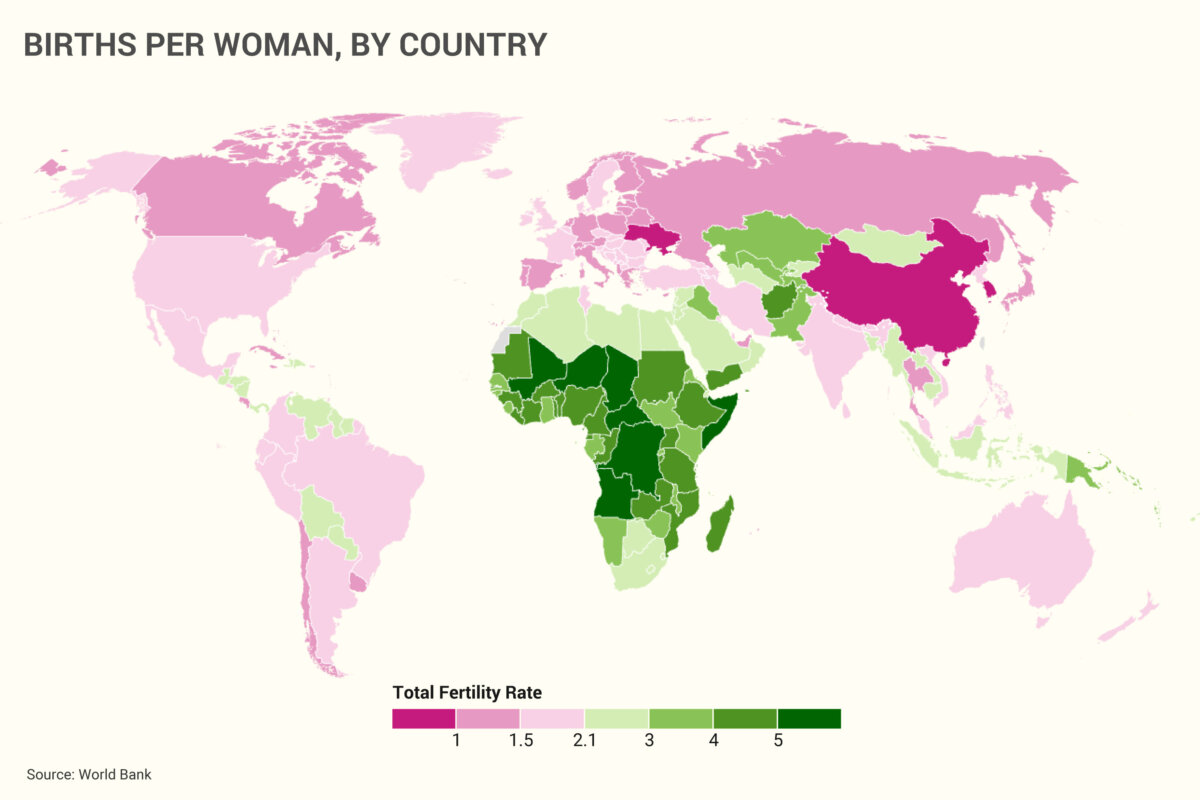
Only about 4 percent of the world’s population is in countries with high fertility rates—more than five children per woman—and all of those nations are in Africa, according to the Census Bureau. Even in those countries, fertility rates are generally lower than they once were.
The Census Bureau reported that nearly three-quarters of the world’s population is in countries where fertility rates are at or below the replacement level.
The fertility rate in India, the world’s most populous country, has steadily declined over the past six decades. In June, the U.N. Population Fund reported that India’s fertility rate stood at 1.9 children per woman, down from five or six children in 1960.

In 1990, China’s fertility rate was 2.51, despite its one-child policy. By 2023, it had dropped to less than one birth per woman, according to the U.N.’s population division.
In the United States, fertility has undergone a persistent decline. It fell below the replacement level in 1972, and in 2023, it reached 1.62—a historic low.
Asian and European countries have the lowest fertility rates in the world, and South Korea (0.72), Singapore (0.97), Ukraine (0.977), and China (0.999) all have rates below one.
Across much of Europe, North America, and Eastern Asia, fertility rates have fallen below replacement level.
Looking Back to the ’60s
In the Western world, the decline in fertility rates that began in the 1960s coincided with the advent of oral contraception, the legalization of abortion, and the widespread adoption of no-fault divorce.
In the United States, the first oral contraceptive was approved by the Food and Drug Administration in 1960. Within five years, the birth rate in the United States had already declined “substantially,” according to a report from the National Fertility Study. By 1976, the U.S. fertility rate had fallen to a record low of 1.7.
In 1973, abortion became legal in the United States following the Supreme Court decision in Roe v. Wade. At the time, a handful of other countries, including the UK, Norway, and Singapore, had also legalized abortion.
The United States’ decision was followed by several countries, including Denmark, South Korea, France, West Germany, New Zealand, Italy, and the Netherlands. Today, only 22 countries completely ban abortion.
Research indicates that abortion legalization led to a significant drop in birth rates.
Shortly after Roe v. Wade, live births dropped by one-third in upstate New York, according to a 1975 study published in the International Journal of Epidemiology.
Fertility rates on average dropped by 4 percent in the United States after abortion was legalized, a 1999 study of individual states published in the American Journal of Public Health found.
A study by researchers at the University of Pennsylvania, conducted after Mexico City legalized first-trimester abortion in 2007, offered a more recent look at the connection between abortion and declining fertility.
The Mexico City Federal District—with a population of about 8.8 million in 2007—was the first of Mexico’s jurisdictions to legalize abortion. The effect of the city’s legislation on women in their 20s was “pronounced,” the study’s authors concluded.
“We estimate that abortion legalization reduced the number of births in Mexico City by an additional 4 percent,” they wrote.
In 2023, the country’s supreme court decriminalized abortion nationwide.
In another example, a report in the peer-reviewed journal PLOS One concluded that after abortion was legalized in Nepal in 2002, “total fertility … declined by nearly half, despite relatively low contraceptive prevalence.”
Data from Nepal’s Demographic and Health Survey indicate that from 2001 to 2011, the total fertility rate dropped from 4.1 to 2.6.
The Nepal study found that not only did the country’s total fertility rate drop, but also “desired fertility declined.”
In line with that, the National Bureau of Economic Research said in a 2004 report that the decline in births following abortion legalization is a permanent effect.
“Much of the reduction in fertility at the time abortion was legalized was permanent in that women did not have more subsequent births as a result,” the report concluded, noting an increase in the number of women who remained childless.
The Guttmacher Institute estimates that more than 63 million abortions were conducted in the United States between 1973 and 2021. Worldwide, 73 million abortions are conducted per year, according to the World Health Organization.
Additionally, several studies have drawn a connection between skyrocketing divorce rates and shrinking fertility rates.
In the late 1960s, divorce rates shot up in Western countries as divorce law reforms made it easier for couples to end marriages without proving that one partner was at fault.
A study published in the journal Labour Economics in 2014 concluded that “the introduction of divorce law reform decreases fertility rates” and that “the effect appears to be permanent.” That study was conducted across 18 European countries, spanning the period from 1960 to 2006.
The Decline in the East
In China, as many as 40 million people died of starvation during the Chinese Communist Party’s Great Leap Forward campaign from the late 1950s to the early 1960s.
Additionally, about 7.73 million Chinese were killed in the subsequent Cultural Revolution campaign from 1966 to 1976.
Despite the death toll from these campaigns, China enacted a one-child policy in 1979, accompanied by mandatory contraception, sterilization, forced abortion, and even infanticide. China claimed that the policy prevented 400 million births between 1979 and 2011.
The impact may have been even greater. A 2017 paper in the journal Demography by Daniel Goodkind, an analyst at the Census Bureau, writing about the “astonishing impact of China’s draconian policy choices,” estimated that China’s one-child policy had actually “averted” as many as 520 million people as of 2015, with a much greater future impact because of “demographic momentum.”
Economic Concerns
Today, economic concerns such as the high cost of housing and child care are often cited as factors in declining fertility rates.
In South Korea, which has both a strong economy and the world’s lowest fertility rate, a U.N. survey indicated that “financial limitations” were the main reason for the country’s record-low births.
In the survey, 58 percent of respondents cited financial limitations as obstacles to parenthood—12 percentage points to 19 percentage points above the worldwide average. In the highly urban nation, nearly one-third said they faced housing challenges, such as lack of space or high costs for homes and rent, and 28 percent cited child care as an issue.
In the United States, a July 2024 Pew Research survey found that among adults aged 18 to 49 who don’t have children, 36 percent said they couldn’t afford to raise a child.
In another 2024 survey, conducted by The Harris Poll for NerdWallet, more than one in five of 2,000 U.S. parents of children younger than 18 said they didn’t plan to have another child because it would be too expensive. Twenty percent of respondents called child care their most significant financial stress.
The Labor Department has called child care an “almost prohibitive expense” for many Americans. In 2022, the annual cost for a child’s full-day care ranged from $6,552 to $15,600, or 8.9 percent to 16 percent of median household income, according to a November 2024 post on the department’s website.
In certain counties, the median cost of center-based child care exceeded the national median of $15,216 for annual rent in 2022.
Income and Family Size
Despite financial concerns, cultural and religious factors have more of an effect on fertility rates than income levels, according to Lyman Stone, senior fellow and director of the Pronatalism Initiative at the Institute for Family Studies.
His 2024 analysis suggests that “there is no cross-culturally stable impact of income on fertility,” despite what he calls “the common stereotype that poor people have more babies than rich people.”
Stone’s research indicates that high-income black and Hispanic women in the United States tend to have fewer children, while high-income white women tend to have more children than white women at lower income levels.
Foreign-born women in the United States have higher fertility rates at every income level.
Meanwhile, Amish and ultra-Orthodox Jewish women in the United States average approximately double the amount of children that other American women have, no matter their income.
Current Factors in Fertility Decline
A host of other factors affect decision making about family size.
Access to schooling and job opportunities for women often leads “to delayed marriage, postponed childbirth, and smaller family sizes,” according to Kent Smetters, professor of business economics and public policy at the University of Pennsylvania’s Wharton School. Smetters calls this factor “by far the biggest” when it comes to falling fertility rates.
In China, despite more relaxed policies meant to encourage childbearing, studies show that women are still reluctant to have babies. In 2015, the Chinese regime relaxed its one-child policy for the first time; two years later, births had actually fallen by 3.5 percent, according to Chinese state media.
In a May 2017 survey of 40,000 working women in China conducted by Zhaopin, a recruitment agency, about 40 percent of childless women surveyed said they did not want children, and nearly 63 percent of working mothers with one child said they did not want another child. Those surveyed cited lack of time and energy, finances, and career concerns as the reasons.
Nearly 40 years of anti-natal propaganda have had a corrosive effect on attitudes toward children and childbearing in China, Mosher said.
“Not to mention that the sex-selective abortion and infanticide of millions of unborn and newborn baby girls has reduced the number of young women in China—to the point where every young woman would have to marry in their early 20s and have three children to offset the population decline,” he said.
Young people in China were told for decades that the fewer children they had, the better off the country would be and the better off they would be, Mosher said in a 2023 interview with Parousia Media.
Finally, there are intangible factors limiting family size.
A June study of almost 1,500 adults commissioned by Population Connection found that about 30 percent of respondents said “overpopulation and climate change” made them uneasy about having children.
White House Efforts
The One Big Beautiful Bill Act, signed by President Donald Trump in July, includes provisions to support new families, including financial grants for newborns and an expanded child tax credit.
The bill creates savings accounts for children born between 2025 and 2028, seeded by a federal government deposit of $1,000. Parents and others can add up to $5,000 per year in after-tax dollars before the beneficiary is 18. Employers can contribute up to $2,500. Money in the account grows without being taxed, and withdrawals for approved uses are taxed at a lower rate.
The new bill also provides more tax relief for families with children younger than 17. The federal Child Tax Credit will increase from $2,000 to $2,200 per child in 2025 and will be adjusted for inflation going forward.
Even families who owe no income tax can receive up to $1,700 per child as a tax refund for the 2025 tax year. In February, Trump signed an executive order aimed at expanding access to in vitro fertilization and reducing out-of-pocket and health plan costs for the treatments.
“My Administration recognizes the importance of family formation, and as a Nation, our public policy must make it easier for loving and longing mothers and fathers to have children,” the president said.
Efforts Across the Globe
In France, eligible families can receive at least 1,080 euros (about $1,276) for each birth. Families can also have up to 85 percent of child care costs covered for children younger than 6.
Italy offers a one-time grant of 1,000 euros for each child born or adopted after Jan. 1, 2025. It also offers a bonus to cover the costs of child care. It provides a monthly allowance for families with dependent children, at between 50 euros and 175 euros per child, plus additional benefits for mothers younger than 21, as well as kindergarten vouchers.
Seoul will spend about $2.3 billion in 2025 to boost births by expanding housing support for families with newborns, offering public housing and additional benefits to newlyweds and larger families, increasing emergency and 24-hour child care access across the city, and hosting matchmaking events for singles seeking partners. Gyeonggi Province, where Seoul is located, is also experimenting with a shorter work week in response to concerns that South Korea’s intense work culture is affecting fertility rates.
Singapore’s bid to boost births includes a plan subsidized by the government that covers up to 75 percent of the cost of fertility treatments at public hospitals for eligible couples. The government also offers a grant of $5,000 for babies born after April 1, 2025.
Japanese Prime Minister Ishiba Shigeru has called his country’s declining fertility a “quiet emergency”—the country’s fertility rate fell to a new low of 1.15 in 2024. In a policy speech in January, Ishiba announced measures to address the slump.
Key initiatives include raising child care leave benefits to 100 percent of take-home pay for both parents, increasing wages, and aiming for a 1,500 yen (about $10.20) per hour minimum wage by the late 2020s.
 Friends Read Free
Copy
Facebook
Tweet
Friends Read Free
Copy
Facebook
Tweet