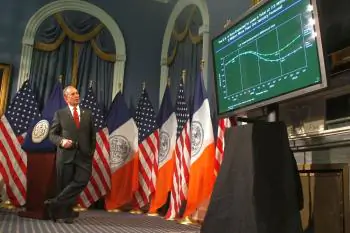
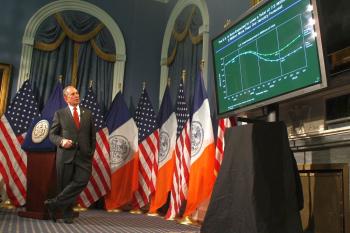
“Now, we’ve already made a lot of progress together,” said Bloomberg in his published speech outlining his vision for New York in 2013.
"We’ve dramatically cut crime, turned around a broken school system, banned smoking in the workplace, created 311, and added new parkland. I could go on, but as you know, New Yorkers don’t like to boast.”
His plan includes continuing to reduce crime in New York City and increasing the amount of parkland and trees.
“I’ve never been one for small ideas, I’ve never shied away from the toughest challenges and I’ve always insisted on being held accountable for my campaign promises,” he said.
In landslide votes, Bill de Blasio won the public advocate seat and John Liu won the seat of comptroller.
For district attorney, Cyrus Vance Jr. won the seat in Manhattan, and Charles Hynes (the only candidate) won in Brooklyn
For borough president, all the incumbent candidates won, with Scott Stringer in Manhattan, Marty Markowitz in Brooklyn, Helen Marshall in Queens, Ruben Diaz Jr. in the Bronx, and James Molinaro in Staten Island.
Polling stations on Nov. 3, the day of the general elections, were still slow—much like the preliminary elections.

“I vote for Bloomberg," said Alejandro Murillo, 68, just after casting his vote at the P.S. 166 polling station in Astoria, Queens. "I see him same as Obama."
Murillo brought his nine-year-old son along to the polling site to learn about voting. He was proud about how relatively honest New York politics are, commenting that in Ecuador, where he is originally from, corruption in politics is a big problem.
Voter turnout was also high at the polling site at 210 Joralemon St. in Brooklyn. A poll worker said that at 1:30 p.m. an estimated 82 people had already voted, as opposed to an estimated 15 who had voted during the preliminaries.
For many New Yorkers, the 2009 elections were about the economy. With the financial crisis still weighing heavy on people’s minds and pockets, Bloomberg likely won many votes through his strong reputation in finance. Fear of the narrowing middle class was a large concern among supporters for Bill Thompson's mayoral campaign.
"I think this election is going to define the livelihood of a lot of us," said Chris Mendoza, a field coordinator for Thompson, as he helped prepare materials for the arrival of Thompson near a polling site on the corner of 37th Ave. and 77th St. in Queens.
Campaign volunteers filled the sidewalks. One woman shouted loudly in Spanish, "Get Bloomberg out!" as she distributed pamphlets. Mendoza commented that the campaign volunteers in the local area were among their more "animated and emotional" of supporters.
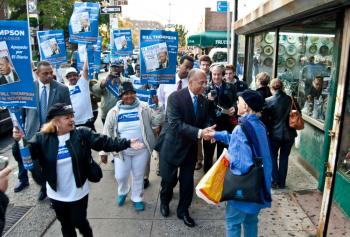
Just after 3 p.m., Thompson's van drove up and a swarm of supporters surrounded him as he stepped onto the street, hugging him and cheering his name. "I think the people in New York City are ready for change," said Thompson with hopes still high.
Thompson said that through his interactions with voters, he observed "they don't feel the mayor who is in City Hall is fighting for them. They believe he is there for a very limited group of people."
"My gut is telling me we are going to surprise not only the city of New York, but also the nation this evening," he added.
With billboards waving and a megaphone announcing his arrival, Thompson and his supporters paraded down the sidewalks. Shop owners peeking out their doors to see what the ruckus was about were greeted with a smile and a handshake. Several passersby lit up in smiles and scurried over to pose for photos. Others quietly slipped by without word.
 Friends Read Free
Copy
Facebook
Tweet
Friends Read Free
Copy
Facebook
Tweet