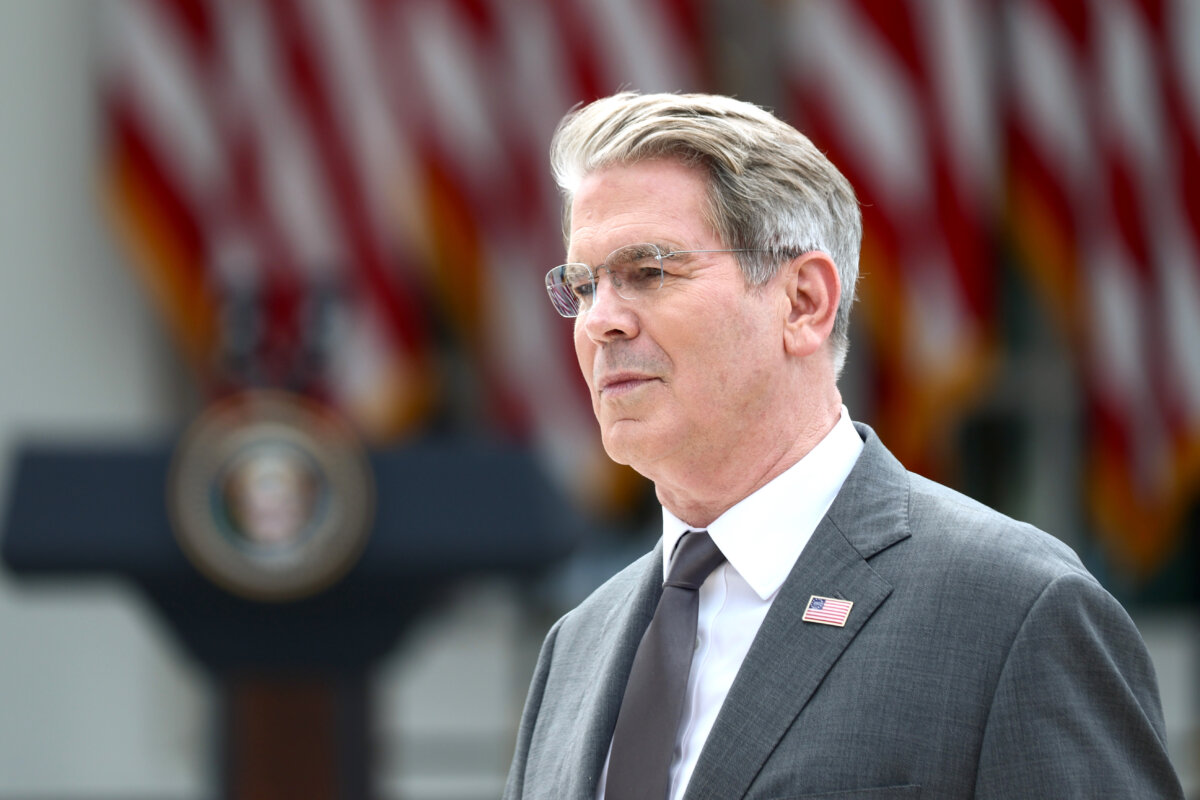

Treasury Secretary Scott Bessent said on Aug. 20 that the United States will impose the “toughest sanctions in history on Iran,” the details of which will be announced on Monday.
In an interview with CNBC on Thursday, Bessent said he planned to hold a press conference on Aug. 24 to share the Trump administration’s plan to increase economic pressure on Iran following months of military conflict. The Iran war, which started on Feb. 28, restarted last month following the collapse of a memorandum of understanding between Washington and Tehran.
“It is a one-two punch. We have the blockade, and we are going to have the toughest sanctions in history, and I will tell you this will work. It worked in Venezuela once we put up the blockade. It is working in Cuba right now, and it is going to work in Iran—and we are going to collapse this regime,” Bessent said.
The secretary’s comments came after President Donald Trump announced on Aug. 19 that the United States was going to engage in major economic warfare against Iran. He said that economic sanctions and isolation would be carried out at an “unprecedented scale.”
Bessent on Thursday called for America’s allies to join the United States in imposing the “greatest coordinated economic isolation in the history of the world.” He said it was time for America’s allies and the rest of the world to make a decision as the United States prepares to increase economic pressure on Iran and “squash the economy of this murderous regime.”
“And we are going to them and saying you are either with us or against us,” Bessent said.
The secretary warned that countries continuing to do business with Iran by transferring money, purchasing oil, or conducting seaborne ship transfers would face the “full might and force” of the U.S. Treasury and the federal government.
By increasing economic pressure on Iran, the Trump administration will reduce the regime’s ability to project power through its proxy network, Bessent said. He added that Tehran would also be unable to pay the military as the country faces additional sanctions and ongoing inflation.
In a Wednesday post on Truth Social, Trump said the Iranian regime had failed to take advantage of the opportunity he had given it to make a deal. As a result, he announced that the United States would launch the “MOST CRUSHING ECONOMIC OPERATION EVER TAKEN AGAINST ANY COUNTRY.” The president did not immediately provide details on what the economic operation would include.
“This will be an ECONOMIC D-DAY, and we need all of our Allies to stand with the United States of America to isolate, and defeat, the Iran threat,” Trump said. “These maniacs are on the ropes, and these HISTORIC MEASURES will cripple them and their ability to project terror worldwide.”
Trump also warned that any countries that allowed businesses, financial institutions, government entities, or airports to provide Iran with “any type of lifeline” would face major economic consequences.
During Thursday’s CNBC interview, Bessent said that the Trump administration’s policy of “maximum economic pressure” on Iran meant that it was less likely the United States would restart large-scale military strikes on Iran for now.
Iranian Foreign Minister Abbas Araghchi responded to the Trump administration’s threat of increased economic pressure by claiming that it was an effort to distract from America’s national debt, which crossed $40 trillion this week.
“The so-called ‘Economic D-Day’ is a diversion from America’s own crisis: unprecedented debt & surging interest costs,” Araghchi wrote on social media. “Doubling down on failed policies will only bring further defeat—and enmity of Iranians.”
Araghchi also claimed that the Trump administration’s policies threatened the global economy.
Iranian Deputy Foreign Minister Kazem Gharibabadi also responded to the economic threat Thursday afternoon in a post on X.
“They claim Iran is on the brink of collapse and hanging by a thread, yet they beg all their allies to help them! The problem is the wrong calculations that, each time to cover them up, they’re forced to create a bigger failure for themselves. The military war didn’t yield results, so now they’ve named the next failure ‘economic war,’” he wrote.
In April, the Treasury Department launched Operation Economic Fury to target Iran economically with the “financial equivalent” of the U.S. military’s Operation Epic Fury. The department imposed sanctions on entities and individuals supporting Iran’s oil smuggling operations and threatened to impose secondary sanctions on countries purchasing oil from Iran.
In June, Bessent said the Treasury Department was using Operation Economic Fury to disrupt the foreign procurement networks supporting Tehran’s efforts to obtain weapons.
The U.S. military also reinstated its naval blockade of Iranian ports on July 14 after the regime fired at commercial ships in the Strait of Hormuz in early July. As of Aug. 20, U.S. forces had redirected 67 commercial vessels, disabled three ships, and boarded two others to ensure compliance with the blockade, according to U.S. Central Command.
Trump told reporters on Wednesday that the United States might restart negotiations with Iran “at some point” but that he believed the situation was “so good” at the moment. He reaffirmed that the main priority in the negotiation process with Iran was ensuring that the regime would not develop a nuclear weapon.
 Friends Read Free
Copy
Facebook
Tweet
Friends Read Free
Copy
Facebook
Tweet