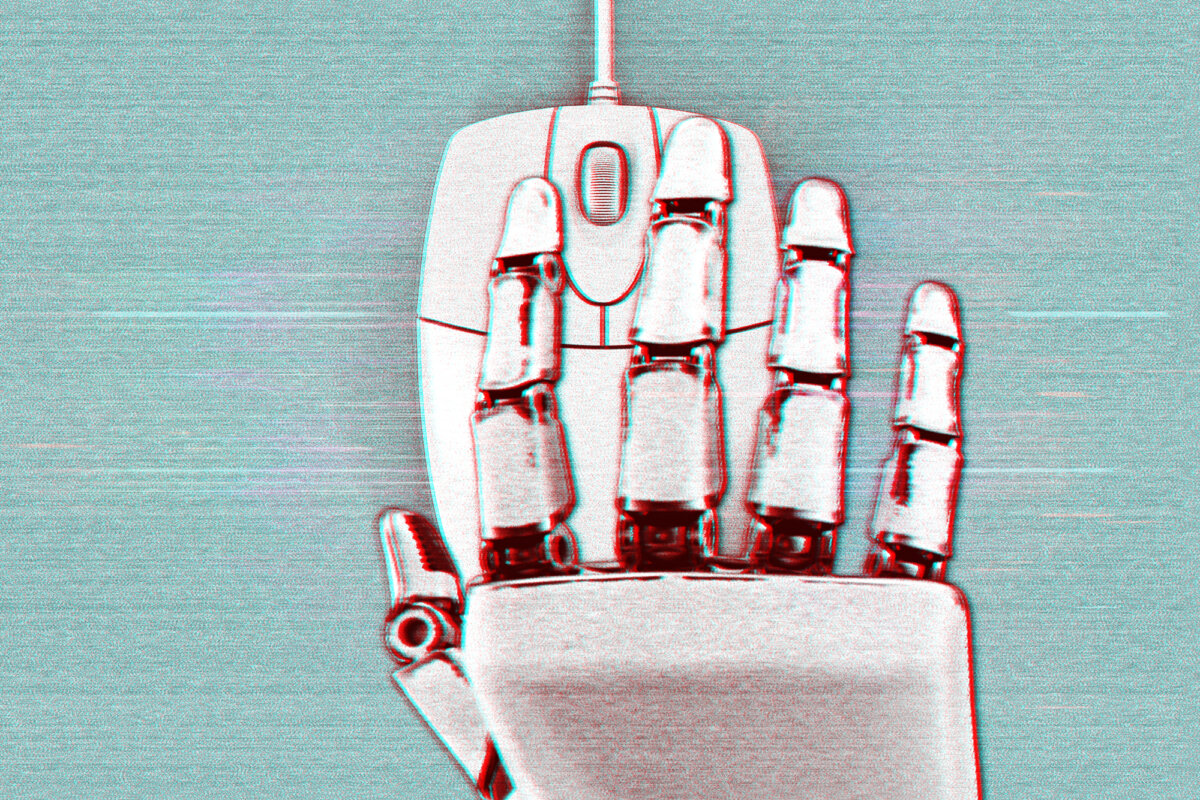

More than half of all internet traffic now comes from bots, analysts say, and for businesses, that means reaching customers may be more challenging than ever. The flood of artificial intelligence-powered bots is forcing small businesses especially to find new strategies to make human connections.
“When traffic is overblown, making advertising decisions becomes impossible,” business owner Cameron Figgins told The Epoch Times. “I’ve seen monthly analytics with 30 [to] 40 percent of site visits as non-human.”
Figgins owns Absolute Maintenance and Consulting, a California company that specializes in remediating mold and water damage. He said the flood of AI bots visiting his company’s website costs real-world money.
“Imagine that you’re spending $2,000 a month on paid ads, with one third of your clicks being bots. You’re wasting $600 to $700 a month with nothing to show for it,” he said.
Business owner Ilya Ornatov said he’s having the same problem.
“I run a house cleaning business, but our website is basically our number one salesperson,” Ornatov, the owner of NW Maids, told The Epoch Times.
“For a small local business, the biggest impact is that the bot traffic makes it really hard to tell what’s actually working. Our website is where most of our new customers come from, so I watch the numbers closely, and a chunk of that traffic is just bots crawling the site, not real people who might book a cleaning.”
Like Figgins, Ornatov said paying for advertising makes less and less sense when the audience is mostly automated. “You’re literally paying for fake visits, so you can burn money without a single real customer to show for it,” he said.
There’s growing evidence to back these claims, especially now that many tech insiders believe the internet has crossed the inversion point. That’s when human web traffic Tech insiders say the internet has already crossed the inversion point, or the moment when human web traffic officially became less than that of bots.
Cybersecurity firm Imperva found in its “2026 Bad Bot Report” that 53 percent of all web traffic in 2025 came from bots.
“Welp, that happened faster than I predicted,” Matthew Prince, co-founder and CEO of Cloudflare, posted on his X account in June. He said he’d originally predicted the inversion point would come at the end of 2027.
And the ratio of bots to humans is increasing. On Aug. 18, 63 percent of all HTTP requests came from bots, according to Cloudflare’s global tracker.
The Imperva team noted that its observations were indicative of “a structural change in how the internet operates.”
“Increasingly, businesses are not serving customers alone. They are serving machines,” the analysts wrote.
Beyond the Numbers
Tech insiders say bot domination creates trouble by obscuring human behavior.
“The biggest impact is that businesses are losing visibility of actual customer behavior,” Naveen Ayalla, a senior data engineer at Microsoft, told The Epoch Times.
Ayalla said an e-commerce company might mistake a 30 percent traffic spike from AI crawlers for a successful marketing campaign. That distorts marketing reports and creates unnecessary infrastructure costs, which can lead to poor investment decisions based on misleading data.
“Traditional analytics assume most visitors are human, which is no longer reliable,” Ayalla said. “A new product page might receive thousands of views from AI bots indexing content without any intent to purchase, creating false engagement.”
To counter this, Ayalla said businesses must shift their focus from superficial metrics such as page views and clicks to deep funnel signals, or actions by potential customers that indicate genuine intent. Those include purchases, completed forms, long-term retention, and more.
“When the bots are in the mix, bounce rates, session times, and conversion metrics all lose their significance,” Figgins said. “You believe that your landing page isn’t working well enough and you discard it, only to find that the actual human visitors were converting quite well.”
Not All Bots Are Equal
Not all automated traffic is harming businesses. In fact, some of it is helping to create connections with real customers.
A growing number of people are asking large language models (LLMs) such as ChatGPT for recommendations on goods and services. AI-recommended brands are “significantly more likely” to see a human website visit, according to a SimilarWeb analysis. On average, researchers found that ChatGPT users were 2 1/2 times more likely to engage with an AI-recommended brand over its competition.
“Search engine crawlers and AI assistants can actually drive value by helping websites get discovered,” Ayalla said.
The key challenge is distinguishing between what he called “valuable automated traffic” and run-of-the-mill, resource-consuming bots.
Ayalla said blocking all bots from visiting a website isn’t a realistic approach, given the technology’s rising importance in connecting with potential clients. “Businesses need a balanced approach to maintain visibility in AI-powered search while protecting their infrastructure and content,” he said.
For Ornatov, AI bots have revolutionized his approach to creating web content.
“It’s changed what we write and how we lay it out. We used to just write for Google rankings,” he said. “Now I make sure our pages answer real questions in plain language, with clear FAQ sections, because that’s the stuff an AI assistant can actually pull and repeat back to a customer.
“So instead of stuffing keywords, we try to just clearly answer ‘How much does a deep clean cost?’ or ‘Do you bring your own supplies?’—because that’s what gets quoted.
“We leaned into it, we made sure the site was easy for those tools to read and quote, and now it’s turned into a small but real source of new customers instead of a threat.”
Protecting Information
But just as problematic is AI-driven bot “scraping” of online information—including private and copyrighted content—to train LLMs such as Claude or ChatGPT. Much of the content scraped is used for training LLMs and offers no benefits to the businesses they pilfered from.
Bots that track multiple web pages or sites are called “crawlers.”
“Many scraping applications continuously steal confidential legal materials, placing companies in the position of trade-secret misappropriation, and causing company servers to crash due to thousands of dollars in remedial efforts,” attorney Robert Tsigler said.
Tsigler’s work as a lead counsel on high-profile corporate litigation has given him “firsthand experience of how copyright liability and cyber-security vulnerabilities are created through automated scraping.”
He said automated “scraper traffic” is responsible for increasing clients’ server bandwidth costs by up to 40 percent while creating false impressions in user analytics.
“To separate legitimate users from automatic [bot] scraping software now requires that many businesses implement specialized cybersecurity infrastructures, which can cost anywhere from $15,000 per year for mid-sized companies,” he said.
When asked how companies can blunt the impact of bad bots, Ayalla predicts it won’t be a “binary choice” in the future, but about more layered access controls.
“We will likely see a clear separation where general information remains accessible to AI systems, while high-value, proprietary data requires authenticated access,” he said.
“The focus will ultimately shift from blocking AI to safely collaborating with it.”
 Friends Read Free
Copy
Facebook
Tweet
Friends Read Free
Copy
Facebook
Tweet