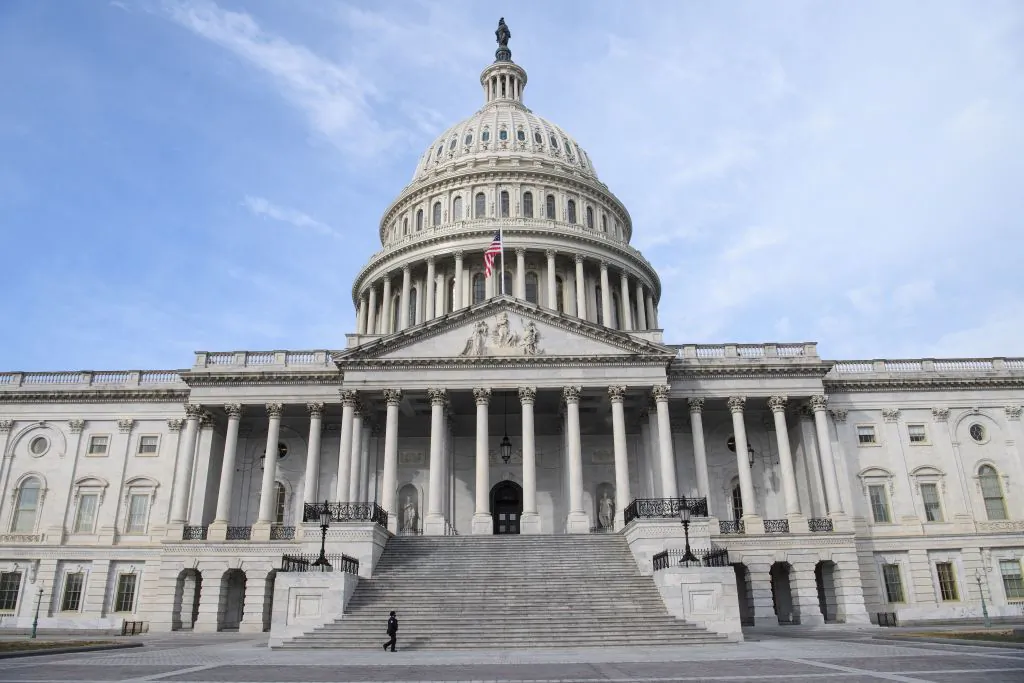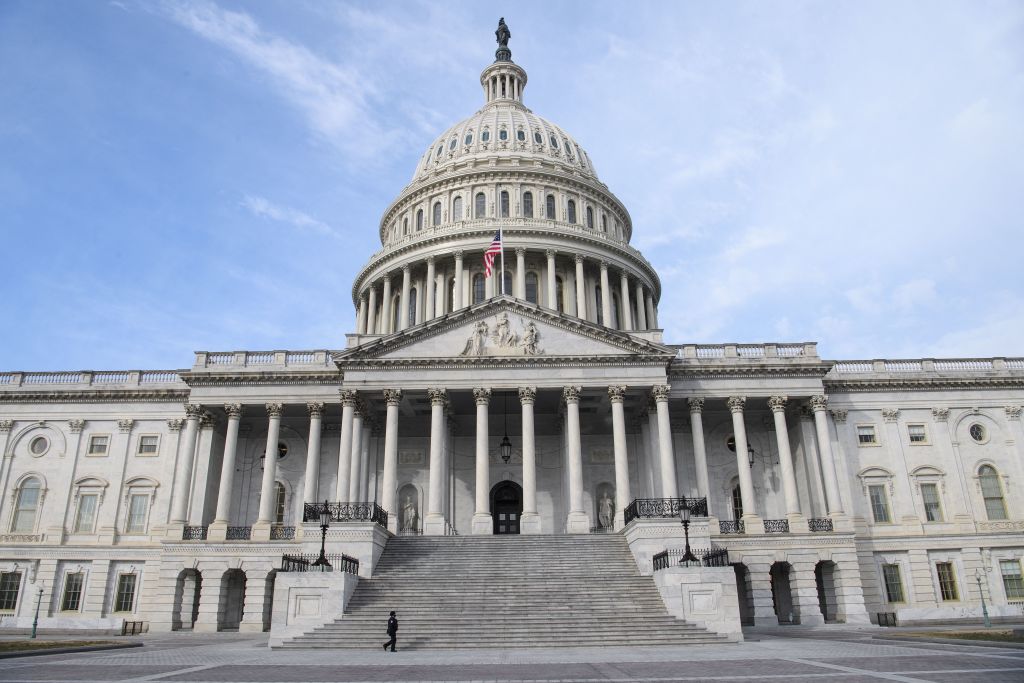

With the “One Big Beautiful Bill” pending before the Senate, several provisions may be stripped out in what is known as a “Byrd Bath.”
The Byrd Rule, named for the late Sen. Robert Byrd (D-W.Va.), restricts reconciliation bills, like the one the congressional GOP is looking to pass, to deal with matters related to the budget.
Under the rule—adopted in 1985 and amended in 1990 to restrict the powerful reconciliation process—all provisions in a reconciliation bill must have an effect on the federal budget that is more than “merely incidental.”
The rule is designed to prevent either party from taking advantage of the filibuster-proof reconciliation process to pass policy changes that would normally require 60 votes.
Whether a provision aligns with the Byrd Rule is determined by the parliamentarian. While Republicans technically could overrule MacDonough, Senate Majority Leader John Thune (R-S.D.) has already strongly signaled that it’s not a route Republicans are considering.
Thus, it will fall to Senate Parliamentarian Elizabeth MacDonough to determine what makes it into the final package. Here are some provisions in the House bill that she could cut.
The bill currently includes a 10-year ban on state-level regulation of artificial intelligence—a policy change that would be difficult to describe as having an impact on federal revenues and outlays.
The provision states that “no state or political subdivision may enforce any law or regulation regulating artificial intelligence models, artificial intelligence systems, or automated decision systems.”
This section could be stripped out as it does not relate to budgetary matters and is purely policy—precisely what the Byrd Rule seeks to guard against.
The bill would also seek to bar Medicaid recipients from receiving care at Planned Parenthood, which provides several services, including abortion.
Since the reconciliation bill is a budget bill and deals with mandatory spending, which funding for Planned Parenthood is not, a measure that would lead to ending federal funding for the organization might not be able to pass muster.
A similar provision was stripped out of the GOP’s 2017 tax bill by MacDonough, who ruled it as out of order.
Amid the administration’s ongoing disputes with the judiciary—particularly on issues related to President Donald Trump’s operation to deport illegal immigrants—the bill would limit federal judges’ ability to hold members of the administration in contempt.
It would achieve this by requiring plaintiffs to supply a bond before receiving an injunction. Such fees can be—and often are—waived by courts, particularly in cases dealing with civil rights allegations. This would effectively limit the number of injunctions granted.
It could be ruled out of order by MacDonough for not affecting federal budgets.
—Joseph Lord and Jackson Richman
UKRAINE DRONE STRIKES
Ukraine’s surprise drone attack on airbases throughout Russia on Sunday could have profound significance for the trajectory of the war.
Ukrainian President Volodymyr Zelenskyy personally oversaw the operation, codenamed “Spiderweb,” which took more than a year and a half to plan and implement, he said on Monday.
The wide-reaching attack saw Ukrainian security services hide 117 drones and their high-explosive payloads in the roofs of wooden sheds, which were then smuggled on trucks throughout Russia, some as far as 2,500 miles from Ukraine.
On Sunday, the roofs of those sheds were lifted off by a remote mechanism allowing the drones to fly out and strike at their targets simultaneously despite their distance from one another.
The primary targets of the attack were Russia’s long-range bombers, which form a key component of Moscow’s nuclear capabilities.
Aircraft targeted included the Tu-95 long-range bomber, the Tu-22M bomber, and the A-50, an early warning command and control plane used to coordinate Russian air attacks.
Ukrainian officials said the operation damaged or destroyed 41 strategic aircraft, valued at around $7 billion, and accounting for roughly one-third of Moscow’s strategic bomber fleet.
Russia has contested those figures, but acknowledged that several planes were struck at the bases while some drones were successfully repelled.
What is certain is that the Russian military has been dealt a blow from which it could take years to fully recover.
That’s because the Tu-95 and Tu-22 have not been manufactured since the Cold War, and therefore cannot be replaced until the Russian military manufactures new nuclear bombers.
There are efforts to do that, including a program to modernize and fly new versions of the Tu-95 bomber, but it is unclear how quickly Moscow will be able to produce those aircraft at scale.
U.S. Chief of Staff Gen. Randy George said on Monday that the attack demonstrated the profound impact of new technologies on the military cost curve, that is the amount of money it takes to conduct research and development, acquisition, and then provide maintenance and carry out operations with any given weapons platform.
“Look at how cheap those systems were compared to what they took out,” George said.
The commercial-first drones used by Ukraine in the attack likely only cost several thousand dollars to produce apiece. One of Russia’s Tu-195 bombers, on the other hand, costs about $270 million to manufacture.
Kyiv has long sought to inflict costly losses on Russian forces by prioritizing expensive, hard-to-replace targets. The success of Sunday’s attack demonstrates the viability that such a strategy may yield, and has likely sent Russia’s military-industrial apparatus into troubleshooting mode.
Speaking in Washington on Monday, U.S. Air Force Chief of Staff Gen. David Allvin said that leadership in Moscow was likely considering changes to their combat doctrine given the magnitude of losing strategic aircraft.
“Right now, I think that Russia is rethinking a lot of their approaches to defense because of this very cost-effective, asymmetric, but smartly done attack,” Allvin said.
—Andrew Thornebrooke
BOOKMARKS
Despite Trump’s orders ending diversity, equity, and inclusion (DEI) mandates, aviation insiders say these practices remain entrenched at airlines. The Epoch Times’ Janice Hisle spoke to some of these insiders—they say they’re worried lingering DEI practices could lead to unqualified pilots and potentially endanger passenger safety.
Employment vacancies unexpectedly rose in April, reaffirming the health of the U.S. labor market. The Epoch Times’ Andrew Moran reported that job openings climbed by 191,000 to 7.391 million, from the upwardly revised 7.2 million in March.
The Department of Homeland Security (DHS) said Tuesday that Federal Emergency Management Agency (FEMA) Acting Administrator David Richardson was joking when he remarked that he didn’t know that the United States has a hurricane season, The Epoch Times’ Jack Phillips reported. Multiple media reports that cited anonymous sources claimed that FEMA made the comment during a meeting with staff.
The fight between the Trump administration and Harvard University has now expanded to two legal disputes, The Epoch Times’ Aaron Gifford reported. The university argues that the administration violated the First Amendment in stripping over $2 billion in federal funding for the school and then briefly blocking it from being able to enrol foreign students.
 Friends Read Free
Copy
Facebook
Tweet
Friends Read Free
Copy
Facebook
Tweet