

Canada’s obesity rates have reached alarming levels and are continuing to rise, a University of British Columbia study shows.
The study adds to the growing body of papers raising concern about Canada’s growing obesity problem, now deemed an epidemic due to dramatic increases in overweight and obesity over the past 30 years.
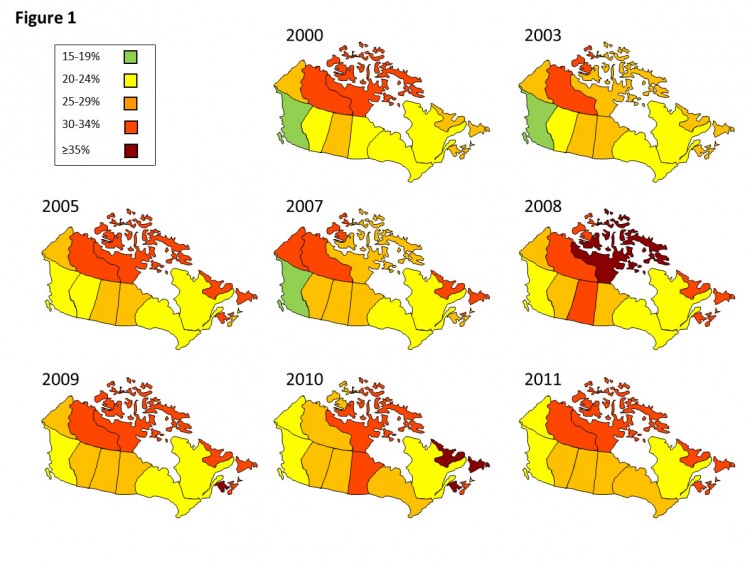
According to Prof. Carolyn Gotay, the lead author of the study, one third to a quarter of Canadians are obese, with the rates varying by region.
The rates were highest in the Maritimes, Northwest Territories, and Nunavut from 2000 to 2011, and the lowest in British Columbia.
In doing the analysis, Gotay and her colleagues used data from the Canadian Community Health Survey which asks people to indicate their height and weight to calculate their body mass index (BMI—the ratio between weight in kilograms and height in metres squared).
The researchers corrected the self-reported figures to get closer to the actual numbers based on methods proposed by previous studies.
“For example, women tend to underreport their weight, men tend to overreport their height, and so those people’s true BMI is higher than what comes out on the self-report,” Gotay says.
Gotay and her colleagues also used maps to show the changing obesity rates over time in different regions and for different genders. The study was published in the Canadian Journal of Public Health last week.
Changing Habits
While the study focused on the prevalence of obesity rather than its causes, Gotay says possible reasons for the growing rates of obesity could include people’s eating and working habits.
“We know that people have tended toward larger portion sizes, a lot more processed food—that’s what’s catching up with people,” she says.
“We are eating more of that stuff and then we’re sitting much more looking at screens at home and at work, and these two things together likely account for much of the rise.”
She also speculates that income and access to fresh food could be possible causes of differing rates in different parts of Canada.
“We know that economic factors affect a lot of health behaviours; the cost does drive some of our decisions, so we think that’s probably likely to play out in the nutrition area.”
In more remote areas, such as the territories, it is also harder to get fresh food at reasonable prices, Gotay adds.
According to the Public Health Agency of Canada (PHAC), obesity is affected by both individual and environmental factors, including age, gender, income, and place of residence.
A PHAC report shows that obesity is lower in higher-income women, but the same trend is not seen among men.
Public Education
The UBC study shows the highest increase in obesity occurred between 2000 and 2007.
Gotay says one reason for the slowdown since 2007 could be because people started paying more attention to the issue thanks to reports and public awareness campaigns.
“I think those news articles started to come in the beginning of the decade, and we think it’s possible that they encouraged people to make changes,” she says, while cautioning that the rates need to continue to be monitored for a longer period of time before reaching conclusions.
“People started to realize for example that young children were developing type 2 diabetes, which used to be an adult disease but was starting to show up in children that were obese.”
Gotay says she hopes the research will help authorities develop public policies to address the obesity epidemic.
“I think public policy as well as individual decision making is part of the equation,” she says.
“People will say, ‘Look we got heavy in not that long a period of time and we can get back to a healthier weight as well—it’s not in our genes, it’s actually something we have control over.’ That’s what I’m hoping, it will provide for action.”
Some of the approaches used in other jurisdictions, such as New York City’s ban on large sugary drinks coming into effect in mid-March, could be something that Canadian authorities can look at, she adds.
“I’m not saying that’s the answer, but I think everything’s on the table, and that if it’s a serious enough problem, different options to correcting it should be considered.”
The Epoch Times publishes in 35 countries and in 21 languages. Subscribe to our e-newsletter.
 Friends Read Free
Copy
Facebook
Tweet
Friends Read Free
Copy
Facebook
Tweet