VICTORIA, Canada—For the fourth straight season, Parks Canada is sending an expedition to the Arctic hoping to solve a mystery that dates back to 1845.
They will be searching the vast territory for the two lost ships, HMS Erebus and HMS Terror, of British explorer Sir John Franklin. The ill-fated Franklin expedition set out to chart the Northwest Passage and find a safe and reliable route from Europe to the Orient.
The expedition was to last three years, but after 18 months the vessels went missing along with the 129 men on board. Although traces of the expedition have been found, the ships’ final resting places remain unknown.
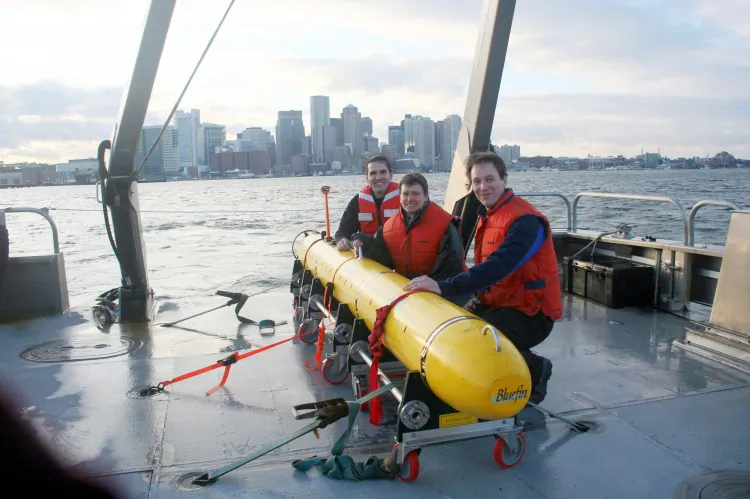
A team of engineers from the University of Victoria’s Ocean Technology Lab in Canada will be using the lab’s autonomous underwater vehicle (AUV) to assist the Parks Canada team in its search.
The torpedo-shaped AUV, which is equipped with a bathymetric sidescan sonar system to gather three-dimensional data, will enable the team to dramatically increase the size of the search area.
“Driven by a propeller, [the AUV] can swim rapidly and efficiently and cover fairly large swaths of the seafloor,” says Colin Bradley, a mechanical engineer and director of the Ocean Technology Lab.
“So it’s an efficient way of using acoustic imagery to look at the seafloor, examine it, and try and determine any telltale signs of a wreck.”
The search will concentrate in two areas: the Victoria Strait/Alexandra Strait region, where one of the vessels is thought to have foundered, and the southern region near O’Reilly Island, where Inuit oral tradition places one of the wrecks.
The University of Victoria team will spend 12 to 14 hours a day on the water operating the AUV from a 16-foot boat launched daily from a Canadian Coast Guard vessel and a research vessel provided by the Arctic Research Foundation.
One of the challenges will be navigating the AUV in uncharted waters where the magnetic field is erratic, says Bradley.
“The navigational system could be a little susceptible to the variability of the magnetic field. But that’s something that we’re going to have try and determine in the early stages of the project and perhaps be a little bit more cautious in the first few days.”
Past Searches
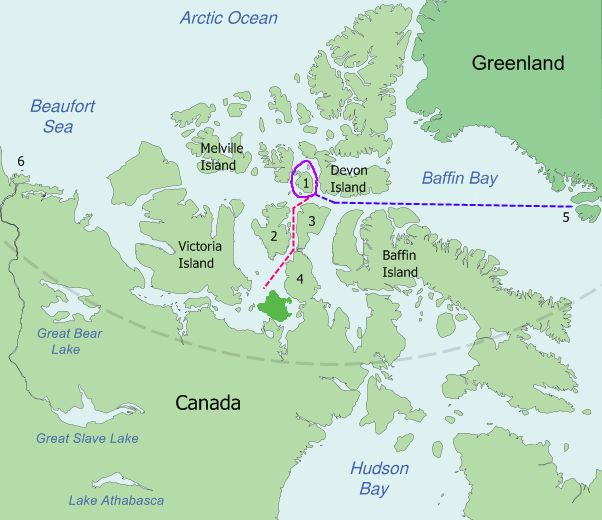
In 2010, the Parks Canada research team made international headlines when it located the HMS Investigator, a vessel sent out 155 years ago in search of the missing ships that also went down.
Searches by several ships off the east coast of Beechey Island in the years after the ships disappeared turned up the first relics of the expedition, including the graves of three crewmen on the island as well as remnants of a winter camp.
A search in 1859 discovered a note left on King William Island with details about the expedition’s fate.
According to the note dated April 25, 1848, the officers and crew of the two ships, 105 men in all, finally deserted the Erebus and Terror 18 months after being stranded. Sir John Franklin and 23 of his men died en route to King William Island.
Searches continued through much of the 19th century, but the missing ships were never located.
Parks Canada is expanding the scope of its investigation this year with new partners, vessels, and instrumentation to cover a larger area, and the search is being extended to four to six weeks rather than the six days of previous years.
Other collaborators include the Canadian Hydrographic Service, Canadian Space Agency, Canadian Ice Service, the government of Nunavut, and Environment Canada.
To increase knowledge of the Arctic, the search effort includes the collection of data for the production of navigational charts and topographical maps in the Arctic and supporting marine archaeology and ecosystem management.
The Epoch Times publishes in 35 countries and in 19 languages. Subscribe to our e-newsletter.
 Friends Read Free
Copy
Facebook
Tweet
Friends Read Free
Copy
Facebook
Tweet