
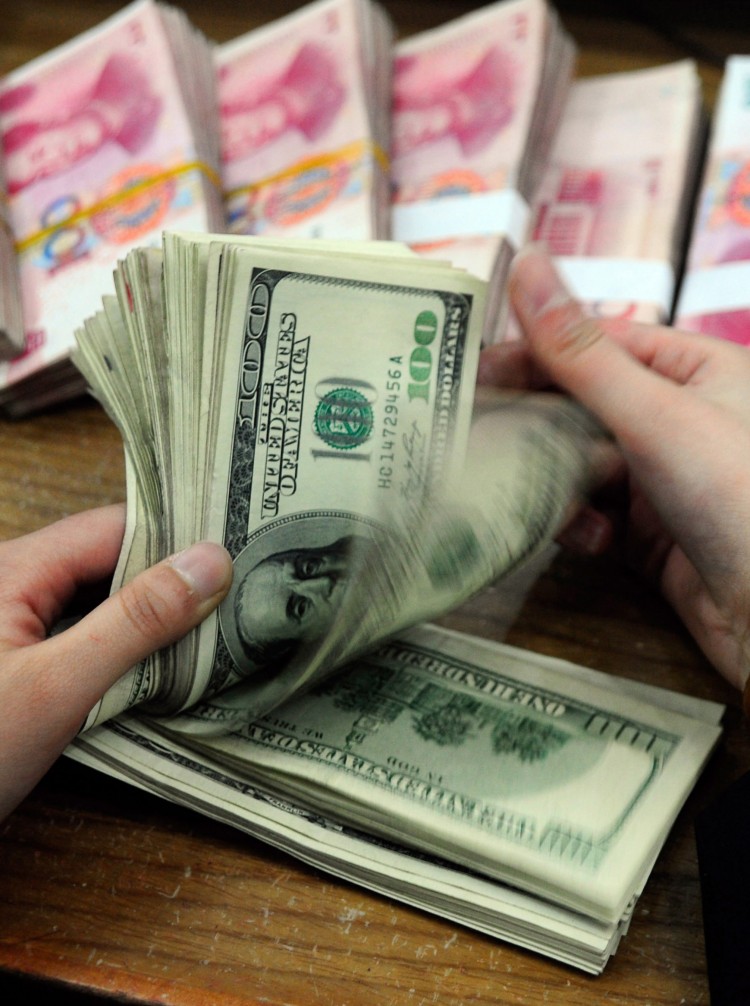
Massive foreign exchange reserves maintained by the Chinese central bank are causing the bank to incur large amounts of debt while feeding China’s out of control inflation.
In a June 17 article by Caijing.com.cn, the website of leading business magazine Caijing, reporter Xu Bin calls attention to the high debt amassed by the People’s Bank of China (PBOC), China’s central bank, alleging that the bank’s financial losses are “the biggest threat for the Chinese economy.”
According to official statistics, by April, the PBOC had accumulated total liabilities of 27 trillion yuan (approximately US$4.2 trillion), while its net worth was only 21.9 billion yuan (approximately US$3.4 billion). Its liabilities are 1,235 times its net worth. “What other business entity on earth could hold so much debt?” Xu asked.
In comparison, the U.S. Federal Reserve’s liabilities are 53 times its net worth, with $2.9 trillion in liabilities and $53 billion in net worth as of June 22.
The debt has been raised primarily to hide the true value of its foreign exchange reserves. On the bank’s April balance sheet, 22 trillion yuan in foreign exchange accounted for over 80 percent of its total assets.
Xu suggested that in some respects, the central bank handles the currencies like a hedge fund. “After all, the yuan issued domestically is the central bank’s debt, and the foreign reserves are owed to it by its foreign creditors… From this angle, China’s central bank is operating the world’s largest hedge fund.”
Hedge funds are privately managed investment portfolios that aim to secure positive return on investment by diversifying investment options. Unlike traditional funds that invest only in assets whose values are likely to increase, hedge funds try to make profit also from assets whose values are expected to decrease by selling borrowed assets and later repaying the lender at lower prices when the assets’ market value decreases.
If the central bank is thought of as a hedge fund, the logic behind the PBOC’s borrowing yuan and lending in U.S. dollars is based on the PBOC’s understanding of market forces, and China’s Central Bank is acting as if the value of the yuan will decrease and conversely, the dollar value increase, Xu said.
But, such an assumption cannot be further from the reality. Since 2005, the yuan to dollar exchange rate has dropped from 8.27 to slightly under 6.5.
“If it was a hedge fund in a real market economy, how long do you think it could survive with such an investment strategy?” Xu said. “The PBOC is the world’s most incompetent hedge fund.”
High Costs of Foreign Exchange Reserves
The Chinese authorities seem to be well aware of the risks and causes of the large forex (foreign exchange) reserves. Discussions over the risks started at least six years ago, and even China’s state-run media admitted the high-speed growth in forex reserves is a result of lagging domestic demand and the economy’s over reliance on exports. But effective measures to address this are still missing. At this point, China has accumulated the world’s largest forex reserves, which topped $3.04 trillion at the end of March.
Maintaining such massive foreign exchange reserves costs dearly. According to a report in the First Financial Daily, the costs of the funds outstanding for foreign exchange between 2003 and 2010 add up to 1.08 trillion yuan (approximately US$167 billion).
The costs include the cumulative interest expenses for the central bank bills issued between 2003 and 2010, and the interest for part of the incremental deposit reserves that occurred during the same period, the report says.
Both costs continue to surge in 2011 as China has expanded its forex reserves at an increasing rate. In May, the funds outstanding for foreign exchange stood at 376.4 billion yuan (approximately US$58 billion), making May the eighth month in a row when funds outstanding for foreign exchange increased by more than 300 billion yuan.
In order to offset the impact of soaring funds outstanding on liquidity, as well as head off criticism about its currency manipulation at the Group of 20 (G-20) meetings in France earlier this month, on June 20 the PBOC raised the deposit reserve ratio for the sixth time this year, bringing it to a record 21.5 percent. In addition, the PBOC is planning to resume its issuance of long-term three-year bills.
Continued on the next page …
 Friends Read Free
Copy
Facebook
Tweet
Friends Read Free
Copy
Facebook
Tweet