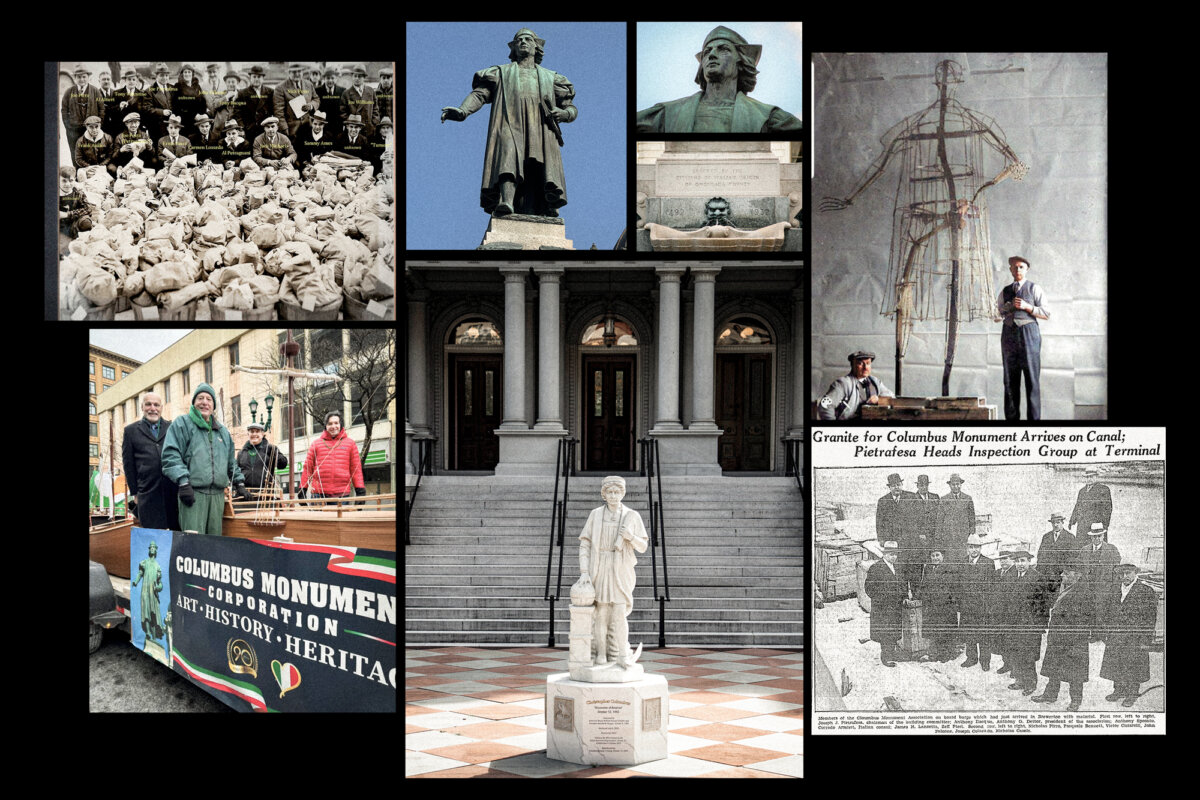

That treasured picture shows 13 men—including Pirro’s father and Ilacqua’s grandfather—standing on a barge in a canal at Brewerton, near Syracuse, New York.
They were greeting 153 tons of pink granite shipped from Italy—stone that would form the pedestal and base of a community-funded monument honoring Italians’ contributions to America, starting with the Italian-born explorer Christopher Columbus.
“It’s our history; it’s part of our community,” Pirro said.
Ilacqua said, “Columbus is representative of the immigrants’ experience—sailing across the ocean and coming to a new world.”
He noted that Columbus’s voyage dramatically changed the course of human history.
However, on this Columbus Day, the existence of the Columbus statue in Syracuse and other American cities remains threatened; some places have discontinued local observances of the federal holiday.
Nick Pirro, vice president, Columbus Monument Corporation
People who see Columbus as an invader with a shameful legacy say he doesn’t deserve to be honored. Activists have called for abolishing the Columbus Day holiday and tearing down Columbus statues.
Pirro and Ilacqua told The Epoch Times why they and their supporters are determined to preserve the Syracuse Columbus monument.
“Nobody’s history should be destroyed,” Pirro said.
Similar conflicts over statues and traditions have been playing out across the nation.
The summer riots of 2020 were a flashpoint, as protesters often turned their anger toward monuments of perceived oppressors. No figure was targeted more often than Columbus, based on news reports of vandalism, destruction, or removal campaigns.
In places such as Columbus, Ohio; San Francisco; and St. Paul, Minnesota, Columbus statues remain mothballed—hidden from public view as controversies continue.
At least one new Columbus statue—donated by a large Italian American organization—now stands on the White House grounds. It’s a replica of one that Baltimore protesters knocked down in 2020 and dragged into the harbor.
During a speech in the White House East Room on Oct. 9, ahead of the official holiday on Oct. 12, President Donald Trump said: “Christopher Columbus changed the future of humanity forever and in this administration … he’s a hero.”
Italian Americans say their support for Columbus statues is part of a quest to preserve their art, heritage, and ethnic pride. Some non-Italian allies see a broader picture.
Pirro, who held public office in the Syracuse area for decades, said people often approach him and say: “I’m not Italian, but I’m with you. … Keep fighting for that statue.”
They also told him: “We have statues of our own here in the community. If it’s you today, it could be us tomorrow.”
Meanwhile, a private foundation is running a quarter-billion-dollar campaign to “reimagine” America’s monument spaces—an initiative that includes funding for statue removal.
Nickels and Dimes Produce a Jewel
Funding the Syracuse Columbus statue during the Great Depression required “scraping together nickels and dimes,” Pirro said. One man even borrowed his 25-cent donation from a local businessman, according to local lore.
Italian Americans self-funded statues in more than a dozen other communities across America—from Boston to San Francisco.
Pirro’s father and Ilacqua’s grandfather played key roles in the Columbus Monument Association, which worked to make the statue a reality.
The monument was completed in 1934 after nearly 25 years of effort. That Columbus Day, 20,000 people lined the route of a parade celebrating the statue’s dedication.
The 11-foot bronze statue faces westward, the direction Columbus originally traveled. Standing atop a 30-foot granite pillar and base, the monument anchors the Columbus Circle Historic District, “a jewel in the heart of the city,” Ilacqua said.
It’s a gathering spot where people enjoy lunch or a chat beside the calming flow of a fountain built into the monument. Stunning European-inspired architecture serves as a backdrop.
Trouble on the Horizon
Storm clouds began brewing over that peaceful scene in the early 1990s, as activists decried Columbus’s legacy.
In 1991, as the 500-year anniversary of Columbus’s voyage approached, anti-Columbus sentiment picked up steam in America. People started pushing for Columbus Day to be replaced with Indigenous Peoples Day. In Syracuse that year, vandals splashed red paint on the Columbus statue’s base, symbolizing indigenous bloodshed. The damage cost the city $450,000.
Opposition rose from the Onondaga Nation, Native Americans who say they have lived in the Syracuse area “since time immemorial.”
After welcoming the monument’s arrival 92 years ago, the Onondaga began calling for the statue’s removal.
“As indigenous people, we are taught of the exploits of Columbus while our own history was being unheard, misunderstood, and often erased,” the Onondaga Nation Council wrote in 2020. The Onondaga have maintained that position in recent months.
Rather than trying to adjudicate Columbus’s history from five centuries ago, Pirro, Ilacqua, and others emphasize the more recent, 100-year backstory of America’s Columbus statues, including the one in Syracuse.
The history of any honored person can be picked apart, Pirro said, leaving no statue protected from special-interest attempts to tear it down.
“If we start doing stuff like that, it’s going to destroy every community in the country,” he said.
2020 Protests
In 2020, racial-justice protests erupted nationwide following the death of George Floyd, a black man who was killed during an arrest when a white police officer knelt on his neck for more than nine minutes.
In many places, demonstrations turned destructive, with support from communist and socialist sympathizers.
At least 180 monuments of presidents and other icons were vandalized, toppled, or targeted in removal campaigns, based on news reports. Even statues of President Abraham Lincoln, who freed slaves, were defaced in places such as Chicago and Portland, Oregon.
In response, Trump issued an executive order directing authorities to enforce existing federal laws that can send monument vandals to prison for up to 10 years.
Among 44 Columbus monuments targeted in 2020, 35 of them were eventually removed. In four places—Richmond, Virginia; St. Paul, Minnesota; Denver; and Baltimore—protesters pulled statues down. Richmond’s was later restored and relocated, while salvaged fragments of Baltimore’s statue became part of the replica later installed at the White House.
Some removal attempts failed after Italian American groups fought back in places such as Pittsburgh, Philadelphia, and New York City. In addition, a court restored Columbus Day as a citywide holiday in Philadelphia.
But in 31 instances, officials or owners removed the sculptures, often in response to public pressure.
An Uncertain Future
Against that backdrop—and after discussions with the Onondaga Nation—in October 2020, Syracuse’s mayor declared his intention to dismantle the citizen-donated monument.
The Columbus Monument Corp., which includes Pirro and Ilacqua, sued. A judge temporarily blocked the removal.
“[Today] our statue stands and remains standing, and we’re proud of that,” Ilacqua said. At least eight others across the nation survived removal attempts, too.
But the Syracuse monument’s future is still in limbo. The Columbus supporters’ lawsuit ended in 2023. An appeals court ruled that the city had not reached a final decision, so it was premature to challenge the statue’s intended removal.
Since then, opposing camps have remained entrenched.
The Keep the Columbus Monument campaign that Ilacqua and Pirro support faces opposition from a Replace Columbus movement led by Native Americans.
Both sides are waiting to see the results of the Full Circle Design Competition, which the Onondaga Historical Association is overseeing.
The association says it maintains “neutrality” on the fate of the Columbus monument, as designers submit plans for revamping a section of the city that includes Columbus Circle.
Public presentations by the three finalists are set for next month; a winning design is to be chosen in December.
2 Statues Gone, 1 Still Standing in Ohio Capital
A different type of Columbus statue dispute is unfolding in Columbus, Ohio—with national and international involvement.
That central Ohio city used to proudly refer to itself as the world’s largest city named after the explorer.
But the city stopped celebrating Columbus Day in 2018 and two years later replaced it with Indigenous Peoples Day.
Two of its three Columbus statues were taken down in 2020; one remained standing at the statehouse after police guarded it during the 2020 riots and legislators took action to slow down attempts to remove it.
Earlier this year, Giacomo “Jack” Conte, 67, spearheaded a federal lawsuit to resurrect a statue that formerly stood outside city hall. It has been in storage since 2020, the same year that Columbus State Community College took down its statue.
Trump, during his Columbus commemoration speech, called for the statue to be returned “to the heart of Columbus, Ohio,” where he said it belongs.
Columbus Mayor Andrew Ginther, a Democrat, responded that he and the Republican president “clearly have different priorities,” The Columbus Dispatch reported.
Ginther declined to comment further on the controversy because of the ongoing court battle. He had ordered the statue removed in June 2020, saying that it represented “patriarchy, oppression and divisiveness” for many people in the community.
Conte decided to file suit after attempts to mediate the dispute with the city failed, he told The Epoch Times.
A coalition of Italian American leaders joined several Ohio Italian American groups in suing the city of Columbus, along with state and federal agencies. The suit involves the Italy-based estate of the statue’s deceased sculptor, Edoardo Alfieri.
The mayor of Columbus’s birthplace, Genoa, Italy, has told media outlets that he objected to removal of the statue his city gifted to Columbus, Ohio, when the two cities established a sister-city relationship.
Conte’s lawsuit says Genoa donated the 22-foot-tall bronze statue in 1955 “with the express understanding” that it would remain “for eternity” outside Columbus City Hall.
Conte said he took legal action on behalf of future generations.
“I’ve got two beautiful granddaughters, and as a child, I can remember going to see the statue on Sunday after church with my grandparents or my parents. I can remember taking my kids to show them the statue,” he said.
The suit states, “There has never been any legal basis for the removal of this Statue, nor is there any legal authority for its continued absence from its intended location outside of Columbus City Hall.”
The plaintiffs are asking the court to “vindicate their constitutional rights, cease the flow of illegal funds to culpable parties, and order the return of the Statue to its rightful location.”
In court filings, the defendants denied the allegations.
The Ohio controversy has drawn attention from national media, and one outlet has filmed a documentary, Conte said.
Historical Legacy
Italian Americans say their side of the story is often drowned out by activists who blame Columbus for violence, slavery, racism, and other atrocities that followed his 1492 landing in the Bahamas.
Columbus’s defenders argue that distorted historical accounts and misperceptions appear to be fueling much of the outrage. Pirro recounted talking with an activist who declared that Columbus came to the United States and “killed many, many of the Native Americans” on the nation’s shores.
Pirro’s response: “Don’t you know Columbus never set foot in the United States?” The woman continued insisting that her version of history was accurate, Pirro said.
Pirro and Ilacqua also say that modern-day arguments over Columbus as a man wrongfully overshadow the significance of his exploratory feat.
Neil deGrasse Tyson, an astrophysicist who studies humankind’s place in the universe, has repeatedly called Columbus’s landing in the New World “the most important” event in human history.
The explorer’s daring trans-Atlantic voyage opened the Americas to ongoing European settlement and reconnected populations that had been separated for roughly 10,000 years. After the Ice Age ended, rising seas had submerged the Bering Land Bridge between Siberia and Alaska—halting migration between the Eastern Hemisphere and Western Hemisphere.
Tyson’s description of Columbus’s impact is “not an overstatement,” Ilacqua said.
“Just think about the cultural exchange that occurred between Europe and America after Columbus,” he said.
Immigrants brought new science, medicine, and technology to the Western Hemisphere, along with Greek democracy, Roman law, and Judeo-Christian ethics.
“I mean, the whole world has just changed … and it all followed Columbus,” Ilacqua said.
The legacy of Columbus is embedded in the American landscape.
More than 6,000 U.S. places are named after Columbus, “but we never wanted him here,” according to a 2021 article published by Monument Lab. That Philadelphia nonprofit says it is “dedicated to advancing justice by reimagining monuments as places for belonging, learning, and healing.”
Monument Lab received a three-year, $4 million grant as part of the $250 million Monuments Project launched by the Andrew W. Mellon Foundation in late 2020.
That project set out to “transform the way our country’s histories are told in public spaces,” Mellon’s announcement states, adding that the “unprecedented” initiative came during “a moment of national reckoning on the power and influence of monuments.”
Besides research and education, the project also involves funding new monuments and memorials or “historic storytelling spaces,” as well as “relocating existing monuments or memorials.”
This work calls for realigning “the assumed center” of the nation’s history to “include those who have often been denied historical recognition.”
Last year, Trump pushed back with an executive order titled “Restoring Truth and Sanity to American History.”
He described a decade-long “concerted and widespread effort to rewrite [the] Nation’s history, replacing objective facts with a distorted narrative driven by ideology rather than truth.”
Decrying this “revisionist movement,” Trump directed officials to reinstate monuments if they were removed or altered since 2020 “to perpetuate a false reconstruction of American history, inappropriately minimize the value of certain historical events or figures, or include any other improper partisan ideology.”
Marxist Influence
In 2022, the National Italian American Foundation launched a lecture series intended to set the record straight about Columbus.
Those lectures featured Mary Grabar, author of the 2019 book “Debunking Howard Zinn: Exposing the Fake History That Turned a Generation Against America.”
Grabar argues that Zinn’s 1980 work, “A People’s History of the United States,” falsely portrayed Columbus and touched off the wave of anti-Columbus sentiment that gained ground over the years.
As her book puts it, “Zinn’s narrative about the genocidal discoverer of America has captured our education system and popular culture.”
Today, 46 years after his book’s release, Amazon.com still ranks it as the top seller in the “social sciences research” category.
Zinn, a historian who died in 2010, admired “The Communist Manifesto” and considered himself to be a “communist with a small ‘c’ … someone who believes in communism,” he said in an interview posted to his website.
Grabar was born in Slovenia, which was then part of communist Yugoslavia; her family fled to the United States.
She went on to become a college professor and saw Marxist influence in education.
“They’ve twisted people’s minds, and they’ve changed how people see Columbus,” she told The Epoch Times, adding, “Their modus operandi is to cause strife among different groups of people.”
Today, long after Zinn’s death, the Zinn Education Project “promotes and supports the teaching of people’s history in middle and high school classrooms across the country.”
Its initiatives include the Abolish Columbus Day campaign.
“Instead of glorifying a person who enslaved and murdered people, destroyed cultures, and terrorized those who challenged his rule, we seek to honor these communities demanding sovereignty, recognition, and rights,” the project website states.
A counter-initiative by the Order Sons and Daughters of Italy in America critiqued that campaign, saying, “There are pregnant gaps in the narratives that paint a distorted image of Columbus that is definitely misleading and in some cases practically false.”
Seeking the Truth
Getting to the truth about Columbus is no easy feat.
Columbus’s original diaries of his voyages have been lost, according to the National Library of Spain—the country whose monarchs commissioned his expeditions.
That raises questions about the accuracy of attempted reconstructions of Columbus’s writings, which Zinn’s book quotes. Grabar says some of those are deceptively edited to change the meaning.
Zinn and others are wrong to cast Columbus as “a rapacious capitalist out to subjugate the natives,” Grabar said.
Other historians, such as Carol Delaney, point out that Columbus was on a religious mission to convert natives to Christianity.
Grabar said: “And you don’t try to convert someone you hate. If you’re really sincere about your religious faith, you do it out of love.”
Therefore, Columbus really was “the opposite of what they make him out to be,” she said.
Zinn’s chapter on Columbus—the first in his book—occupies only about 22 pages in a book with a current edition spanning 752 pages. But the Columbus passages are what stuck with his readers, a 2003 article in The Chronicle of Higher Education states.
“Nearly every college textbook published during the last two decades now begins, as Zinn did, with the European destruction of the Indians,” the article reads.
Grabar acknowledges that there are legitimate criticisms of Columbus. He was unable to control some Spaniards who were part of his expedition. They considered him an outsider; they didn’t like him and “would not obey him,” she said.
She sees the reimagine-and-remove movement as an insult to Italian Americans because it presumes that “the poor Italian immigrants didn’t really know what Christopher Columbus was like” when they chose to honor him.
“[That approach] takes away the dignity of this community, and it takes away from the dignity of all Americans,” Grabar said, “because it goes back to the founding of this country.”
“It’s an affront. … It’s very patronizing, and it’s done from a place of supposed superior insight and sensitivity—but it’s very insulting.”
 Friends Read Free
Copy
Facebook
Tweet
Friends Read Free
Copy
Facebook
Tweet