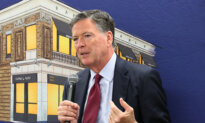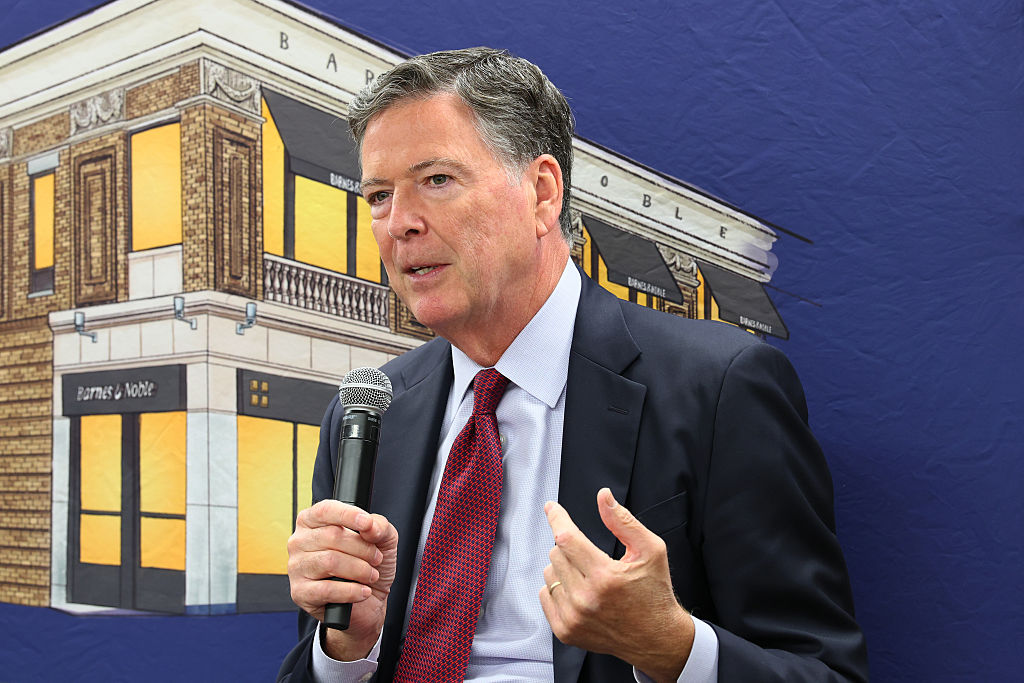

The Department of Justice announced on Tuesday that former FBI Director James Comey was indicted on charges relating to threatening to kill or harm President Donald Trump.
“Today, a grand jury … returned an indictment against James Comey on two counts,” acting Attorney General Todd Blanche said at an April 28 news conference.
Blanche announced that Comey had been charged with one count of making threats against the president for a social media post he made in 2025 that was interpreted as a call for violence against Trump. The charge is a criminal offense under 18 U.S. Code Section 871 that carries penalties ranging from a fine to five years in federal prison.
“Threatening the life of the president of the United States will never be tolerated by the Department of Justice,” Blanche said. “Over the past year, this department has charged dozens of cases involving threats against all sorts of individuals. We take these seriously, every single one of them.”
Comey was also charged with a count related to threatening criminal conduct across state lines through online or other interstate communications. The related offense under 18 U.S. Code Section 875 carries the same penalties as the initial charge.
“While this case is unique and this indictment stands out because of the name of the defendant, his alleged conduct is the same kind of conduct that we will never tolerate, and that we will always investigate and regularly prosecute,” Blanche said.
Comey has maintained that he is innocent of any intentional wrongdoing in the case.
“Well, they’re back. This time, about a picture of seashells on a North Carolina beach a year ago,” Comey said in a video posted to his Substack, referencing the social media post that sits at the center of the case.
The post showed the numbers “8647” written in seashells on sand. To “86” is to get rid of, discard, or remove. In some contexts, it has been used as a euphemism for killing someone. Administration officials and other Trump allies say Comey’s post was a call for violence against Trump, the 47th president.
“Nothing has changed with me,” Comey said. “I’m still innocent. I’m still not afraid. And I still believe in the independent federal judiciary. So let’s go.”
The indictment relates to a social media post that Comey made last year.
After receiving backlash for the post, Comey deleted it, saying that he had not understood that any violent meaning was associated with the phrase and emphasizing that he opposes violence in all forms.
He was interviewed by the Secret Service in May 2025 about the incident. The Justice Department initially chose not to take further action on the matter; however, Republican officials have revisited the incident in recent months.
Trump, in a Fox News interview in May 2025, rejected Comey’s claims that he did not know that the post could be interpreted as having a violent meaning, accusing Comey of knowing “exactly what that meant.”
“A child knows what that meant,” Trump said. “If you’re the FBI director and you don’t know what that meant, that meant assassination, and it says it loud and clear.”
The “8647” and “8646” themes have been used as political slogans and on T-shirts during the presidencies of Trump and his predecessor, Joe Biden, the 46th president.
Proving Intent
In order to bring and maintain a conviction under the two federal laws, the DOJ will need to prove both that Comey’s statements were truly threatening and that Comey subjectively knew them to be so—his claims to the contrary notwithstanding.
“The question about intent matters, and we have to prove that,” Blanche said. “That’s something that’s our job, and that’s something that prosecutors will have to do in front of a jury at the right time.”
The Supreme Court has historically been skeptical about the statutes being used in Comey’s case, given the Constitution’s prohibitions on prosecuting political speech.
In 1969’s Watts v. United States, the Supreme Court established that the state must prove that words constituted a “true threat” to bring a conviction.
In that case, anti-war protester Alan Watts was convicted for making threats against the president after remarking at a political rally, “If they ever make me carry a rifle, the first man I want to get in my sights is [President Lyndon B. Johnson].”
The court reversed Watts’s conviction, finding that the statement was protected political speech rather than a “true threat.”
More recently, the Supreme Court in 2023’s Counterman v. Colorado ruled that prosecutors must prove at a minimum that a defendant recklessly disregarded the risk that their words could be taken as a threat.
During the press conference, a reporter asked Blanche how the DOJ planned to prove that Comey intended to threaten the president, citing Comey’s past denials that he had any malicious intent with the post.
“This case was indicted today. This conduct occurred about a year ago,” Blanche replied, saying, “There’s been a tremendous amount of investigation.
“How do you prove intent? In any case, you prove intent with witnesses, with documents, with the defendant himself, to the extent it’s appropriate. And that’s how we’ll prove intent in this case,” Blanche said.
Tuesday’s indictment marks Comey’s second major run-in with the DOJ under Trump.
Comey had previously been charged in September with making false statements and obstructing Congress. However, a federal judge dismissed that case in November, ruling that the prosecutor responsible for the indictment, Lindsey Halligan, had not been lawfully appointed.
Comey had posted a video to Instagram saying that he was appreciative of the judge’s ruling, labeling the case “a prosecution based on malevolence and incompetence, and a reflection of what the Department of Justice has become under Donald Trump.”
Comey was the FBI director when Trump took office in 2017. He was appointed by President Barack Obama and previously served as a senior Justice Department official in President George W. Bush’s administration.
—Joseph Lord, Jackson Richman
BOOKMARKS
The conflict in the Strait of Hormuz is forcing China to seek alternative oil sources. Check out Michael Zhuang’s latest report to see what insiders are saying.
Virginia’s Supreme Court denied a request by the state’s attorney general to certify the results of its redistricting referendum. The court is still weighing whether to strike down the redistricting vote entirely because it allegedly violated procedural and constitutional rules.
The United Arab Emirates (UAE) announced on Tuesday that it is leaving the oil-producers cartel OPEC. UAE officials said the decision is “based on our national interest and our commitment to contributing effectively to meeting the market’s pressing needs.”
President Donald Trump said officials from Iran have informed him that the country is in a “state of collapse,” but didn’t give many further details. “They want us to ‘Open the Hormuz Strait,’ as soon as possible, as they try to figure out their leadership situation,” he said in a Truth Social post.
The Department of Homeland Security says it will scrutinize past “extremist” political views of immigrants applying for green cards and naturalization. “Terrorist ideologies, expressing hatred for American values, advocating for the violent overthrow of the United States government, or providing material support to terrorist organizations,” were among the red-flag behaviors, according to a spokesman for the U.S. Citizenship and Immigration Services.
—Stacy Robinson
 Friends Read Free
Copy
Facebook
Tweet
Friends Read Free
Copy
Facebook
Tweet