
For decades, American farmers relied on a diverse patchwork of seed companies to grow the nation’s food supply.
That landscape of thousands of small suppliers began narrowing with a quiet wave of mergers in the 1990s and ultimately ended with a handful of multinational giants.
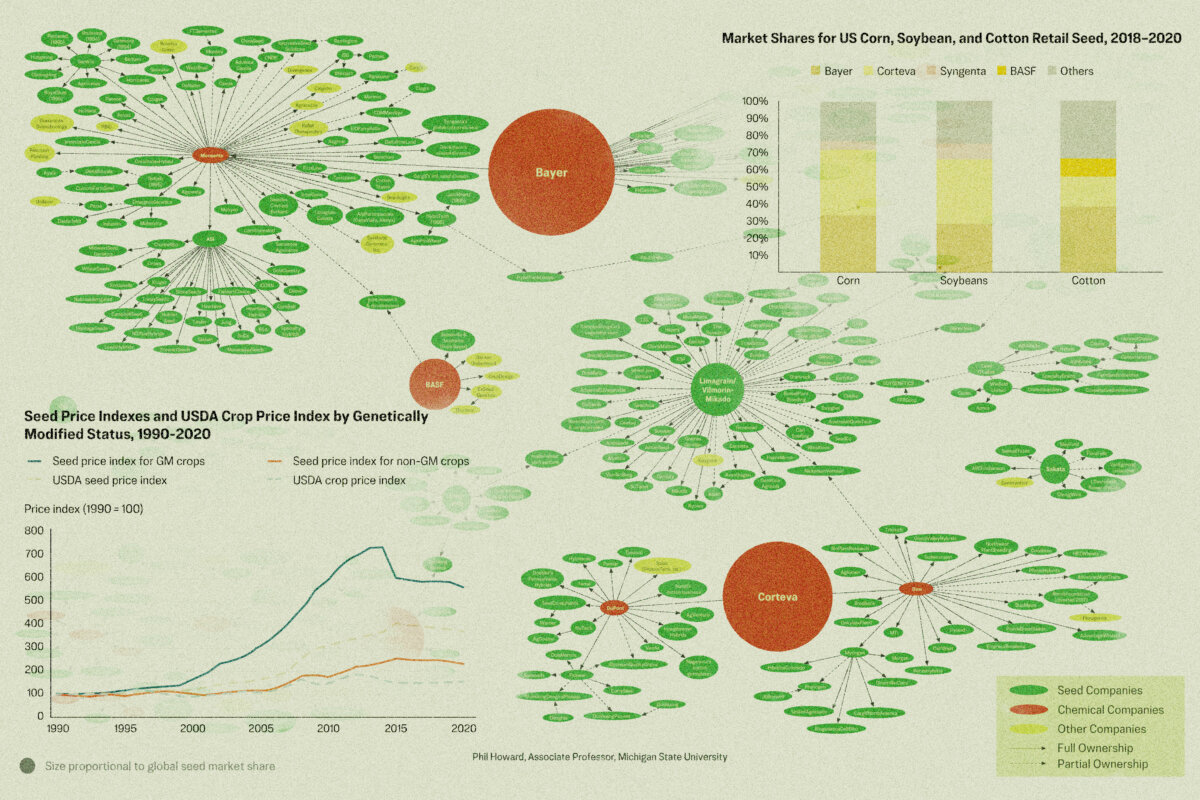
Today, a majority of the seed supply for nearly every major row crop planted across the country is consolidated in the hands of four global companies: Bayer, Corteva, Syngenta Group, and BASF.
Between 50 percent and 60 percent of the world’s seed supply is owned by these four companies, according to a May report from Land and Climate Review. Between 2018 and 2020, Bayer and Corteva accounted for more than half of all U.S. retail seed sales for corn, soybeans, and cotton, according to the U.S. Department of Agriculture (USDA).
Farmers, legislators, and national security analysts warn that this corporate concentration in the first link of the U.S. food chain is leaving farmers with fewer choices amid higher input costs and concerns over food security.
Some farmers now describe seed purchasing as less of a transaction and more of a licensing arrangement. Instead of buying seeds and owning them, growers are paying steadily rising annual fees to access patented genetic traits and packages—seeds they cannot save, replant, or breed into other varieties without permission from seed companies.
At the same time, plant breeding programs have steadily declined, leaving most research and innovation in the hands of the Big Four seed companies.
In July, the USDA released its National Farm Security Action Plan, which designated domestic agriculture a national security concern.
The plan “makes clear that USDA is taking decisive action to defend American agriculture from foreign adversaries and other emerging threats,” a USDA spokesperson told The Epoch Times.
When asked how the plan will strengthen domestic food security, the spokesperson said the agency is “identifying critical supply chain deficiencies—like fertilizers, chemicals, and minerals—and tightening import controls to block restricted goods from entering the country.”
The spokesperson said, “This historic plan strengthens research security through a new process to make certain all research funded by USDA is protected from foreign influence, prevents collaboration with countries of concern or other foreign adversaries, and ensures taxpayer funds directly benefit American farmers.”
At a July press conference announcing the plan’s release, White House senior trade counselor Peter Navarro highlighted a significant aspect: foreign ownership of seed companies.
Although all of the Big Four seed providers have an international presence, including in the United States, only Corteva—which emerged after the split of DowDuPont—is headquartered in the United States.
Meanwhile, Syngenta Group has faced scrutiny in recent months because of its links to the Chinese Communist Party and the amount of farmland it owns in the United States. Although the company’s Syngenta Seeds division has its North American headquarters near Chicago, Syngenta Group is owned by Chinese state-controlled ChemChina.
“Seeds really can be the revolution that keeps the world fed. And China now owns a key part of that,” Navarro said.
“We are indeed in a new world where kinetic warfare is not the first choice of our rivals anymore.”
National Security Implications
“Reliance on a small group of suppliers in any strategic sector creates vulnerabilities that are difficult to ignore, and the situation is no different in the case of seed for major field crops,” national security lawyer Irina Tsukerman told The Epoch Times.
Today’s farmers operate in an agricultural system where the sources of commercial crop genetics have narrowed to the point that core decisions about what gets planted, how it’s managed, and which technologies are being used are shaped outside the farm gate, Tsukerman said.
The role of the modern American farmer has also changed. Instead of choosing among numerous independent suppliers, growers now make purchasing decisions within a marketplace shaped by a few dominant providers whose products are tied to binding technology agreements.
“These agreements regulate seed use, prohibit saving seed, and govern how traits can be integrated into farming operations,” Tsukerman said. “This contractual framework redefines the relationship between farmers and suppliers, placing farmers in a position where their autonomy is limited by legal and technical restrictions.”
The Center for Agriculture and Food Systems at Vermont Law and Graduate School confirmed this practice.
In a February review of seed-related technology agreements, the institute stated, “A thriving agricultural sector depends on fair competition, including access to diverse seed options at fair prices.”
Some researchers say this increased power at the planting level could create domestic food chain instability.
“In my experience evaluating systemic vulnerabilities in commodity markets, consolidation compresses optionality and increases the likelihood that a single point of failure can cascade through the broader food system,” regulatory and government investigations attorney Braden Perry told The Epoch Times.
Perry has worked with novel and emerging risk issues in commodities and is also a qualified risk director. He said he believes that seed ownership consolidation becomes a national security concern when market concentration influences resilience rather than just competition.
“Competition issues focus on price, innovation, and choice,” Perry said. “Food security issues focus on whether the system can withstand disruption. When four companies control the bulk of seed supply for corn, soy, cotton, and other cornerstone crops, the country becomes more exposed to biological threats, cyberattacks on agricultural technology, supply chain disruptions, and geopolitical risk.”
Tsukerman said much the same.
“When two or three companies collectively control the majority of commercial genetics for corn and soybeans, dependence is not a theoretical concern but a structural fact,” she said.
“From a national security perspective, the reality that much of the country’s grain production flows from traits and breeding pipelines managed by a handful of actors is a clear signal that dependence has reached a level that warrants scrutiny.”
A large part of the energy and protein consumed by Americans—both through meat and processed foods—begins with the country’s grain crops, Tsukerman said.
But the scale of this dependence goes beyond food. That’s significant, she says. Corn and soybeans underpin not only the domestic human food supply, but also livestock feed, biofuels, industrial inputs, and export earnings.
From a regulatory standpoint, the existing frameworks that govern these firms were not designed with national security in mind, Tsukerman said.
Perry points out that years of seed ownership consolidation mean farmers are becoming reliant on the same genetic lines, the same technological platforms, and the same distribution channels.
“This uniformity increases efficiency, but it also increases systemic exposure. As a qualified risk director, I look at this the way I would evaluate concentration risk in any critical infrastructure,” he said.
“When the genetic diversity, sourcing, and decision-making authority for a major input is housed within a small group of global corporations, the resilience of the system narrows.”
There’s also a geopolitical element, Tsukerman said.
“At least one of the major seed and trait providers has foreign ownership, and others operate with extensive global supply chains and cross-border [research and development] networks,” she said.
“That does not automatically imply hostile intent, but it introduces additional layers of exposure to international tension, sanctions regimes, and technology controls.”
Corteva and Syngenta Group did not respond to The Epoch Times’ request for comment.
“We know this is a tough time for America’s farmers,” a Bayer spokesperson told The Epoch Times.
“We’re encouraged to see the administration’s efforts to keep markets competitive, helping keep prices in check at the farmgate, and streamline regulations. Faster access to innovative tools means more choices for farmers and stronger food security for Americans.”
BASF said it remains compliant with applicable laws and “conducts its business with integrity.”
“We support free market economies that recognize the value of crop protection and seed and trait innovations, which have made the American farmer a global agricultural leader,” a spokesperson told The Epoch Times.
“We spend nearly $1 billion annually in research and development, which includes our breeding activities. These activities are specifically tailored to the regional needs of farmers and use traits that are native to that region, delivering U.S. farmers additional choice.”
Impact on Farmers
For years, American farmers and independent seed businesses have expressed concerns about the consolidated “market power in agriculture,” according to a 2023 USDA report.
“In the seed market, promoting fair and vibrant competition involves considerations of intellectual property (IP) law, antitrust, and other fair business practices law, and public investment in our food system,” the report said.
“I don’t think you have to be an expert to know that when four companies control your major input, [and] seeds, the power equation is all in their favor,” Joe Maxwell, co-founder of Farm Action Fund, told The Epoch Times.
The farmer-led watchdog group is focused on stopping corporate monopolies and urging government accountability.
Beyond his advocacy work for fair competition in agriculture, Maxwell is a fourth-generation farmer. He raises livestock and grows grain crops.
When asked how the decades-long consolidation of seed ownership has affected him as a farmer, Maxwell said, “As farmers, we’re just stuck.”
And it’s not seed ownership alone that makes growing crops more complicated for farmers, according to Maxwell.
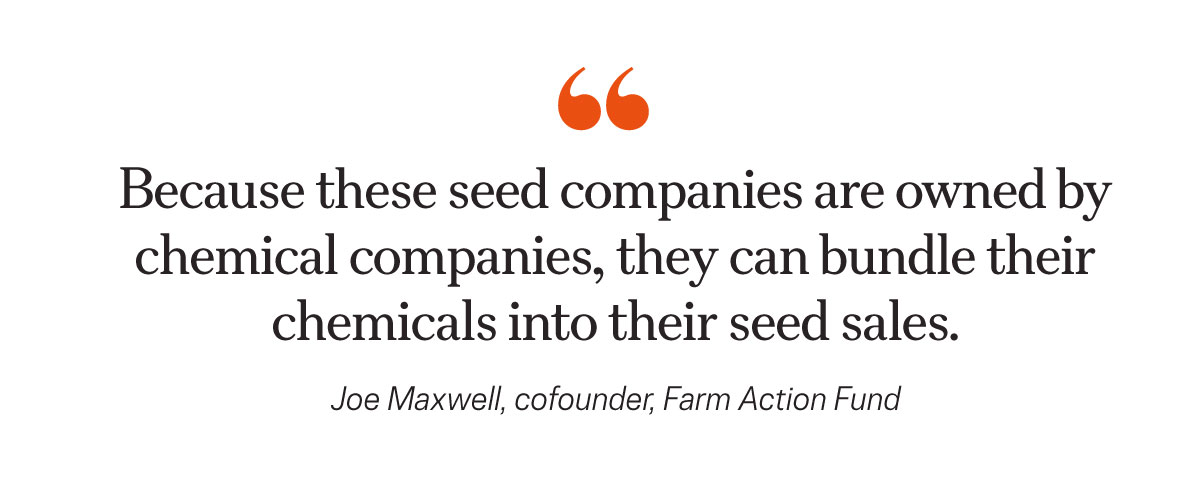
“Because these seed companies are owned by chemical companies, they can bundle their chemicals into their seed sales,” he said.
Along with the consolidation comes a one-size-fits-all approach: There’s a dearth of new research on how weather and climate affect seeds in different growing regions in the United States.
“Farmers are facing more droughts, more floods, but no one is out there to address it,” he said.
Others have complained about poor funding for research into climate-resilient seeds and crops.
“[USDA research funding] has stagnated for decades, limiting innovation and jeopardizing our future,” said a 2020 blog post from the National Sustainable Agriculture Coalition.
Maxwell said this gives the Big Four a “near monopolistic” power over not just seeds, but also research and development.
“The farmer has lost the decision-making because of the power of these companies,” Maxwell said. “Upwards of 70 percent of vegetable seeds are also controlled by these four, so it’s a significant amount.”
This years-long ownership and research consolidation has also fueled concerns about a potential loss in crop diversity.
Although the discussion on this topic often centers around genetically modified organisms (GMOs), loss of crop diversity is a problem that’s much older than that debate.
Even before GMOs, modern advances in agricultural science boosted crop yields but dramatically reduced crop diversity. Between 1900 and 2000, roughly 75 percent of crop diversity was lost because of increasing abandonment of local varieties in favor of genetically uniform, high-yielding types, according to the Food and Agriculture Organization of the United Nations.
In the 1990s, the introduction of commercially available, genetically engineered seeds for major field crops turbo-charged crop yields. Since the mid-1990s, when GMOs entered the agricultural mainstream, U.S. farmer yield data for corn and soybeans have soared.
A study by Italian researchers, published in 2018, found that over 21 years, GMO corn increased yields by up to 25 percent.
Seed prices have also risen dramatically over the past 25 years, outpacing farm income, USDA data show.
From 1990 until 2020, the USDA observed a 270 percent price hike in average seed prices. Comparatively, the crop commodity price index—a broad measure of what farmers receive for crops—rose by 56 percent. Crops planted predominantly with genetically modified (GM) seeds—which account for more than 90 percent of U.S. corn, upland cotton, and soybeans—surged in price by 463 percent.
However, some research suggests that increased farm input costs over the years correlate more with general inflation than with market consolidation. Although “not perfectly correlated,” farm input prices are nonetheless “significantly correlated with general inflation,” according to a May article by Purdue University’s Center for Commercial Agriculture.
Meanwhile, Sen. Chuck Grassley (R-Iowa) sounded the alarm over the lack of market competition in seed and fertilizers during an October Senate Judiciary Committee hearing.
“This time of year, farmers are going in to buy the basics they need to plant and harvest a crop—but they don’t always feel like they have a real choice, let alone a fair price,” Grassley said.
On the other side of the aisle, Sen. Cory Booker (D-N.J.) told the hearing that the commercial seed industry has accomplished “corporate capture of the very first link in our food chain.”
“When you control the seed, you have unjust control over farmers, and ultimately you control the food,” Booker said.
 Friends Read Free
Copy
Facebook
Tweet
Friends Read Free
Copy
Facebook
Tweet