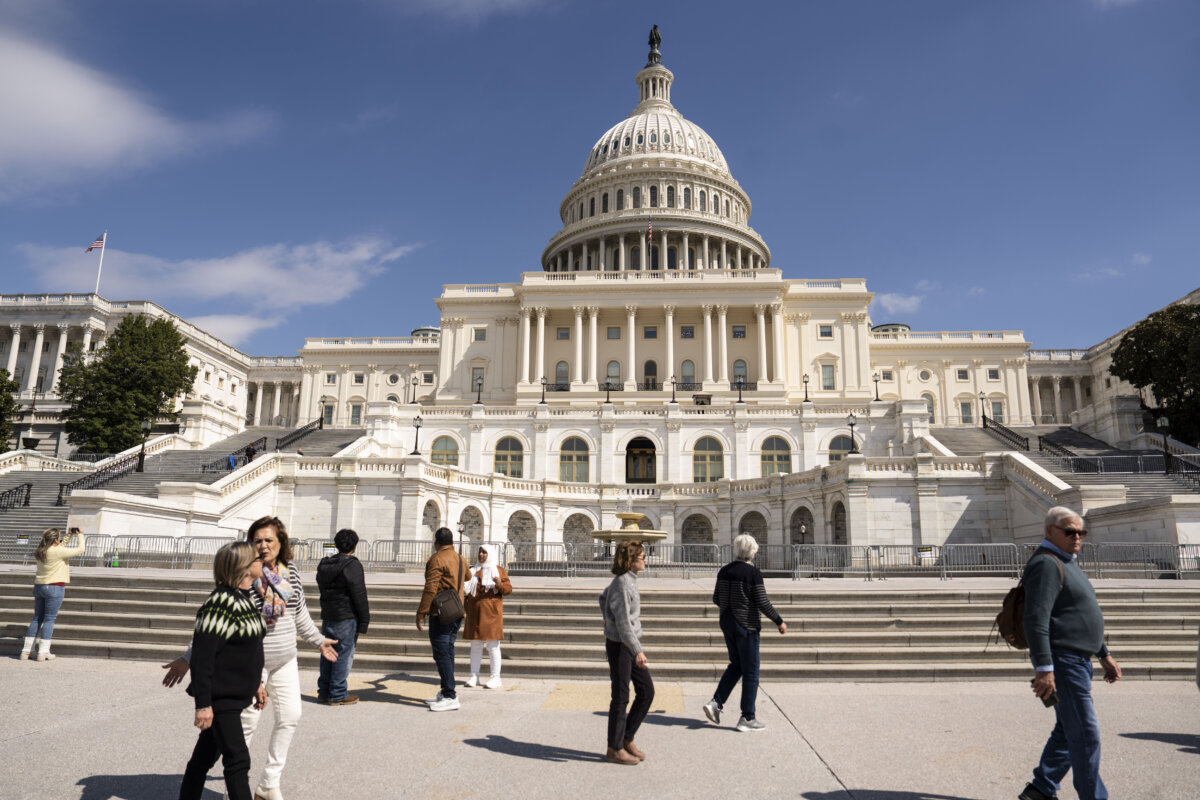

Lawmakers will return to Capitol Hill this week with a long to-do list as the Department of Homeland Security (DHS) continues to remain in a shutdown.
Ending that shutdown—which has now has reached its 58th day—will be a top priority for lawmakers, even as they remain divided along party lines on how to move forward with the funding.
Lawmakers will also work on reauthorizing Section 702 of the Foreign Intelligence Surveillance Act (FISA), a spying authority that has raised concerns over its incidental collection of American citizens’ personal data, which is set to expire on April 20.
They’ll also consider a budget request from the White House raising the Pentagon’s budget to $1.5 trillion—by far the largest military budget ever requested.
Here’s what to know.
Congress’s No. 1 priority will be to find a way forward as DHS remains shut down—though at present, a compromise still seems distant as the two chambers remain at odds on how to move forward.
Democrats have demanded significant reforms to Immigration and Customs Enforcement (ICE) and parts of Customs and Border Patrol (CBP)—both subsidiaries of DHS—in exchange for supporting new funding for the department. They have tied these demands to the fatal shooting of Alex Pretti and Nicole Renée Good in Minneapolis by immigration enforcement agents.
Republicans have rejected parts of these demands, particularly a proposed prohibition on agents wearing masks while in the field.
Some House Republicans have also pushed for passage of the Safeguarding American Voter Eligibility (SAVE) Act, a voting bill, as a condition of any reforms to ICE and CBP. However, Senate Democrats have consistently opposed the proof-of-citizenship measure along party lines, and the push doesn’t seem to have a clear path forward in Congress.
Before leaving for the spring recess, the Senate passed a bill that would have fully funded DHS with the exception of ICE and CBP, whose immigration enforcement operations have already been funded through 2029 by the One Big Beautiful Bill Act.
House Speaker Mike Johnson (R-La.) rejected this deal as a “joke.“ Instead, the House passed a 60-day stopgap that would have fully funded DHS. The bill has been rejected by Senate Democrats for its lack of reforms.
Ahead of Congress’s recess, President Donald Trump signed an executive order granting backpay to agents of the Transportation Security Agency (TSA), whose increasing employee absences had led to record-breaking security queues at airports across the United States.
Another top priority for lawmakers will be passing a reauthorization of Section 702 of FISA, a spying authority that’s due to expire on April 20.
On March 25, Trump—a former critic of Section 702—requested that Congress pass a “clean” reauthorization of the spying authority.
“I have called for a clean 18-month extension,” Trump wrote in a post on Truth Social.
Section 702 targets intelligence from foreign nationals thought to be outside the United States. Yet, it also enables intelligence agencies to gather information from Americans who are in contact with targeted non-U.S. persons—all without a warrant.
Although intelligence officials must obtain a warrant to access Americans’ data, Section 702 has long caused bipartisan discomfort on Capitol Hill and beyond.
Previously, Congress had approved a two-year extension of the program with 56 major reforms designed primarily to prevent misuse of the American data by agents with access to Section 702 data. It was signed into law by President Joe Biden in April 2024.
Trump acknowledged his previous opposition to—and run-ins with—Section 702.
Nevertheless, Trump said, “When used properly, FISA is an effective tool to keep Americans safe.”
Another top issue for lawmakers this week will be Trump’s request for a $1.5 trillion military budget—the largest increase in military spending since World War 2.
In an April 3 budget proposal, the White House formally requested the historic Pentagon budget increase, though the amount had been floated by Trump for weeks.
The proposal suggests that this amount could be passed through a two-track process.
The bulk of the funding, $1.1 trillion, would be passed through the normal appropriations process. This amount could likely pass easily, as it’s aligned with the gradual increases seen over recent years.
The second track in the White House proposal would come through a $350 billion reconciliation package—allowing Republicans to bypass a filibuster from Senate Democrats entirely.
It would fund this in part, the proposal states, through a $73 billion reduction in non-defense spending,
Office of Management and the Budget Director Russ Vought is scheduled to testify before the House Budget Committee on April 15, and to testify before its Senate counterpart on April 16.
While the U.S. and Iran are currently in a ceasefire, signs of its fragility are already becoming clear—meaning that the issue will be a key focus for lawmakers this week.
On Friday, peace talks between the U.S. and Iran in Islamabad, Pakistan, fell apart after Iran refused U.S. demands to completely dismantle its nuclear infrastructure, including its civilian nuclear power program. The U.S. demanded as well that Iran turn over its entire supply of enriched uranium.
After the peace talks collapsed, Trump said that, beginning at 10:00 a.m. ET on Monday, the U.S. will set up a blockade in the Strait of Hormuz as U.S. ships have already begun sweeping the area for Iranian mines.
Meanwhile, Democrats—with the support of some Republicans—have vowed to pursue War Powers Resolutions designed to curb Trump’s power to wage war in Iran without explicit congressional approval.
Before the break, a bid by House Minority Leader Hakeem Jeffries (D-N.Y.) to pass a War Powers Resolution via unanimous consent was blocked by Republicans. However, Jeffries has vowed to force another vote on the issue this week.
Senate Minority Leader Chuck Schumer (D-N.Y.) has also stated that Senate Democrats will attempt to force a vote on the matter this week.
“Congress must reassert its authority” over war-making powers, Schumer said on April 8. [delete]
Sen. Rand Paul (R-Ky.) and Rep. Thomas Massie (R-Ky.) have consistently backed War Powers Resolutions related to the Iran conflict, citing support for Congress’s constitutional role in declaring wars.
Meanwhile, a contingent of Republican lawmakers in both chambers—including Sen. John Curtis (R-Utah)—have stated that they will throw their support behind such a measure if hostilities continue after the statutory 60-day window laid out in the War Powers Act.
—Joseph Lord
BOOKMARKS
Rep. Eric Swalwell ended his campaign for California governor after facing pressure to pull out over sexual assault allegations—which he has denied.
The U.S. Navy will begin blockading the Strait of Hormuz on Monday, The Epoch Times’ Jacki Thrapp reported. “Effective immediately, the United States Navy, the Finest in the World, will begin the process of blockading any and all Ships trying to enter, or leave, the Strait of Hormuz,” Trump wrote on April 12.
Hungarian Prime Minister Viktor Orban conceded defeat on April 12 in the national election, ending his 16 years in office. The Epoch Times’ Tom Gantert reported that opposition leader Peter Magyar had received a call from Orban to congratulate him on his victory.
As children these days find themselves growing up in a digital world where information and entertainment are instantly accessible at the tap of a finger, some are increasingly pushing to get kids back into an activity that’s falling out of favor—reading. The Epoch Times’ Aaron Gifford reported that Stanley Kurtz, a senior fellow at the Ethics and Public Policy Center, and Mark Bauerlein, a trustee at New College in Florida, have introduced model legislation requiring sixth through 12th graders to read four books per school year.
The UK has put on hold an agreement to give the Chagos Islands back to the country of Mauritius, citing U.S. opposition to the deal. Diego Garcia is Chagos’s largest island and home to a UK military base. The Epoch Times’ Tom Gantert reported that the deal would transfer sovereignty of the Chagos Islands to Mauritius while allow the UK to maintain control of the base.
 Friends Read Free
Copy
Facebook
Tweet
Friends Read Free
Copy
Facebook
Tweet