
If all politics is local, as former House Speaker Tip O’Neill said in tying politicians’ fortunes to constituents’ pocketbooks, then a voter’s electricity bill is about as local as an issue can get, landing on kitchen tables every month.
With electricity costs spiking for many of the nation’s 133 million households, this local issue could determine whether Republicans retain control of Congress or Democrats seize one or both chambers in November’s midterm elections.
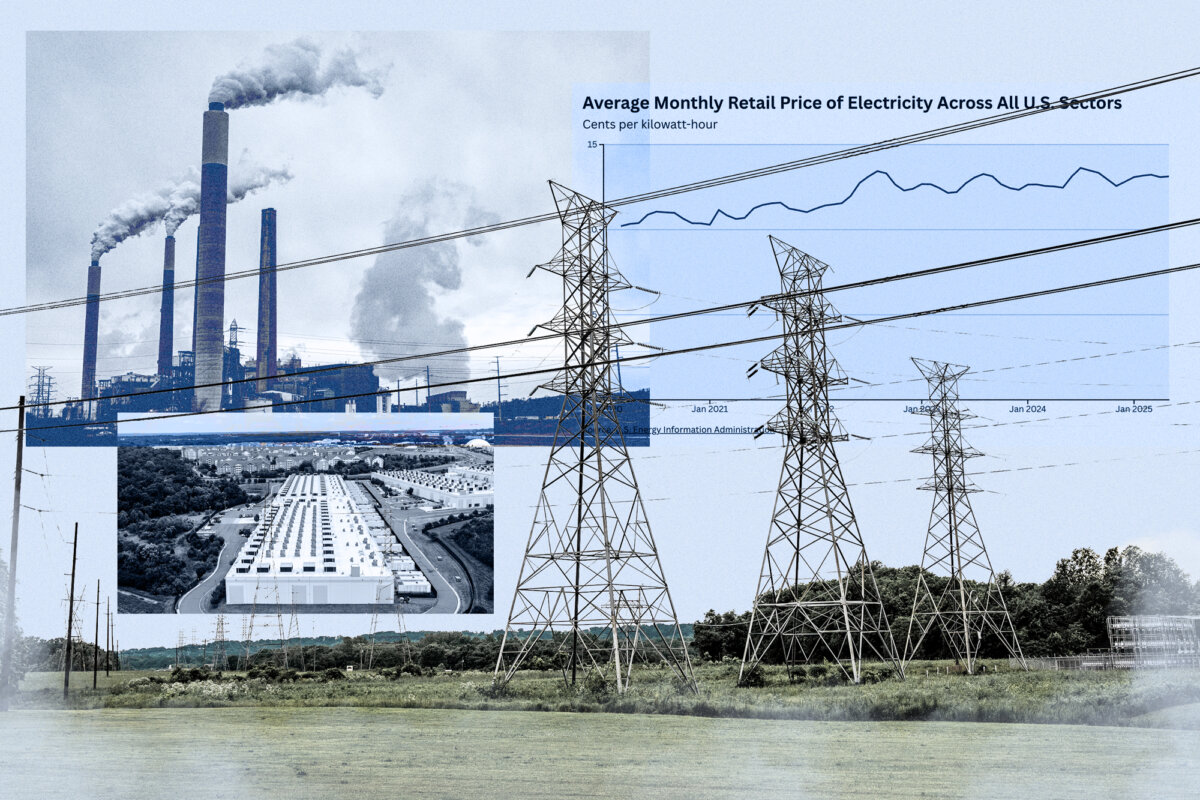
According to the U.S. Energy Information Administration, average residential electricity rates increased nationwide nearly 13 percent from April 2020 to April 2025. Since President Donald Trump returned to office in January 2025, they’ve increased 6 percent.
Electricity prices are expected to increase, on average nationwide, by another 6 percent in 2026, the administration projects, and as much as 40 percent by 2030, warns economic development finance firm ICF.

The reason is simple: supply and demand. The North American Electric Reliability Corp. projected in its 2026 long-term reliability assessment report that electricity demand will increase in the coming decade by 70 percent more than what was estimated in 2024. Many analyses find that overall demand will increase 25 percent by 2030.
The surge is driven by the development of power-hungry data centers, artificial intelligence computing, advanced manufacturing, and “the electrification of everything,” with the average home featuring up to 21 digital devices—all eating electricity all the time.
The solution is also simple: The nation’s 2,896 utility companies must increase the electricity their power plants produce with the most abundant, least expensive energy sources. Meanwhile, the nation’s seven major grid operators must add up to 7,500 miles a year to their 240,000-mile network of high-voltage transmission lines while also upgrading up to 100,000 miles of those live wires, through 2035.
But determining what solutions work best and what long-term investments to make is a complex $1 trillion challenge mired in partisan politics and buried in century-old federal, state, and local regulations.
Not only are utilities and regional transmission operators amping up from a standing start after nearly two decades of inertia, but many are scrambling to keep pace with swelling demand while also building out generation and transmission capacities to meet projected need.
The cost of these capital improvements is showing up in customers’ electricity bills, leading to heightened scrutiny of investment decisions and generation choices, as well as spurring debate about how individual communities want to develop, all while meeting a Trump administration mandate to expand rapidly to win the “AI arms race” with China.
The focus and investment is long overdue, said Robert Bryce, a film producer and author of a widely read Substack on the grid and seven books on energy policies, including, “A Question of Power: Electricity and the Wealth of Nations.”
“Given what we’ve seen in recent months, where both Republicans and Democrats are focusing on power prices, it’s clear that the days of ignoring the electric grid—and its pivotal role in our society—are over,” he told The Epoch Times. “That’s a good thing.”
Bills on the Ballot
Rising electricity, health care, gasoline, and grocery prices are components of the 2026 midterms’ top issue—affordability, as voters question why they’re paying so much for basic needs.
A sampling: Electricity bills were among primary concerns cited by 84 percent of 2,710 nationwide respondents in a January Climate Power survey. Eight of every 10 in a Kaiser Family Foundation poll of 1,426 voters that same month said “affordability” was their top issue, with 22 percent placing electricity just below gasoline and grocery prices. In a March Environmental Defense Fund poll of 1,000 Florida voters, 57 percent said electric bills are stressing household budgets.
Data center development is the lightning rod of this angst. In a January Pew Research Center poll of 8,512 adults, nearly 40 percent blamed data centers for higher utility bills. A February Politico national survey of 2,000 voters found nearly half see energy costs spurred by data centers as a top issue in congressional, state, and local elections.
How campaigns tackle “electricity inflation” will be pivotal in many of November’s 33 U.S. Senate elections, especially in Maine, Michigan, and Ohio races rated as “toss-ups” by Cook Political Reports. Sixteen House campaigns, including 13 seats held by GOP incumbents, are classified as “toss-ups.”
Assuaging voter anger over rising electricity bills will be among defining factors in many of these elections and will determine whether Republicans hold on to their 53–47 Senate majority and 217–212 House advantage.
“I have been writing about politics and energy for three decades,” Bryce said. “I cannot remember another time when so many politicians, from all parts of the political spectrum, are talking about electricity.”
Aron Solomon, chief strategy officer for campaign consultancy Amplify Inc., told The Epoch Times: “This is, honestly, shaping up to be one of the most interesting political issues of the 2026 cycle because electricity bills hit people in a very direct, and profoundly emotional way.
“Voters may not follow every inflation report or Fed decision, but they for sure notice when their monthly power bill suddenly jumps.”
University of Georgia School of Public and International Affairs professor Charles Bullock III said electricity bills are ripe targets for Democrats looking to unseat Republicans, who voters will perceive as responsible—fairly or not—for rising rates.
“When we get beyond the primaries and we move into the fall—and I could see this happening for a variety of offices—the Democrat accusing the Republican of not having done something to try to constrain energy costs” will be a standard pitch, he told The Epoch Times.
This tactic already proved itself successful in November 2025 with Democrats citing Republican policies for skyrocketing electricity bills in winning gubernatorial elections in New Jersey and Virginia, and in two Democrats unseating GOP incumbents in Georgia Public Service Commission races.
Blame Biden
There are well-defined partisan trenches on federal energy policies that voters believe manifest in their electricity bills. Those differences emerge starkly every spring and summer in congressional budget hearings.
The general gist is that Republicans say higher electricity bills are the residual fallout from President Joe Biden’s “green energy” push that funneled billions into renewable energy and regulatory paralysis fostered by interpretative expansions of the Clean Air Act, Clean Water Act, Endangered Species Act, and National Environmental Policy Act that induce litigation, prolong timelines, and add expenses to energy projects, including grid initiatives.
“There are few policy areas where reality asserts itself faster than it does in the field of energy,” Senate Energy and Natural Resources Committee Chair Sen. Mike Lee (R-Utah) said during an April 21 hearing on the Department of Energy’s Fiscal Year 2027 spending request.
“During the Biden administration, energy policy shifted away from reliability and toward favored sources, toward favored outcomes, and long, brittle supply chains that begin overseas. They assumed the system would hold together anyway, and it didn’t.”
In Trump’s second term, his administration has tossed aside any “all of the above” pretense to aggressively champion “baseload” oil, gas, and coal production as well as nuclear energy development while rolling back environmental regulations and reviving the nation’s refining and mining industries.
The president has orchestrated a “whole-of-government” focus on energy development, beginning with several day-one executive actions: declaring a national energy emergency, withdrawing from the Paris climate accords, opening Alaska’s “extraordinary resource potential” to development, and pausing federally permitted offshore wind projects he’s derided as boondoggle “wind mills.”
Energy Secretary Chris Wright and Interior Secretary Doug Burgum often reiterate that increasing natural gas and coal production and developing emerging nuclear technologies, rather than investing in “intermittent” renewables such as solar and wind, are key to scaling up the grid to accommodate data centers and other large load users. Both have said this is not only as an “affordability” consumer issue, but also as a national security imperative.
Wright has issued at least six emergency orders under the Federal Power Act to require retiring coal-fired power plants remain operable, if not actually operating, to ensure regional grids have capacity to generate electricity during peak demand, such as summer heatwaves and winter storms.
As of 2025, there were 401 coal-fired power plants in the United States, the last one coming online in 2013, according to America’s Power, which advocates on behalf of the nation’s coal-fired power plants. The Energy Information Administration documented in late 2024 that 173 of those units in 33 states were set to close by 2030, a pace accelerated by the Biden administration’s Clean Power Plant 2.0 and Greenhouse Gas rules, which required them to trim emissions by 90 percent or shut down.
Once primary races are settled, when congressional Republicans and candidates face off against Democrats in 2026 general election campaigns, they will claim they inherited rising electricity prices from Biden policies. They will point to actions such as repealing power plant rules, scaling back environmental laws, trimming regulations, streamlining permitting, reinvigorating fossil fuel development, building nuclear reactors, and expanding the nation’s 3.3 million mile natural gas pipeline network as ways to address energy affordability, which, they’re certain to note, is more an issue in Democrat-led states than in GOP-governed states.
Blame Trump
Democrats’ general election campaign pitch will claim the Trump administration and congressional Republicans are directly responsible for spiking electricity bills by ditching support for “all of the above” energy to exclusively favor fossil fuels while pulling the plug on assistance programs and renewable energy investments, especially solar, which has been the largest source of new electricity generation nationwide since 2020.
They point to initiatives adopted the last time Democrats held both chambers: 2021’s Bipartisan Infrastructure Law and 2022’s CHIPS and Science Act and Inflation Reduction Act, which authorized billions in tax credits, low-interest loans, and grant programs incentivizing private investments in renewable energies, advanced manufacturing, and grid expansion.
Many Inflation Reduction Act initiatives and grants were suspended under the One Big Beautiful Bill Act adopted in partisan votes and signed into law by Trump in July 2025.
In October 2025, the administration canceled, or “clawed back,” $8 billion in Inflation Reduction Act allocations for 223 renewable energy projects, nearly all in Democrat-led states.
“Satisfying a president’s desire for political revenge or intimidation is not a lawful basis for terminating projects that were on track to help reduce soaring electricity prices,” Sen. Martin Heinrich (D-N.M.) told Wright during the April 21 hearing.
“These cancellations on a political basis are a blatant betrayal of the communities, the workers, and the businesses counting on those investments to lower their energy costs, and now it is those communities, workers, and businesses who will pay the price regardless of their particular politics.”
Although Congress appropriated $8.8 billion for home energy rebates in 2026 to purchase more energy efficient appliances and for “weatherization” upgrades, the Department of Energy has stalled implementation in nearly 40 states, he said.
“That’s obstruction,” Heinrich said, “and while these cost-saving programs are being obstructed, the department is taking actions that actively raise prices. This [2027] budget reflects the same lack of concern for the real costs facing hard-working families trying to keep the lights on and their vehicles on the road.”
The department’s spending request eliminates the Weatherization Assistance Program, “which saves households, on average, $372 every year,” he said. “It also rescinds another $15.2 billion of [Inflation Reduction Act] funding—congressionally directed funds that are ready to go out the door to support grid reliability and help reduce electricity prices.”
After primaries set November ballots, when Congressional Democrats and candidates square off against Republicans in 2026 general election campaigns, they will pledge to restore these programs, revive defunded projects that boost grid capacity, encourage “all of the above” energies—especially nuclear—while refunding grants that advance renewables, which 65 percent of 3,524 adults surveyed in March 2026 by Pew Research Center said they support, including 44 percent of Republicans.
State, Local Matters Most
In a D.C.-centric media environment where issues are portrayed in a national setting, often overlooked is the reality that federal policy has far less influence on electricity bills than decisions made at state and local levels.
Utility boards—more than 70 percent investor-owned—and state regulators determine generation mixes, infrastructure needs, and rate structures, with vast differences between utilities in California than, say, those in Wyoming, Pennsylvania, or Georgia.
“Affordability” voters comparing campaign plans for keeping electricity bills down should focus on the 36 gubernatorial elections and 6,000 legislature seats on 46 state ballots in November. In addition, nine states will elect 14 public utility commissioners, who directly regulate electricity rates.
“What makes this tricky politically is the usual red vs. blue framing only tells part of the story,” Solomon said. “Once you get outside Washington talking points, the conversations become infinitely messier and a heck of a lot more local. Most voters aren’t sitting around debating energy ideology. They just want the lights to stay on and the bill to stop climbing.”
Data centers will be big issues for voters in many states, including Virginia, Georgia, and Arizona.
Phoenix Republican strategist Barrett Marson of Marson Media said after the Arizona Legislature failed to advance a bill to “strip away some tax incentives for data centers” during its 2026 session, data centers are certain to be an issue in Democratic Gov. Katie Hobbs’ reelection campaign against the winner of the state’s July 21 Republican primary, a field that includes U.S. Reps. Andy Biggs and David Schweikert.
“There were Republicans and Democrats who wanted to do this, to take away those incentives,” he told The Epoch Times. “But if you look at the messaging around the Democrats, the message is, [Republicans are] giving tax breaks to data centers while taking away health care, things like that.”
A winning message for Arizona Republicans, one that could defuse its potency for Democrats, could also be targeting data centers, Marson said.
Arizona isn’t unique, Solomon said.
“What’s fascinating is these debates don’t fall neatly along partisan lines,” he said.
“You can have pro-growth Republicans worried about infrastructure strain, progressive environmental groups doing a pretty good job aligning with local homeowners, unions supporting construction jobs, and tech companies promising economic transformation all at the same time. So it can kind of be a mess.”
 Friends Read Free
Copy
Facebook
Tweet
Friends Read Free
Copy
Facebook
Tweet