
Since the start of the second Trump administration, federal officials have been issuing new policy frameworks and dietary guidelines to advance the “Make America Healthy Again” agenda.
Meanwhile, regenerative farming is gaining spotlight and spreading in Texas, Ohio, and elsewhere, carrying the message that healthy soil makes healthy food and healthy people.
Reflecting a broader shift toward food awareness, Epoch Times readers voiced concern over the use of genetically modified organisms (GMOs), chemical additives, and nutrient-stripped processed foods.
“If you don’t have any nutrients, the food is not food,” Health Secretary Robert F. Kennedy Jr. said during his visit to a Texas regenerative farm last month.
Here are readers’ takes on the nation’s food supply and reasons behind the problems with food.
Low Satisfaction With Quality
Many readers were unsatisfied with the quality of the food supply.
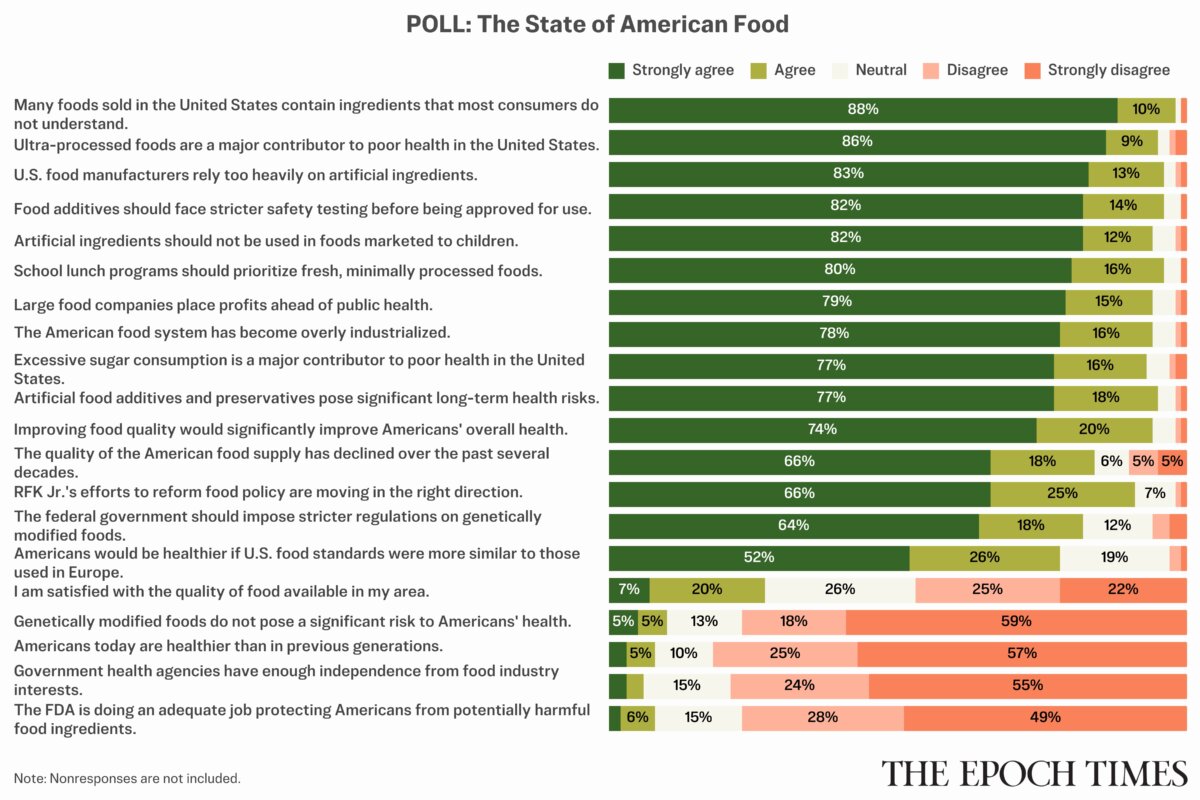
Roughly 47 percent of respondents were not satisfied with the quality of food available in their area. Just over a quarter (27 percent) expressed satisfaction, including 7 percent who showed strong satisfaction. The remaining 26 percent were neutral.
The vast majority of survey takers (84 percent) agreed that the quality of the American food supply has declined over the past several decades.
Concerning Americans’ health status, 82 percent of those polled disagreed that Americans today are healthier than in previous years.
Contributors to Poor Health Listed
Asked to identify major contributors to poor health in the United States, a whopping 95 percent of those polled named ultra-processed foods. A similar number (93 percent) named excessive sugar consumption.
“It is not sugar that is the problem; it is high fructose, which is put in almost all processed food and beverages,” a reader commented. “Eliminate high fructose corn syrup from all food [and] replace with real sugar.”
Readers also recognized the harm of artificial food additives, preservatives, and GMOs.
About 95 percent of polled readers agreed that artificial food additives and preservatives pose significant long-term health risks.
More than three-fourths (77 percent) believed genetically modified foods pose a significant risk to Americans’ health.
Disapproval of Artificial Ingredients
Nearly all those surveyed (98 percent) agreed that many foods sold in the United States contain ingredients that most consumers do not understand, with 88 percent strongly agreeing that is the case.
About 96 percent of the sample group agreed that U.S. food manufacturers rely too heavily on artificial ingredients.
And 94 percent of respondents believed that artificial ingredients should not be used in foods marketed to children.
In light of that, 96 percent agreed school lunch programs should prioritize fresh, minimally processed foods.
Reasons Behind Food Problems
Readers also shared critiques of the food industry, large companies, and government agencies.
About 94 percent of respondents agreed that the American food system has become overly industrialized.
The same proportion concurred that large food companies place profits ahead of public health.
And 79 percent believed government health agencies have too little independence from food industry interests.
In addition, more than three-quarters (77 percent) disagreed that the U.S. Food and Drug Administration is doing an adequate job protecting Americans from potentially harmful food ingredients.
Improvements Needed
Ninety-four percent of survey takers were united in the belief that improving food quality would significantly improve Americans’ overall health.
Stricter regulations on food ingredients are needed, according to readers’ opinions.
Ninety-six percent agreed that food additives should face stricter safety testing before being approved for use, and more than 80 percent agreed that the federal government should impose stricter regulations on genetically modified foods.
About 78 percent acknowledged that Americans would be healthier if U.S. food standards were more similar to those used in Europe.
“The United States should ban glyphosate, as Europe has,” a reader commented.
When asked which changes would most improve U.S. food quality, 29 percent of respondents said fewer additives and preservatives; 24 percent said more natural foods.
A combined 31 percent said stricter food safety standards, less sugar, stricter GMO regulation, better food labeling, and better school meals.
Asked about other approaches for improvements, a reader said: “Education of the population, which would drive purchase decisions. Unfortunately, public education is failing our children.”
Another said, “A move towards regenerative farming instead of industrial food systems. Also, helping local farms have the freedom to sell their products locally without all the red tape.”
Another reader added, “Rescind regulation that advantages corporate farming at the expense of small, independent farms.”
More than 90 percent of readers polled agreed that Health Secretary Kennedy’s efforts to reform food policy are moving in the right direction so far.
The Epoch Times conducted this reader survey on June 10–11, 2026, by email and social media, generating 2,185 responses.
 Friends Read Free
Copy
Facebook
Tweet
Friends Read Free
Copy
Facebook
Tweet