
While most national attention is focused on the upcoming congressional midterm elections, key races for governors’ mansions are shaping up in this year’s top battlegrounds.
At the state level, voters share the same economic concerns and disapproval of President Donald Trump that have driven the congressional cycle. Several of these races have also focused significantly on the growing issue of AI data centers, whose energy and water demands have driven widespread opposition among voters on both sides of the aisle.
The races will determine key state-level issues—which laws pass, which get vetoed, and how states respond to federal policy shifts—with effects that will echo across the national political environment for the next four years.
Governors’ races tend to be more isolated from national politics. This year, some of the same trends are emerging, even as Republicans prepare to enter the midterms with a slight edge.
Some key gubernatorial races are taking place in Wisconsin, Michigan, Maine, Iowa, Georgia, Ohio, and Nevada.
Democrats lead polls in Wisconsin, Michigan, and Iowa.
The races in Georgia and Ohio are toss-ups, with both parties leading or tied in some polls. Recently, Republicans are also seeing tight polls in Texas.
Here’s what to know.
Georgia
Former Atlanta Mayor Keisha Lance Bottoms is vying to flip Georgia’s executive mansion to Democratic control, while billionaire Republican Rick Jackson hopes to keep it in Republican hands.
The winner will succeed Gov. Brian Kemp, who was ineligible to run for reelection.
In 2024, Trump won Georgia by about 2.2 percentage points— Republicans’ narrowest margin of victory in the Peach State since 1996.
A victory for Democrats in a state-level contest would mark a shift in Georgia, which last sent a Democrat to the governor’s mansion in 1998.
The Cook Political Report rates the race a toss-up.
Iowa
Democrats are looking to win back Iowa’s governorship for the first time since 2011.
The Republican nominee is farmer and businessman Zach Lahn, a proponent of the Make America Healthy Again movement.
The Democratic nominee is Rob Sand, the state auditor.
The winner will succeed Gov. Kim Reynolds, who declined to run for a third term.
Sand has led in every poll since June, and the Cook Political Report rates the race as leaning Democratic.
Nevada
In the Silver State, Gov. Joe Lombardo, a Republican, is up for reelection.
Trump flipped the state in the 2024 election for the first time since 2004. It came two years after Lombardo, a former sheriff, was first elected in 2022.
Lombardo has touted his record as governor during the campaign, referencing his work to expand state savings, cut regulation, and boost employment.
Lombardo’s Democratic opponent is Nevada Attorney General Aaron Ford. He has promised affordable housing and to address predatory practices by pharmacy benefit managers.
The race is currently rated a toss-up by Cook Political Report.
Ohio
As Ohio draws national attention for its House and Senate races, observers are also watching its gubernatorial race this year.
Like Iowa, Ohio was once a pivotal swing state that has veered toward Republicans in recent years. With voters in the working-class state feeling the pinch in their pocketbooks from higher fuel and grocery prices, that could be shifting.
In 2012, the Buckeye State backed President Barack Obama before swinging toward Trump in 2016, 2020, and 2024.
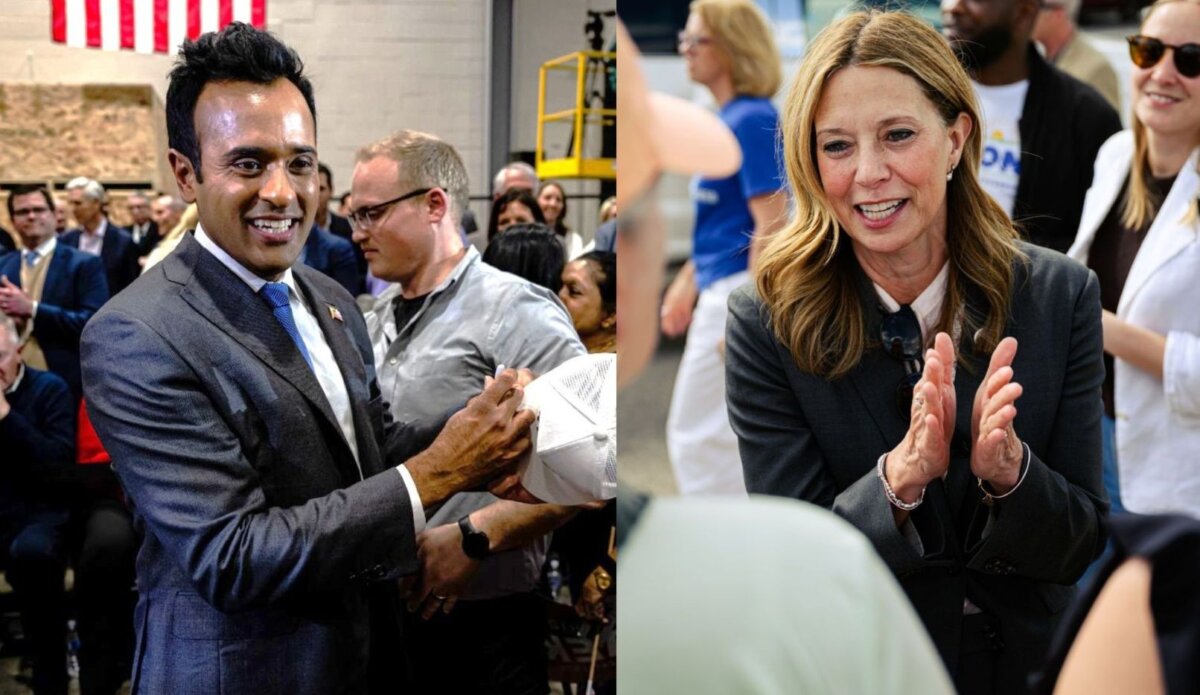
Republican entrepreneur Vivek Ramaswamy is running against Democrat Amy Acton, the state’s former health director.
Acton currently leads the polls by an average of 6 points.
Earlier this year, the Cook Political Report shifted the race’s rating to toss up, citing Acton’s polling leads and ties over the race despite Ramaswamy’s financial edge.
Arizona
In Arizona, Gov. Katie Hobbs faces reelection, fielding a challenge from Rep. Andy Biggs (R-Ariz.).
National issues—affordability, the impacts of Republican party-line cuts to Medicare and Medicaid, and data centers—are factors in the race.
Meanwhile, local issues related to water access for Phoenix—a rapidly growing metropolis situated in the desert—have also been key factors in the race.
Hobbs has led Biggs by nearly a double-digit margin in every poll of the race conducted in 2026.
The Cook Political Report rates the race as leaning Democratic.
Michigan
Republicans have been looking to take back the Michigan gubernatorial mansion since they lost the seat in 2019.
The Republican nominee, Rep. John James (R-Mich.), has campaigned on implementing a parental bill of rights and enabling school choice.
Michigan Secretary of State Jocelyn Benson is facing James, running on a promise to increase the affordability of housing and other goods.
The winner will succeed Gov. Gretchen Whitmer, who is term-limited.
The Cook Political Report rates the race as leaning Democratic.
Kansas
Republican Ty Masterson will face Democrat Cindy Holscher in the closely watched fight for the governor’s mansion of Kansas.
Masterson, who was endorsed by Trump, won the crowded Republican primary on Aug. 4 by a decisive margin. Holscher, a state senator, came out on top in the Democratic race.
Masterson, who has been the president of the Kansas Senate since 2021, says he wants to cut taxes, bring jobs to Kansas, and raise pay for teachers, while Holscher is running on a platform to lower the cost of living.
Though Kansas is known as a red state at the federal level, contests have been closer at the state level. The mansion is currently occupied by Gov. Laura Kelly, a Democrat.
The Cook Political Report rates the race as leaning Republican.
Wisconsin
In Wisconsin, Rep. Tom Tiffany (R-Wis.) faces a tough fight for the governor’s mansion with Milwaukee County Executive David Crowley.
Crowley’s defeat of democratic socialist state Rep. Francesca Hong by a hair earlier this year was a major political upset given that she had dominated polling for weeks over the late-entering Crowley.
Tiffany easily won the Republican nomination in his primary.
National attention has remained centered on the politically critical swing state, which voted for both Trump and Democratic Sen. Tammy Baldwin in 2024.
The Cook Political Report rates the race as a toss-up.
Texas
Recently, Republicans have faced warning signs in Texas, where Gov. Greg Abbott faces a tough challenge from Democrat Gina Hinojosa.
Abbott leads by just 1.4 percent in recent polling.
In the most recent poll by Siena College, meanwhile, Hinojosa led by 49 percent to Abbott’s 46 percent
A loss in that race would mark a major shift for Texas Republicans.
Austin Hein, a Republican strategist working on Bo French’s campaign for the Railroad Commission of Texas, said that the Texas governor race isn’t seriously vulnerable—but warned that Republicans “should take the threat seriously.”
The Cook Political Report rates the race as leaning Republican.
—Joseph Lord and Jackson Richman
BOOKMARKS
Trump announced on Sunday that Russia and Ukraine have agreed to halt attacks on each other’s energy facilities, The Epoch Times’ Emel Akan reported. The deal aims to ease global oil and diesel prices driven up by infrastructure damage in both countries during the war, Trump said.
The United States might join Saudi attacks against the Yemen-based Houthi terrorist group following fresh fighting, Trump said on Saturday. The Epoch Times’ Jack Phillips reported that when the president was asked about the possibility of U.S. forces joining in the Houthi–Saudi conflict following an attack on the King Khalid International Airport in Riyadh, Trump told reporters, “We just found out about the recent attack. So we’ll make a decision. We move very quickly.”
The Sinaloa Cartel used an underground tunnel to smuggle narcotics from Tijuana to a warehouse in Otay Mesa, a residential area in the southern exclave of San Diego along the U.S.–Mexico border. The Epoch Times’ Brad Jones reported on what he found during a tour of the tunnel by elite Border Patrol agents.
Blue Bird Corporation began manufacturing the steel-frame school bus in 1927, an invention that has left a legacy well beyond local American neighborhoods. The Epoch Times’ Aaron Gifford reported that 100 years after its introduction, the Georgia-based manufacturer has built more than 620,000 school buses, with about 180,000 of them still operating today.
 Friends Read Free
Copy
Facebook
Tweet
Friends Read Free
Copy
Facebook
Tweet