

Recent remarks by Chinese leader Xi Jinping about organ transplants and extending human lifespan have focused attention on forced organ harvesting in China.
Xi’s comments to Russian President Vladimir Putin were caught on a hot mic during a military parade on Sept. 3. Putin said organs could be “continuously transplanted” to make people younger—even immortal. Xi added that the practice could allow people to live up to 150 years.
Amid growing awareness among Americans of this practice, which targets prisoners of conscience in particular, we asked readers to weigh in on possible U.S. actions to combat it.
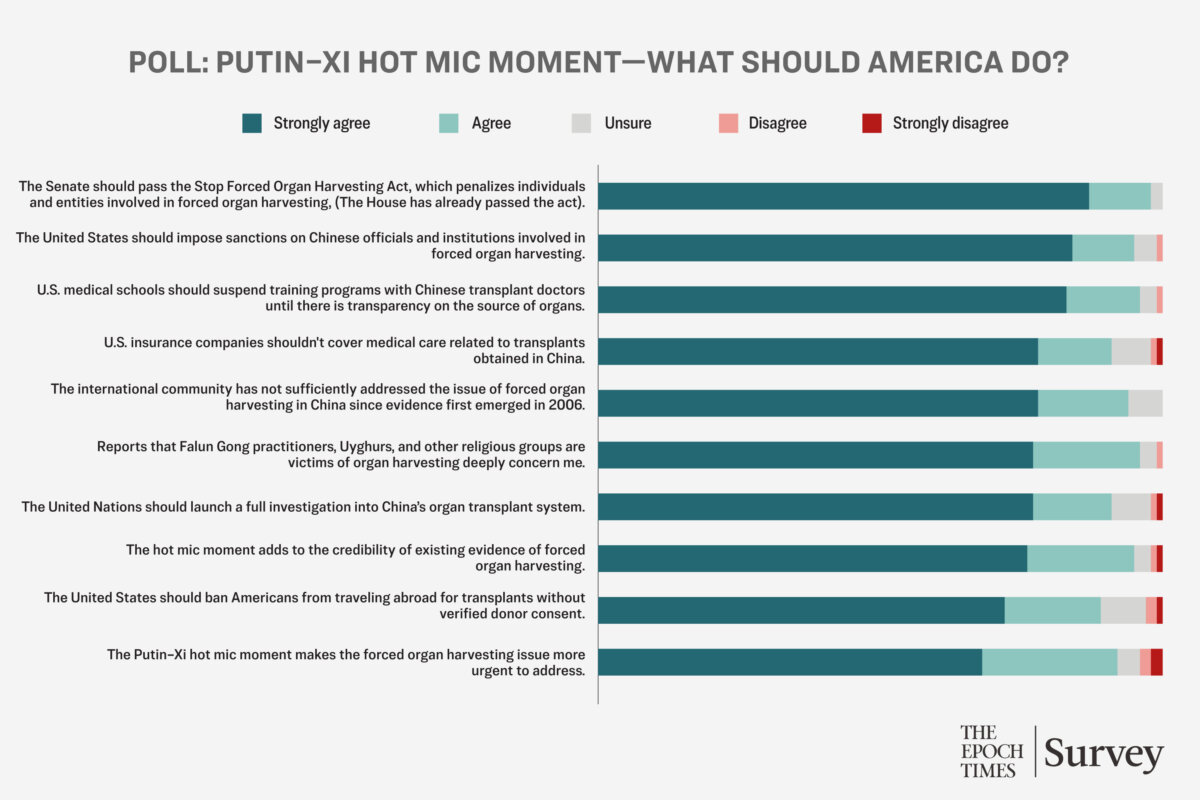
Nearly all readers supported various U.S. actions, with fewer than 5 percent expressing opposition.
Yet reader support was notably stronger for some possible sanctions and other conclusions that might be drawn from the incident than for others.
Strongest Support for Actions Against China
Poll respondents overwhelmingly supported U.S. actions to discourage organ transplants in China over the issue of the sourcing of organs from donors who are murdered in the process.
Ninety-eight percent agreed that the Senate should pass the Stop Forced Organ Harvesting Act, which penalizes individuals and entities involved in forced organ harvesting, with 87 percent strongly supporting that idea. The House passed this bill in May.
Also, 95 percent agreed that the United States should impose sanctions on Chinese officials and institutions involved in forced organ harvesting, with 84 percent agreeing strongly.
And 96 percent affirmed that U.S. medical schools should suspend training programs with Chinese transplant doctors until there is transparency on the sourcing of organs. Eighty-three percent strongly supported that action.
The Association of American Physicians and Surgeons called on the U.S. government and physicians to refuse to enable transplants involving forced organ harvesting by not training personnel from China or other totalitarian states.
Some readers expressed outrage over transplants involving forced organ harvesting, with one saying, “These poor victims of organ harvesting—most of the time are still alive and are victims of horrific and brutal consequences!”
“We need investigations and real consequences,” one reader said. “Sanctions and whatever other monetary punishments can be imposed.”
Some Hesitancy on International Action
Respondents showed slightly less certainty on the need for and value of international efforts to address the problem of transplants involving forced organ harvesting in China.
While 78 percent of respondents strongly agreed that the international community has not sufficiently addressed the issue, the number of those who “somewhat supported” that statement rose to 16 percent. The number who were unsure about it rose to 6 percent, double the average of those uncertain about U.S. action.
As for a United Nations investigation into the matter, seven percent were unsure of the value, though, overall, 91 percent supported the idea.
One reader said, “The U.N. cannot be relied upon for much of anything.”
Yet another said, “Align with other nations to put pressure on China. The U.N. has a part to play along with the World Health Organization.”
Personal Implications
Respondents strongly affirmed statements about the personal implications of China’s transplants from forced organ harvesting, though the number who only “somewhat” supported the statements rose.
As for U.S. insurance companies refusing to cover medical care related to transplants obtained in China, 78 percent strongly supported the idea, 13 percent somewhat supported the idea, seven percent were neutral, and two percent were opposed.
Similarly, 78 percent strongly affirmed that they were deeply concerned of that Falun Gong practitioners, Uyghurs, and other groups were victims of organ harvesting. Nineteen percent were somewhat concerned.
Seventy-two percent strongly favored a ban on Americans traveling abroad for transplants without verified donor consent, 17 percent were somewhat supportive of the action, and eight percent were unsure.
One reader said, “We can’t police the world, but we can inhibit the use of U.S. funds, training, doctors, etc., involved in this horrible practice.”
Another wrote, “Impose a ban on any organ transplant that is harvested from a comatose patient. I am an organ donor, and am rethinking that decision.”
Implications of the Remarks
Here again, a large majority, more than two-thirds, affirmed that Xi’s remarks added credibility to the evidence of forced organ harvesting and made the issue more urgent.
Yet the strength of the support for those ideas was lower. Seventy-six percent strongly agreed that the remarks add credibility to evidence of forced organ harvesting, while 68 percent agreed that the remarks make the matter more urgent to address. Nineteen percent somewhat agreed the remarks add credibility, and 24 percent somewhat agreed the remarks make the matter more urgent.
The Department of Health and Human Services on Sept. 5 called for the United States to stop participation in organ transplants in China, saying, “To affirm the sanctity of human life, America must sever its ties with China’s organ transplant system.”
“Bring it all out in the open. Let the people know,” one reader said.
Commenting on the importance of strong action against forced organ harvesting in China, another said, “By refusing to stand up to a bully, you only make him stronger.”
The Epoch Times first reported on forced organ harvesting in China in March 2006.
Correction: A previous version of this article misattributed the statement that suggests longevity can be achieved through continuous organ transplantation. The Epoch Times regrets the error.
 Friends Read Free
Copy
Facebook
Tweet
Friends Read Free
Copy
Facebook
Tweet



























