Chris Spence was driving a John Deere utility vehicle laden with supplies through the rolling plains of northern Afghanistan in November 2001, when he was captivated by the sight of a mismatched band of U.S. soldiers and Afghans cresting a hill on horseback.
Along with his military gear in the John Deere, Spence also came armed with a camera. Fascinated by the novelty of the moment, he began snapping shots.
His pictures would soon capture the attention of the American public and shape the image of the early days of the U.S. military’s campaign in Afghanistan.
Spence, a Green Beret assigned to the 5th Special Forces Group, was among the first Americans in Afghanistan after the 9/11 attacks.
The mission for these Americans was to recruit Afghan militias and provide them with U.S. airpower and other support to break the Taliban government, which had harbored the Al Qaeda leaders who masterminded the 9/11 attacks.
In the early days of what would become a 20-year war, the U.S. military hadn’t yet established the logistical footprint to deliver and maintain modern tactical vehicles overland. To traverse northern Afghanistan’s austere mountain terrain, many of the first Americans on the ground relied on the horses of local partner forces.
By mid-November, then-Secretary of Defense Donald Rumsfeld began sharing Spence’s photos with the public.
Images of U.S. soldiers on horseback would inspire journalist Doug Stanton’s 2009 book “Horse Soldiers,” a statue in New York City’s Liberty Park, and the 2018 movie “12 Strong.” While the images were shared far and wide for years, Spence’s photos were originally only credited to the U.S. Army.
Spence has since been identified as the photographer behind some of the famous photos, and has begun more openly discussing his role in shaping the public view of the mission.
“The next generation needs to know what we did, so they remember what we sacrificed,” Spence said in an interview with The Epoch Times.
The First Americans In
On Sept. 11, 2001, Spence was sitting in a hospital waiting room with one of his two sons. His son had broken his arm eight weeks earlier, and they were there for a checkup. That’s when someone else in the waiting room told Spence that a plane had just hit one of the twin towers at the World Trade Center in New York City.
Before the day was over, hijackers had seized three more passenger airliners and crashed them in New York, Washington, and rural Pennsylvania. As the nature of the attack became clear, Spence sat down with his two sons and told them, “The world as you know it has officially changed.”
Three days after the 9/11 attacks, both houses of Congress passed an authorization for the use of military force, permitting then-President George W. Bush “to use all necessary and appropriate force against those nations, organizations, or persons he determines planned, authorized, committed, or aided the terrorist attacks.”
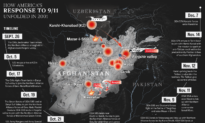
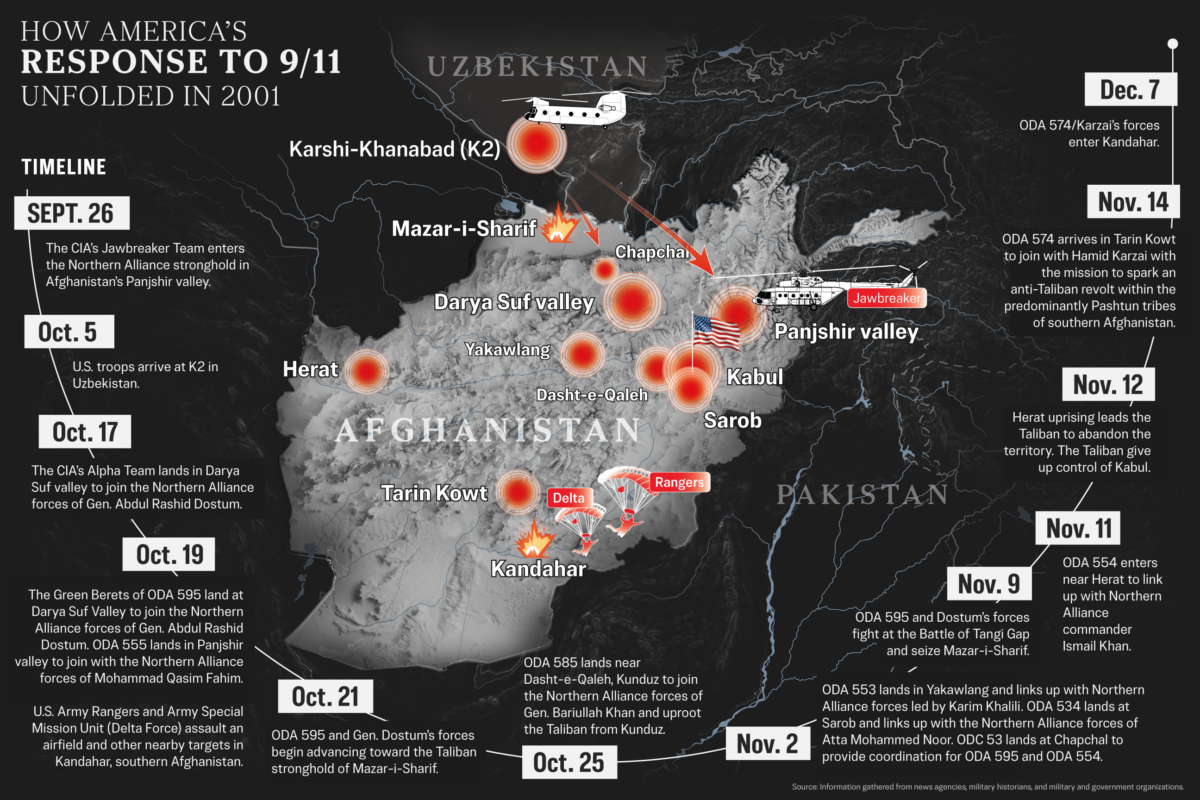
The CIA quickly began preparing teams of paramilitary officers to enter Afghanistan. It brought its first paramilitary team, codenamed Jawbreaker, into Afghanistan’s Panjshir valley on Sept. 26, in a refurbished Soviet Mi-17 helicopter.
Jawbreaker became the first set of Americans into Afghanistan after 9/11.
The Army’s 5th Special Forces Group, whose geographic area of responsibility covers the Middle East and Central Asia, also began putting its soldiers on standby to join the burgeoning conflict. These Green Berets were to form the forward fighting edge of what would come to be known as Task Force Dagger.
Spence had already been preparing for a deployment to Kuwait when his orders changed. With his family affairs already in order, Spence tried to spend quality time with his wife and two boys before leaving for Afghanistan.
Justin Sapp, a 5th Special Forces Group Green Beret, was also among those activated for the early efforts in Afghanistan. Unlike his fellow Green Berets, however, Sapp was to be detailed to a CIA paramilitary team known as Team Alpha.
Sapp had a prior internship with the CIA, he told The Epoch Times, but his being selected to help fill out Team Alpha came down to lucky timing. He was between duty assignments at the time; the opportunity to join the CIA spared him from having to report for an unwanted staff assignment.
He also had to put his personal life on abrupt hold.
As he prepared to depart, Sapp provided his then-girlfriend with few details about the deployment. At the time, he felt the need to preserve the secrecy of his assignment, but said in hindsight he could have handled it differently.
“I just told her I was busy, and I kind of regret that,” he said.
By the first week of October 2001, U.S. forces began arriving at an old Soviet military base in Uzbekistan. Known as Karshi-Khanabad or K2, the derelict base had been contaminated with harmful chemicals and radioactive material left by the previous tenants. It would serve as the launch point for further U.S. military forays into Afghanistan.
The CIA’s Alpha Team departed K2 on Oct. 16, 2001, flying to the Darya Suf valley of northern Afghanistan, to join with a Northern Alliance commander, Abdul Rashid Dostum. As they landed in Afghanistan the next day, Sapp and his teammates became the first Americans behind Taliban lines.
Sapp’s job on Alpha Team included preparing the way for some of the Green Beret teams to follow. This entailed scouting helicopter landing zones and coordinating for the supplies those Green Berets would need, including horses.
Despite being behind enemy lines, the sense of danger was relatively low, Sapp said.
“I wasn’t very worried … when you saw the Taliban, you could see them, but they were 1,500 meters, 2,000 meters, 3,000 meters away,” Sapp said. “They were in artillery range. They were in rocket range, but they were not in [rocket-propelled grenade] or small arms range.”
Two days after Alpha Team reached the Darya Suf valley, two Green Beret teams left K2 for Afghanistan. One, led by then-Capt. Mark Nutsch, linked up with Dostum’s forces in the Darya Suf valley, while a second landed in the Panjshir valley to connect with another Northern Alliance warlord, Marshal Mohammad Qasim Fahim.
As the first Green Beret teams arrived in northern Afghanistan, the Army’s 75th Ranger Regiment carried out a parachute assault in southern Afghanistan, near Kandahar. Over the border, in Pakistan, two Rangers supporting this operation—Pfc. Kristofor Stonesifer and Spc. John Edmunds—were killed when their Black Hawk helicopter crashed during a landing mishap.
To Mazar-i-Sharif by Horse
Within days of connecting with Dostum’s forces, Nutsch’s Green Beret team mounted horses for an overland assault toward the Taliban stronghold of Mazar-i-Sharif.
Retired Master Sgt. Bart Decker, former Special Forces Horse Soldier
Many of the U.S. troops assigned to work with Dostum’s forces had little or no equestrian experience. They had to contend not only with the challenges of steering a thousand-pound animal, but doing so over rugged terrain and with cumbersome military kit. Nevertheless, the novice Americans rode on.
Bart Decker, a U.S. Air Force combat controller attached to one of the Green Beret teams in Afghanistan, also soon found himself in the mounted cavalry. Decker told The Epoch Times that his equestrian experience, at that point, was limited to a couple of trail rides he had gone on as a child.
“There were some epic moments of riding horseback on ledges, and I’m telling you, 500-foot drop on one side and a sheer wall to your right side, so there were no outs,” Decker said.
By the first week of November 2001, the 5th Special Forces Group dispatched additional Green Beret teams to connect with Northern Alliance leader Atta Mohammad Noor, and add to the pressure on Taliban forces in Mazar-i-Sharif.
Spence and Decker arrived in Afghanistan with a smaller Green Beret command element tasked with providing logistical support for the other teams marching toward Mazar-i-Sharif. As a senior communications sergeant for this command element, Spence was responsible for every component of the team’s gear that required batteries, including a digital camera.
As Spence went out to deliver supplies to some of the U.S. troops one day in November, he began photographing the scene. He snapped a shot of several U.S. troops and Afghan partner forces descending from a grassy hillock, and then captured a close-up of Decker on his steed.
“I wanted to document everything, because no one’s ever done this before. [Special Forces] has never gone in first, linked up with that indigenous force, and then here we find ourselves on horseback,” he told The Epoch Times.
Spence passed his photos up his chain of command, unaware of the impact they’d soon have on Americans back home.
Rumsfeld was photographed at the Pentagon alongside other U.S. military officials and South Korean Defense Minister Kim Dong Shin reviewing one of Spence’s photographs on Nov. 15, 2001.
At a press engagement the next day, a reporter asked Rumsfeld about reports of Americans participating in mounted cavalry charges in Afghanistan. The defense secretary responded by sharing one of Spence’s photos.
“I didn’t even know the pictures had gone viral until we got home,” Spence said.
Victories and Setbacks
By early November, Northern Alliance forces had closed in around Mazar-i-Sharif. On Nov. 9, the various teams of Green Berets and Air Force combat controllers coordinated waves of airstrikes on Taliban positions around the key city, clearing the way for its capture.
Elsewhere in the country, other Special Operations teams began notching a series of victories that rattled the Taliban government.
Green Beret teams helped lead partner forces to capture the northwest city of Herat and the capital city of Kabul on Nov. 12, 2001.
Another Green Beret team landed near the southern Afghan city of Tarin Kowt. This team’s task was to join with a militia leader named Hamid Karzai, to expand the southern front of the Afghan war. Together, they helped Karzai take Kandahar from the Taliban.
Decker said the initial idea of using small Special Operations teams to facilitate local partner forces in a fight against the Taliban “was pretty brilliant.”
“I think we took down Afghanistan in like 47 or 49 days,” Decker said.
But these victories were not without setbacks.
Dostum’s forces captured hundreds of surrendering Al Qaeda-linked foreign fighters around Mazar-i-Sharif, and initially used a nearby fort, called Qala-i-Jangi, as a detention facility. CIA Alpha Team members Johnny Micheal Spann and David Tyson went to the fort on Nov. 25, 2001, to begin interviewing the detainees in hopes of gathering valuable information in the growing hunt for Al Qaeda’s leaders.
As Spann began speaking with the detainees, they charged him. Tyson was able to escape the ambush, but Spann became the first American killed in combat in Afghanistan.
The battle for control over Qala-i-Jangi continued for several days before the uprising could be quelled.
Three Green Berets working with Karzai’s forces—Master Sgt. Jefferson Davis, Sgt. First Class Daniel Petithory, and Staff Sgt. Brian Prosser—were killed on Dec. 5, 2001, when a U.S. bomb was accidentally dropped on their position.
After the Taliban collapsed, Karzai became the chairman of Afghanistan’s interim government and became the country’s first democratically elected president in 2004.
Shaping a Legacy
After seeing the first photos of the war in Afghanistan in late 2001, Kentucky-based artist Douwe Blumberg began sculpting a clay model of a soldier on horseback. The sculpture was a passion project he would work on at night after putting his two daughters to bed.
While participating in an art show in 2002, Blumberg crossed paths with another exhibitor who offered to connect him with the base commander at Fort Campbell, Kentucky—the home base of the 5th Special Forces Group. The following day, Blumberg received a call from Frank Hudson, then-deputy commander of the 5th Special Forces Group.
Soon, Hudson began providing feedback to help Blumberg sculpt a piece that more accurately depicted the mounted Green Berets of Task Force Dagger. After returning from his deployment, Nutsch also began to show Blumberg some of the real kit he had carried while fighting across Afghanistan.
“Once they realized that I was committed to making it historically accurate as well as artistic, they really opened up,” Blumberg told The Epoch Times.
As Blumberg refined his sculpture, he added several minute details, including the impression of a wedding band on the soldier’s gloved left hand, in a nod to the families of deployed U.S. service members.
After perfecting the sculpture design, an effort grew to commission Blumberg’s work as a 16-foot-tall bronze statue. He completed the full-size statue in 2011.
Blumberg’s full-sized statue featured in the 2011 New York City Veterans Day Parade, and has since been installed at Liberty Park as the “America’s Response Monument.”
While Blumberg’s statue celebrates the first Americans into Afghanistan after the 9/11 attacks, the legacy of the war remains a challenging one for those same Americans.
After the collapse of the Taliban government in late 2001, the U.S. government sought to foster a new government in Afghanistan. In the years that followed, U.S. forces continued to battle the Taliban insurgency and facilitate the nation-building effort, while successive U.S. presidents tried to find a clean exit strategy.
The U.S.-backed Afghan government ultimately collapsed in 2021 under pressure from a resurgent Taliban. The U.S. military completed its final troop withdrawal and supported a last-minute civilian evacuation mission from Afghanistan during this turbulent moment in time.
Retired U.S. Army Master Sgt. Christopher Spence, former Special Forces Horse Soldier
Rather than fully withdrawing from Afghanistan, the United States could have maintained some force presence in Afghanistan, Sapp said, enabling the U.S.-backed Afghan government to hold onto the major population centers even if the Taliban had reasserted control over the hinterland areas.
“That’s not how we looked at it, and then the outcome was pretty predictable,” Sapp said.
Sapp and Spence both compared the final U.S. troop withdrawal from Afghanistan to the departure of U.S. forces at the end of the Vietnam War.
“I tell Vietnam vets, when I watched those last planes fly out of Afghanistan, I finally understood how you guys felt when you saw the fall of Saigon,” Spence said.
 Friends Read Free
Copy
Facebook
Tweet
Friends Read Free
Copy
Facebook
Tweet