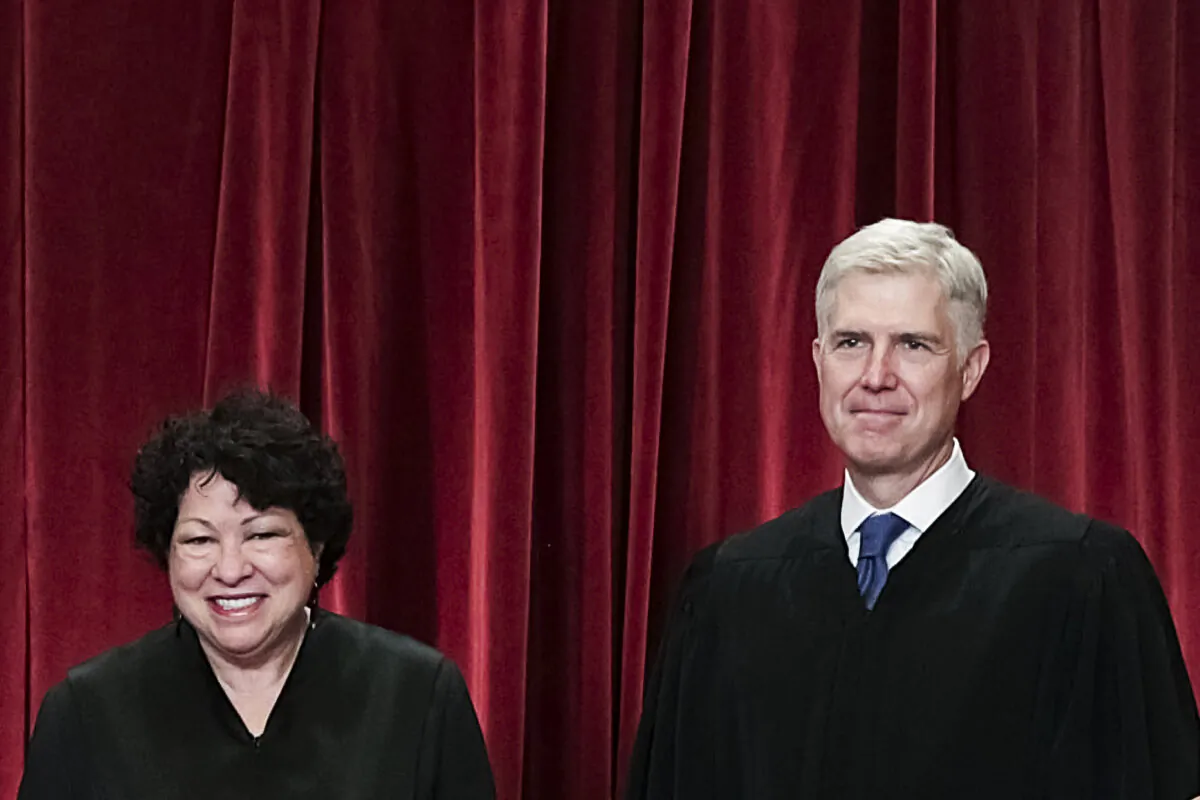

Two Supreme Court justices have said that the prosecution of an illegal immigrant represents serious constitutional issues.
Justice Sonia Sotomayor, in a statement joined by Justice Neil Gorsuch, said the case of an illegal immigrant from Mexico named Jesus Herrera-Salazar revealed a “constitutional absurdity.”
Herrera-Salazar was deported from the United States on multiple occasions, including in 2015. He was found in Texas in 2020 and charged with being in the United States after deportation, in violation of federal law. He pleaded guilty and received a sentence of 15 months in prison, followed by two years of supervised release. Another deportation was not ordered.
Herrera-Salazar was released from prison in 2021 and went to Oklahoma, where his wife and children lived. A probation officer told him not to leave eastern Oklahoma until his period of supervised release was over.
Before the period elapsed, a police officer pulled him over in 2022 and arrested him for being in the United States after deportation. He was convicted in 2024 and deported.
Herrera-Salazar fought the charge, arguing it violated the double jeopardy clause of the U.S. Constitution, or charging twice for the same crime. The U.S. Court of Appeals for the 10th Circuit sided with the government, setting up an appeal to the Supreme Court.
Justices on Tuesday denied Herrera-Salazar’s appeal, and Sotomayor said she respected the decision since Herrera-Salazar had already been deported.
But she said that the case appeared to be an anomaly and underscored “serious constitutional problems.”
“Herrera-Salazar’s second conviction is difficult to square with the Constitution’s admonition that no person shall ‘be subject for the same offence to be twice put in jeopardy of life or limb,’” she wrote.
“As our precedents explain, ‘the Double Jeopardy Clause protects against a second prosecution for the same offense after conviction.’
“The question in a case like this is what constitutes the ‘same offense.’”
The 10th Circuit ruled that the prosecution was valid because Herrera-Salazar was found in the United States following the 2015 deportation in both 2020 and 2024.
“The statute does not provide exceptions for those prosecuted multiple times pursuant to a single removal order,” the appeals court panel said. “Neither does its plain text provide any indication that a ‘found in’ crime must begin with an independent predicate reentry.”
Lawyers for Herrera-Salazar told the Supreme Court in a petition that the decision conflicted with other circuit courts because it treated the offense of being found in the country following deportation as a continuing offense.
“A second, independent found in offense never began, meaning that the prosecution in the Eastern District of Oklahoma constituted a second prosecution for the same offense—a patent double jeopardy violation,” they wrote.
Government lawyers told the court that the prosecution was for a different offense, being found in the country in 2024, not the same one.
Sotomayor said that Herrera-Salazar’s position appeared correct.
“When a defendant is convicted of a crime that involves continuous, uninterrupted conduct, our precedents and the logic of the Double Jeopardy Clause strongly suggest that the Government is barred from charging that defendant with the same continuous crime for a second time simply by focusing on a different time marker,” she wrote, noting that the government forbade Herrera-Salazar from leaving the country before he was arrested a second time.
“Should circumstances like these arise again, I encourage courts to avoid the constitutional absurdity that occurred here and give the Double Jeopardy Clause its full weight and meaning.”
The Department of Justice and an attorney representing Herrera-Salazar did not return requests for comment by publication time.
 Friends Read Free
Copy
Facebook
Tweet
Friends Read Free
Copy
Facebook
Tweet