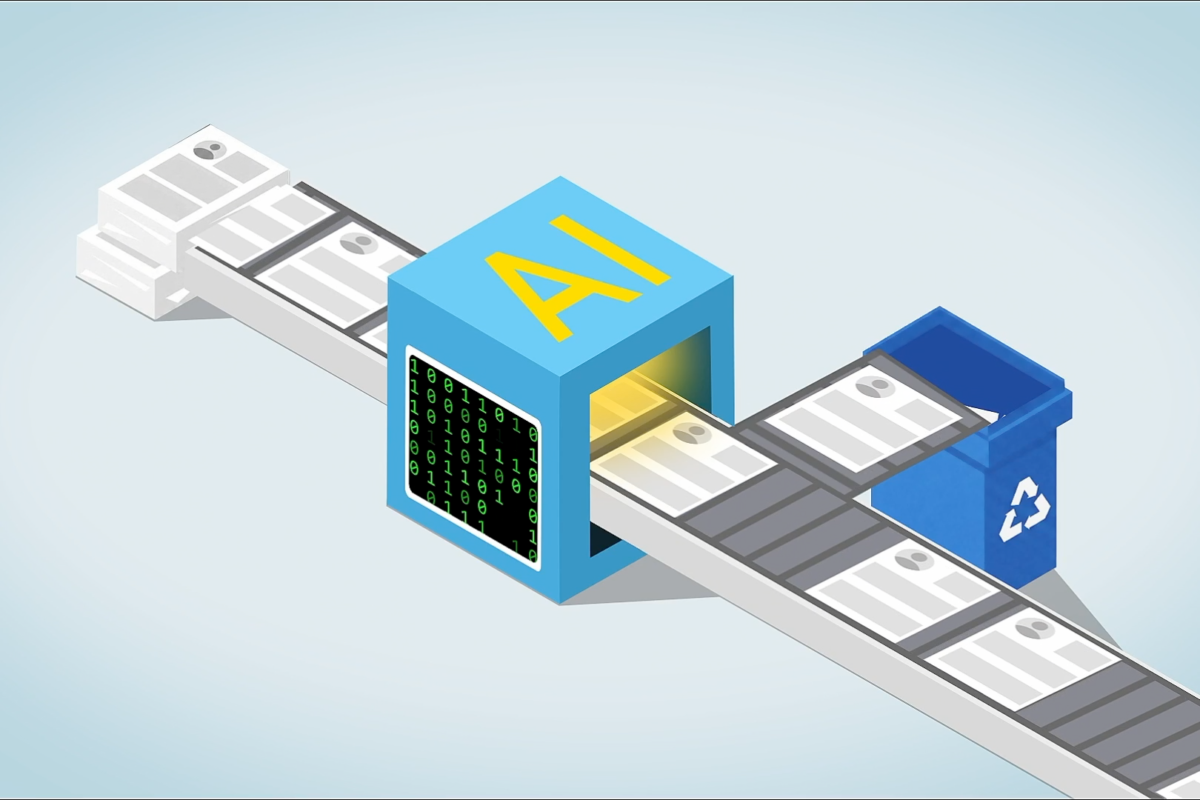
Artificial intelligence (AI) has become a critical threshold that online job seekers must cross, but the technology has presented a unique challenge.
As employers increasingly lean on AI systems to screen, schedule, and evaluate candidates, applicants must learn how to get past the algorithm before reaching human consideration.
More hiring and recruiting professionals are using applicant tracking systems, many of which involve generative AI, according to a report from the International Research Journal on Advanced Engineering Hub. At a glance, these systems help overwhelmed employers sort and prioritize résumés, schedule interviews, and more.
Last year, nearly 98 percent of Fortune 500 companies used some type of applicant tracking system, according to a Jobscan analysis. Research from Select Software Reviews found that 70 percent of large companies—and 20 percent of small- to mid-sized businesses—are using applicant tracking systems.
This has given rise to fears that résumés are being filtered out without any human judgment. Critics have brushed aside these concerns as myth or a misunderstanding of how applicant tracking systems work, according to findings from Enhancv.
However, an Edligo analysis of 1,000 résumés from qualified candidates across multiple industries showed that 43 percent of applicants were rejected for reasons that had nothing to do with their skills. The independent study ran selected, verified résumés through the top three applicant tracking systems platforms: Workday, Taleo, and Greenhouse. The 43 percent rejection rate was due to “formatting, parsing, or arbitrary filter failures.”
People who work in hiring say job seekers’ fears of applicant tracking systems rejecting their résumés aren’t unfounded.
“This isn’t just a claim; it is the fundamental reality of modern hiring,” Gloria Espina, founder of Recruitment Gal, told The Epoch Times.
Espina said job hunting has become a type of “algorithmic audition” that was born out of necessity.
“The ‘easy apply’ button has effectively broken the top of the hiring funnel. It turned applying for a job into a mindless, low-friction swipe,” she said. “As a result, recruiters are flooded with thousands of applications that aren’t even remotely suitable, which completely buries the highly qualified candidates under a mountain of digital noise.”
Espina acknowledged that an applicant tracking system is an essential gatekeeper to manage applicant chaos, but it’s also a rigid one.
“Most legacy systems are painfully literal. They scan for keywords but completely fail to identify entities or context. An algorithm might check the box for the word ‘leadership,’ but it misses the contextual power of ‘scaled a remote team across three time zones during a merger,’” she said. “Context is where the actual value of a candidate lives, but our systems are still grading them on a basic vocabulary test.”
Digital Tripwire
The problem of software rejecting a job applicant without human consideration isn’t a new one.
A 2021 Harvard Business School study found that 88 percent of job candidates were rejected by an applicant tracking system because their résumés didn’t match the posted criteria closely enough. However, the study authors stated that the same applicants were capable of performing the necessary tasks at a “high level” with proper training.
And therein lies the nuance. The sheer volume of job applicants for most posted openings has created the algorithmic audition.
“Many candidates likely don’t realize how many applications the average job posting receives. We often receive 300 [to] 500 applications within a week of posting a mid-level professional role, and using an [applicant tracking system] helps us sort them by relevance and prioritize the queue,” Matt Erhard, managing partner at Summit Search Group, told The Epoch Times.
Erhard said the issue isn’t software. He said the real problem is that many résumés are “unclear, generic, or misaligned with the role,” which makes it challenging for a reviewer to identify candidates who are a good fit.
Alex Chepovoi, CEO of the job search platform Global Work AI, said the first thing to read your résumé “is an algorithm.”
“Applicant tracking systems scan, filter, and reject résumés in seconds based on keywords, education, and experience specifics, and sometimes even demographic indicators,” Chepovoi told The Epoch Times.
He said to pass the “AI gate” and catch the attention of an employer, a savvy job hunter must first optimize his or her résumé for skills.
“Make sure your experience section clearly reflects the keywords used in the job description. If the vacancy says ‘project management,’ don’t just say ‘led initiatives,’ say project management,” he said.
Another recommendation Chepovoi offered was minimizing personal data on the résumé.
“Age, exact address, even gender indicators can unintentionally trigger filters. Focus on professional value.”
Gregg Podalsky, president of American Recruiting & Consulting Group, said candidates should focus on creating tailored résumés that match the job description.
“The real issue is alignment. If a résumé does not clearly reflect the skills and requirements outlined in the job description, it may rank lower and never get serious consideration. That is not a flaw in the technology; it is a mismatch in presentation,” Podalsky told The Epoch Times.
He said it’s critical to mirror the language of the job description where appropriate, clearly list measurable accomplishments, and make skills easy to identify.
“Avoid overly creative formats that [applicant tracking] systems cannot parse properly. Clarity, structure, and relevance matter more than design,” Podalsky said.
Getting past the initial AI gatekeeper and not ending up at the bottom of a list is a challenge that’s recognized across the board. In January, the job search engine Indeed published a list of best practices for “beating” applicant tracking systems, which includes avoiding acronyms, adding a skills section, using relevant keywords, and submitting the correct file type.
In the Edligo study, 23 percent of résumés were rejected because of an inability to read the file, and another 12 percent were declined because of formatting issues.
The Details
Sleek, clever formatting can actually do more harm than good when it comes to getting your résumé in front of an actual person.
“To survive the filter but stand out to the human on the other side, you must anchor those keywords to measurable outcomes,” Espina said.
“Eliminate the fluff, the generic soft skills, and the complex formatting. Nobody cares that you are a ‘highly motivated team player.’ Take out the objective statements, the heavy graphics, and the columns. Those break in the [applicant tracking system].”
Podalsky said he agrees that job seekers should eliminate vague phrases such as “team player” or “results-driven” and replace them with evidence.
“In 2026, strong résumés will focus on impact. Quantifiable results, specific tools used, and clear examples of problem-solving stand out,” he said. “Authenticity, relevance, and measurable contribution will always outperform keyword stuffing or AI-polished fluff.”
Erhard concurred, saying: “Hiring managers today want evidence of impact. Candidates should add quantified achievement, including the scope, metrics, and outcomes.”
As an example, he said that writing “led a team of eight and reduced project delivery times by 20 percent” would be better than just listing responsibilities on a résumé.
“What candidates should eliminate is fluff like generic buzzwords or long summary paragraphs,” Erhard said.
Being specific has become critical for job applicants amid the rise of generative AI. In a 2025 Job Target analysis, 46 percent of the study group used AI tools such as ChatGPT and Google Gemini to create their résumés.
Today, people on the recruiting and hiring end are swimming in generic, AI-generated résumé content, but employers are catching on.
“Hiring professionals are becoming better at spotting language that lacks specificity or real-world detail,” Podalsky said.
Erhard agreed, saying: “Experienced recruiters spot these quickly because the résumé might read well but doesn’t tell a believable story. AI can be a helpful tool, but I’d caution candidates against relying on it too heavily.”
He said he believes that overusing AI can make a candidate sound “generic and indistinguishable from everyone else,” and that using the AI approach can get an applicant’s résumé bumped to the bottom of the stack.
Espina said she believes that the surge in AI-generated résumés is evidence that candidates are leveling the playing field.
“Companies need to combat this with structured interviews and performance profiles, not just AI detection tools,” she said. “If you are hiring based on whether someone used ChatGPT to polish their grammar rather than their actual ability to solve business problems, your hiring system is fundamentally broken.”
 Friends Read Free
Copy
Facebook
Tweet
Friends Read Free
Copy
Facebook
Tweet