
Though invisible, dark matter is thought to comprise over 70 percent of our universe’s mass. It can only be detected by its gravitational effects on visible matter, including light.
The survey will investigate previous research that implies clusters contain more dark matter than predicted by some models, and that suggests galaxy clusters formed earlier than realized.
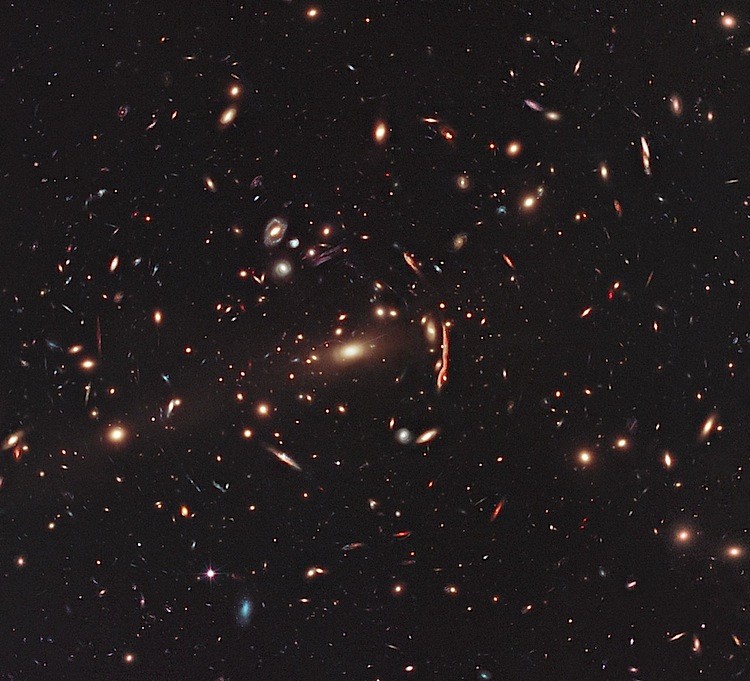
One of the first clusters surveyed is MACS J1206.2-0847, or MACS 1206, which is four billion light-years away.
Clusters like these are ideal for studying the gravitational pull of dark matter, because they are the biggest known structures in the universe to be bound together by gravity.
Their powerful gravity makes clusters behave like enormous lenses, a phenomenon called gravitational lensing, affecting light as it passes through. This effect can also generate more than one image of distant objects, as seen in this photo from the Hubble Space Telescope (HST).
Measuring such distortions can reveal the mass of the cluster and its distribution. Strong distortion shows that much of the cluster is dark matter, because visible matter only produces weak gravitational effects. The CLASH team captured 47 multiple images of 12 new remote galaxies in MACS 1206 using the HST.
In conjunction with the survey, the European Southern Observatory’s (ESO) Very Large Telescope (VLT) is collecting spectographic data to determine the distance to and the composition of the cluster galaxies.
The clusters are thought to have formed between nine billion and 12 billion years ago. If the majority of the clusters to be mapped have high dark matter content like MACS 1206, this could provide new insights into the structure of our early universe.
 Friends Read Free
Copy
Facebook
Tweet
Friends Read Free
Copy
Facebook
Tweet