
What started out as a university project has evolved into an innovative online learning tool that aims to help preserve the Cree language.
After designing a children’s book for a project in her Cree studies class, former University of Alberta student Caylie Gnyra was inspired to create a series of free online e-books that introduce young learners to the Cree language.
“What Colour Are Your Little Ducks?/Tân’sesinâkosiwak kisîsîpimisiwâwak” was the title of her first electronic book, written in Plains Cree text with English translation, which Gnyra made available online free of charge at littlecreebooks.com
The colourful books introduce young learners to a string of characters and their rainbow-hued pet ducks.
With some funding through the Social Sciences and Humanities Research Council of Canada via the Faculty of Native Studies, Gnyra also developed material that could be used in Cree classrooms throughout Alberta, viewed on SMART boards for group reading, printed off for individual use, or even viewed on tablets and smartphones at home.
Although she is not aboriginal and is still learning to speak and write Cree herself, Gnyra said she was enchanted by the language and resolved to help preserve it.
“Cree is a very pretty language to the ear and it has a lot of humorous or thought-provoking aspects. Learning it helps me recognize how culture really is embedded in all languages, including English,” she said.
Fostering Introspection
A self-described introvert, Gnyra said she was drawn to the language in part because of the many ways that Cree culture values and facilitates introspection.
“North American culture tends to promote and validate extroversion, so I think one of the reasons I am so interested in spending time learning about Cree culture and language is that I feel like that very integral part of me is valued.”
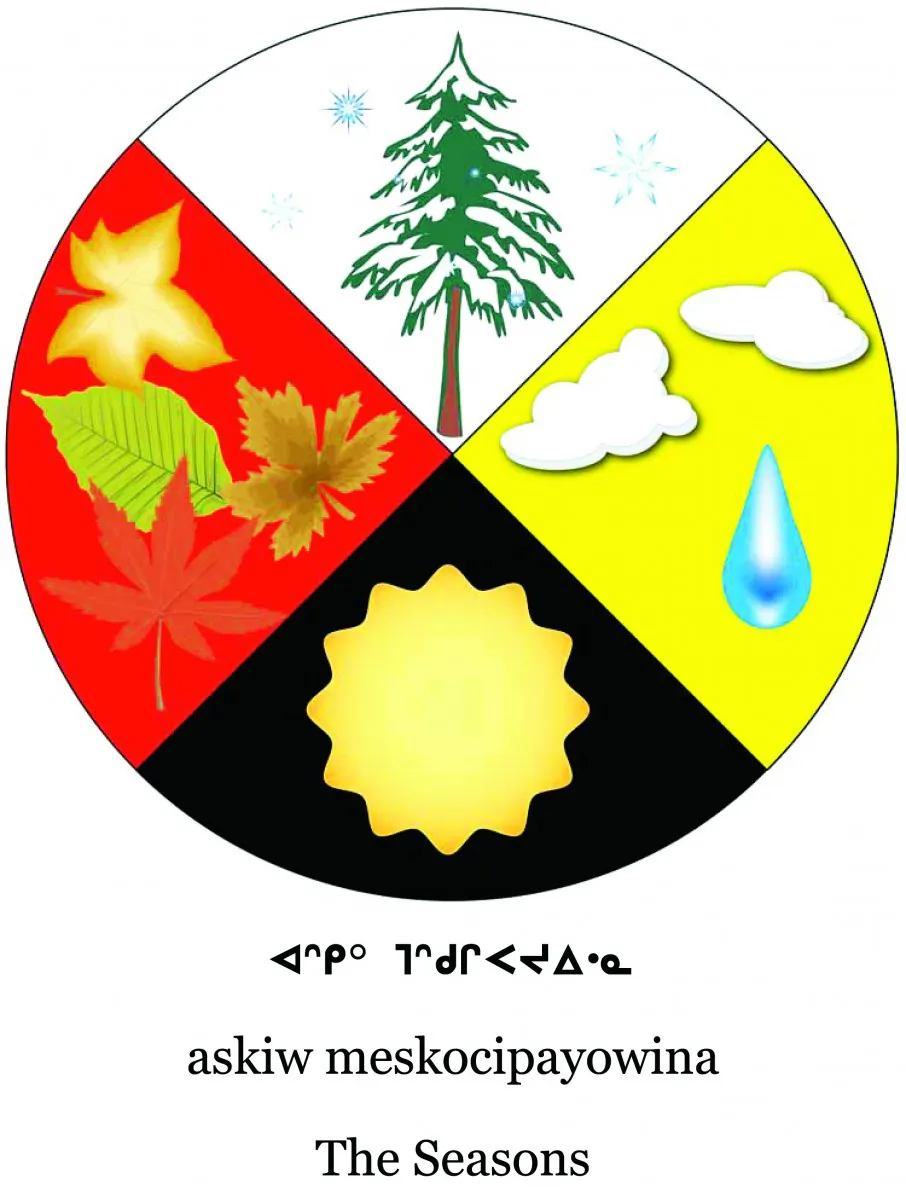
Following her first publication, she has since added two more e-books to the series: one about the seasons, written for a Grade 1 reading level, and one about the daily life of a young bear, for kindergarten children.
Both are designed to work well with the Alberta’s established Cree language education curriculum, and Gnyra hopes to add at least five more e-books to the lineup of her Cree readers for grades 2 through 6.
Collaboration is also a cornerstone of the project and Gnyra hopes to attract both Cree and non-Cree contributors who can share their ideas, artwork, and writing. She also invites instructors of other Algonquian languages to adapt the books to reflect the grammar and vocabulary of their languages, which are closely related to Cree.
Cree in Canada
According to the 2011 census, Cree is one of the most widely spoken Aboriginal languages in Canada, with some 83,475 people claiming it as their mother tongue. Cree speakers lived mainly in Saskatchewan, Manitoba, Alberta, and Quebec.
Cree, Ojibway, and Inuktitut were the three most common of the 60 aboriginal languages reported in the 2011 census, representing nearly two-thirds of the 213,490 people who claimed one as their mother tongue. That’s down by about 3,620 people, or 1.7 percent since 2006, according to Statistics Canada.
In 2005 a task force commissioned by the Department of Canadian Heritage submitted a report to the federal government on how to preserve aboriginal language and culture.
One of the report’s recommendations included the creation of a $160 million national centre to help preserve, revitalize, and promote aboriginal languages and cultures. The recommendation was never adopted but an Aboriginal Languages Initiative was developed, which offers funding for revitalization projects.
In 2009 an online language portal, which includes a dictionary and curriculum-based resources, was launched by the Department of Canadian Heritage to help further the development of the Cree language in Canada.
Disappearing Languages
According to the United Nations Educational, Scientific, and Cultural Organization (UNESCO), approximately 600 languages have disappeared in the last century, and continue to disappear at a rate of one language every two weeks.
If this trend continues, up to 90 percent of the world’s languages are likely to be lost before the end of this century.
Because the loss of a language equates to the loss of the collective wisdom, knowledge, customs, and identity of a cultural group, UNESCO has said the preservation of Indigenous languages such as Cree is a “matter of great urgency.”
 Friends Read Free
Copy
Facebook
Tweet
Friends Read Free
Copy
Facebook
Tweet