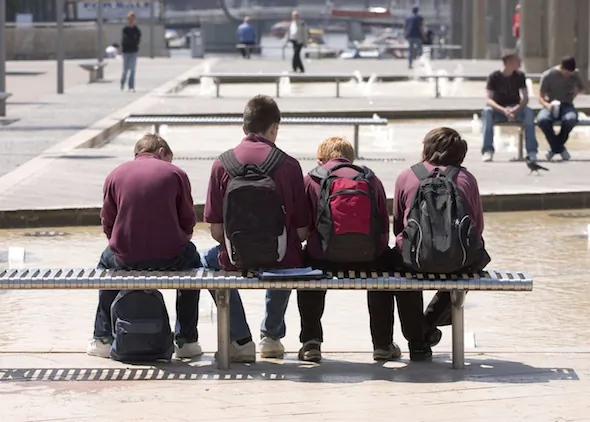

A recent study by Barnardos found that Irish households are under increasing pressure to pay for costs of sending their children to school.
Barnardos has been carrying out this survey for the past seven years, and every year it shows that parents complain about the high costs. This year, however, was worse then usual.
“Many parents are being forced to make very difficult choices and many are getting into debt to pay for uniforms, books, and other education expenses,” Fergus Finlay, CEO of Barnardos, stated in a recent press release.
The survey collected answers from 987 parents throughout Ireland. It found that while costs in most cases have been lower than the years before, the income reductions in many households are making it harder and harder for parents to pay for their children’s education. Also, the Back to School Clothing and Footwear Allowance was reduced by 50 euro for primary school children and 55 euro for secondary school children.
According to the survey, sending a child to school costs parents on average 355 euro for senior infants, 390 euro in 4th class in primary school and 770 euro in first year in secondary school.
For many families this is becoming too expensive. Some statements by the parents who took part in the survey convey this quite dramatically. One parent said:
“We cut back on food and let other bills go unpaid to ensure children have what they need for school … We’re living on the edge all the time. So much for free education.”
The increasingly severe situation can also be seen in the number of children benefiting from the Back to School Clothing and Footwear Allowance. According to Mr Finlay, the number more than doubled to 384,000 this year from 180,252 in 2007.
But also those that do not benefit from the Back to School Clothing and Footwear Allowance in many cases seem to be unable to bear the financial burden alone.
One parent who took part in the survey said: “Our spiralling financial situation has meant seeking help from SVP [St Vincent de Paul] for the first time for an electricity account as a matter of emergency—a very undignified and depressing situation to find myself in but every balance I owe is now late; token part-payments being the only way I can keep the wolves from the door and I am struggling to see any light at the end of the tunnel.”
Many seem to be in a similar situation. St Vincent de Paul is approached much more often by parents who can’t afford the school costs this year, according to The Clare Champion.
The major strains on the budgets are school uniforms, especially those with crests, the survey showed. Other big cost factors are school books and voluntary contributions schools are asking for.
School Uniforms
15 per cent of the parents who took part in the survey said that their children’s school uniforms cost more then 250 euro. The factor driving up the prices seems to be that uniforms with crests are much more expensive than plain uniforms.
Simon Harris, Fine Gael TD for Wicklow, commented on the fact that 72 per cent of the primary school pupils and 97 per cent of the secondary school students need to get crested uniforms by stating in a press release that: “Students should be allowed to wear a plain uniform or even have the option to sew on the school crest to save money on the cost of uniforms.”
This idea is not new. A study by the Bank of Ireland Life made in 2010 found that “Three-quarters of parents think that school uniforms are too expensive, with 90 per cent advocating the idea to introduce a school crest badge which could be affixed to a standard uniform that could be bought in a supermarket.”
Donations
Another big factor is voluntary donations to the schools. Those contributions are usually due up front in September or October thus adding to the parent’s financial burden, Mr Harris said. Unfortunately the survey discovered that these donations are not entirely voluntary. According to The Irish Examiner, Barnardos’ CEO Mr Finley even spoke of emotional blackmail.
One example of the parents’ statements that was published by Barnardos gives an insight into the subtle details that make parents feel that contributions are not entirely voluntary.
“Voluntary contribution is not voluntary because the kids that do not pay get a different coloured letter a few months later to remind us to pay, so everyone knows we haven’t paid and it is very embarrassing for the children.”
School Books
School books posed a special problem. The survey revealed that school books in many cases cannot be passed onto the siblings or be sold second-hand. This is due to the fact that oftentimes new books are introduced every year. Also Irish schools seem to rely heavily on workbooks.
To remedy the first matter school book publishers last year formulated a Code of Practice in which they agreed to only publish new editions after significant changes, so that books are in use longer.
According to Mr Harris the effects of this Code of Practice are not felt by parents yet. He stated that a rental scheme for school books is the obvious solution for him. He, however, said that such a rental scheme, which is recommended by the government, is only available in half of the public schools at the moment.
St Vincent de Paul too is in favour of a wider implementation of the book rental scheme. “The rental schemes are the way forward. You see them around the world. In the UK and all across Europe, you find book rental schemes,” Mr Cathal Oakes from the Clare branch of the Society told The Clare Champion.
Barandos also gave a suggestion on how to remedy the school book situation. Their plan is based on approaches in Scotland and Northern Ireland, who according to the CEO of Barnardos are facing similar problems. The plan basically suggests that schools year by year buy the books for some subjects for the whole school. Then these books are lent to the pupils for free. The number of subjects the books are provided for by the school rises every year. When at some point all books are provided by the school, parents shall only pay a nominal fee to allow the school to replace damaged books. The schools shall cover the costs by using their School Book Grant.
The Epoch Times publishes in 35 countries and in 19 languages. Subscribe to our e-newsletter.
 Friends Read Free
Copy
Facebook
Tweet
Friends Read Free
Copy
Facebook
Tweet