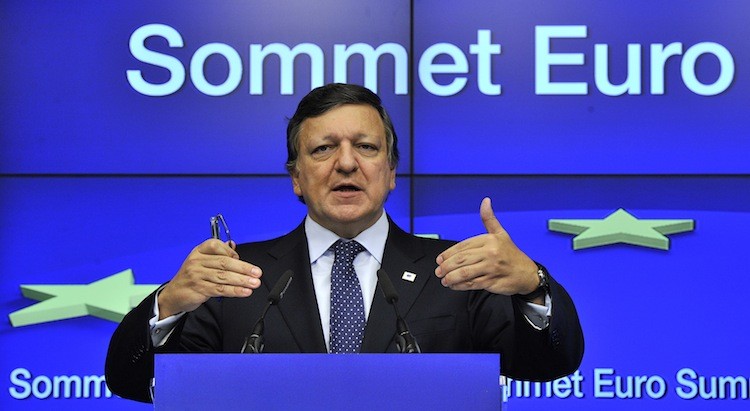
After 10 hours of intense talks in Brussels, eurozone leaders walked away in agreement of a far-reaching, three-pronged plan to combat the festering European debt crisis, recapitalize the region’s embattled banks, and increase the pot of EU’s bailout fund.
Although the end result was not very detailed, it was full of intention and a welcoming development given the nervousness regarding EU unity in the days leading up to the summit.
First, officials proposed a plan agreed upon by the creditors to enforce a 50 percent write-down on Greek debt. This plan will reduce Greece’s current debt burden to roughly 120 percent of the Mediterranean nation’s GDP by 2020. While still high, it will be a reasonable goal given passage of austerity measures.
EU’s bailout fund European Financial Stability Facility (EFSF) will also be increased to roughly 1 trillion euros ($1.4 trillion), which will invest in (and in turn, insure against) sovereign debt. This fund will be used to guarantee bonds from nations such as Spain and Italy, which are too large to be bailed out. This increase in capital, European leaders hope, will be partially financed by investments from other nations such as China.
Since all of this will be taxing for the region’s banks, regulators will also ask banks to raise additional capital—roughly 106 billion euros ($149 billion). Spanish banks need 26.2 billion euros ($37.2 billion) and Italian banks need 14.8 billion euros ($21 billion), according to the officials. French and Portuguese banks will also need to raise additional capital, but Irish and British banks are spared.
“Europe will do what it takes to safeguard financial stability,” said Jose Manuel Durao Barroso, president of the European Commission, in a statement released on behalf of the commission. “The technical work needed to finalize certain aspects of this package will be completed by the relevant authorities in the coming weeks.”
“While lots of technical details will have to be clarified and agreed upon in the coming weeks so as to implement the summit conclusions, our first takeaway from yesterday’s official statements is positive,” Barclays Capital wrote in a research note on Oct. 27. “The policy response is comprehensive, targeting the relevant problem areas and provides decisive support to overall risk sentiment in financial markets and the broader public at a time the euro area economy is close to sliding into recession.”
In the new plan, Greece will get an additional 100 billion euros ($142 billion) to help stabilize its economy.
US Shares Get Boost
Stocks in the United States received a boost Thursday after the framework of the EU’s meeting was released.
The Dow Jones Industrial Average soared 340 points Thursday, for a gain of 2.9 percent. The S&P 500 Index gained 43 points, or 3.4 percent, and the Nasdaq Composite Index climbed 88 points, or 3.3 percent. It was the first time the Dow surpassed 12,000 points since August.
The biggest gainers were financial shares, which were boosted by news out of Europe that a larger bailout fund may guarantee certain sovereign debt securities. The energy industry was propelled by the price of oil, which rose due to a weaker U.S. dollar. In addition, oil and gas giant ExxonMobil announced quarterly earnings surpassing $10 billion, or $2.13 per share, which is above analysts’ expectations.
Raising Cash
While the EFSF currently has 440 billion euros ($625 billion) in its coffers, much rests upon the procurement of the balance of the required funds.
“There is no guarantee that this can be done. The eventual outturn of this summit will depend on whether this missing €1,000 bln (billion) can actually be raised,” Financial Times columnist Gavyn Davies wrote in a blog Thursday.
One of the target investors into the fund is China, a nation that has a large amount of foreign reserves. French President Nicolas Sarkozy spoke with Chinese leader Hu Jintao on Thursday, and a full EU delegation, led by EFSF (European Financial Stability Facility) President Klaus Regling, will travel to China later this week for talks.
There is no guarantee that China will contribute to the fund. European officials had also hoped that Brazil would be open to buying European debt, but Brazilian Finance Minister Guido Mantega shot down those rumors, saying that the South American nation would not make such purchases.
 Friends Read Free
Copy
Facebook
Tweet
Friends Read Free
Copy
Facebook
Tweet