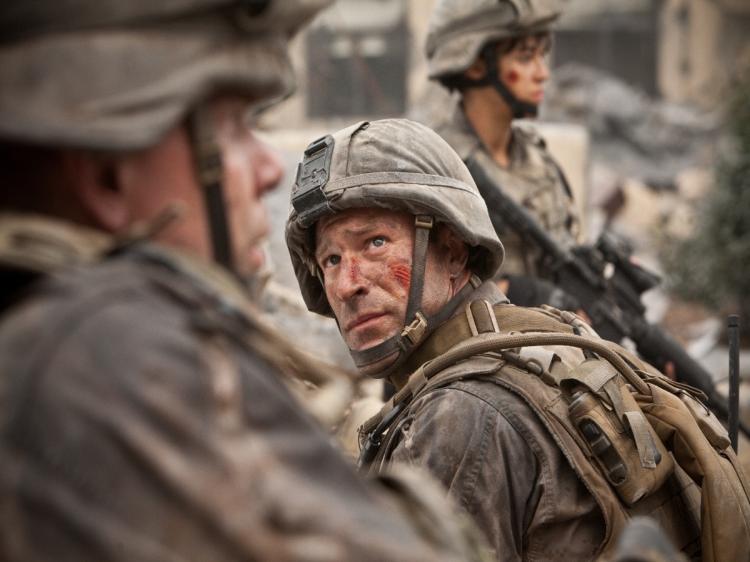
The story begins with a beautiful California day and a morning run along the sandy ocean blue. Nothing seems out of the ordinary as we are introduced to Staff Sergeant Michael Nantz (Aaron Eckhart), icing a sore knee in his twilight years.
Nantz served for 20 years in the Marines and recently decided that he’s too old to keep playing the game. But just as his papers are signed and he is walking off the base, his veritable call-to-action arrives.
Astrological observatories are detecting meteor-like objects, and major cities across the world are reporting the arrival of more. What are these oddities, and why wasn’t NASA able to detect them until now? Evacuation orders have been given for civilians to vacate their homes, under military supervision.
Accepting his fate, Nantz suits up. But will there be a conflict with his new superior officer, fresh-out-of-the-academy 2nd Lt. Martinez (Ramon Rodriguez)?
A man with a well-refined character, throughout the film Nantz switches between insightful male patriarch figure and heroic action-oriented leader; he is a stoic yet sensitive Marine. Unfortunately, he has a bad reputation for losing soldiers under his command and placing his own survival as the most important objective. Can Nantz win the support of his men and simultaneously win the battle against this unknown threat?
The enemy in Battle: Los Angeles is an unfamiliar force that appears both organic and robotic, rooted in a fresh science-fiction-based design. The mystery that surrounds its origin is left in the shadows, yet with nothing lost in the cinematic process.
The movie’s focus on the lone squadron of warriors as they struggle to rescue civilians, escape from West L.A., and defeat their newfound foes is captivating all the way to the end.
Nantz receives his orders to rescue civilians holed up in a Santa Monica police station. With three hours to complete the objective before a citywide missile strike, can his squadron rescue the civilians? Furthermore, can his men make it there in one piece?
One of the most striking features of “Battle: Los Angeles” is that it brings a violent and life-altering war to American soil. The portrayal of Los Angeles is extremely realistic and accurate, from citywide shots to individual street signs, maps, and public transport. The concrete jungle comes to life through death and destruction amid an ever-expanding cityscape.
As a Los Angeles resident, I found it rather odd to watch my own home city turn into a smoldering crater. Ironically, the iconic theater I watched the film in was transformed into a mound of burning rubble. Watching the entire City of Angels go up in red-hot flames, including famous landmarks and downtown towers, was a bit surreal.
Read More . . . cinematography, battle scenes
 Friends Read Free
Copy
Facebook
Tweet
Friends Read Free
Copy
Facebook
Tweet