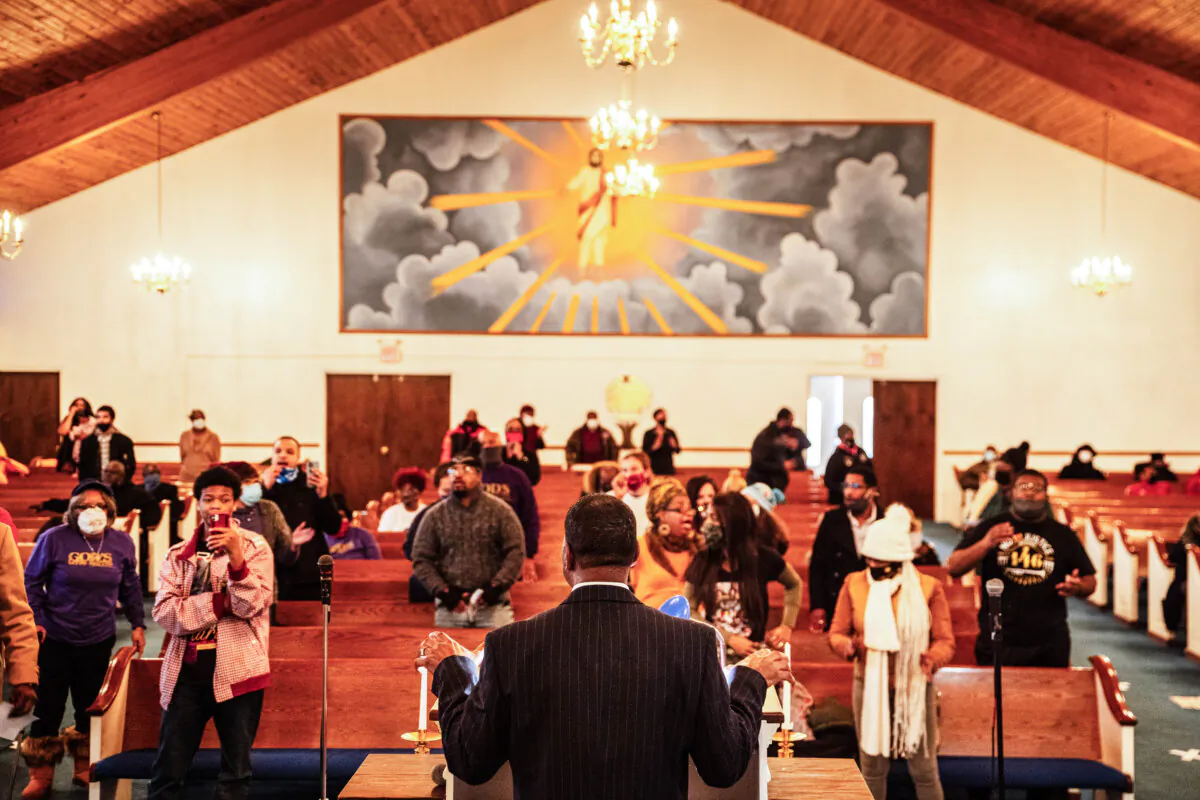

A national survey of 1,000 regularly attending churchgoers has found that core Christian beliefs and traditional views continue to erode, revealing what researchers call a widening chasm between evangelical Christian identity and biblical conviction.
The full report, Social Issues and Worldview: A National Survey of Churchgoing Americans, was released on Nov. 13. The study, commissioned by the Family Research Council (FRC) and conducted by the Cultural Research Center at Arizona Christian University, tracks worldview, political identity, and moral beliefs among adults who attend Christian worship services at least once per month.
The study found that 34 percent of churchgoing adults now identify as conservative on social and fiscal issues, while 29 percent call themselves moderate and 19 percent liberal or progressive. The greatest change was found among those identifying as “moderate,” up by 10 percent in two years, with only “modest” increases for those calling themselves “conservative” or “liberal/progressive,” researchers said.
One in three churchgoers surveyed (32 percent) prefers socialism to capitalism, a figure nearly unchanged from 2023. That finding takes on some added heft in the wake of democratic socialist Zohran Mamdani’s election as New York City mayor on Nov. 4, followed by self-proclaimed socialist Katie Wilson’s victory in Seattle’s mayoral election this week.
Fewer than half of regular churchgoers (46 percent) said they reject socialism in favor of capitalism, and nearly one-quarter (22 percent) said they did not know which economic system they prefer. Those numbers are “statistically unchanged” from a 2023 survey, according to the pollsters.
The results come roughly one year after self-identified Christians proved decisive in returning President Donald Trump to office, researchers said.
The survey took place in July and incorporated responses from 1,003 adults aged 18 and older who attend worship at a Christian church at least once per month. The range of churches spanned those describing themselves as “born again,” “not born again,” Catholic, Protestant, white, and nonwhite.
“This generation of churchgoers is increasingly unsure of what they believe, or why,” said George Barna, the study’s director and FRC senior research fellow, in a statement. “It is embarrassing how poorly informed the Christian community is about the foundational perspectives and applications of its faith. The all-too-common dismissal by Christians of the importance of worldview reflects their indifference to their palette of religious beliefs and its integration into their lives.”
Compared with 2023, the share of “moderates” jumped by 10 points—a shift partly attributable to an increasingly volatile political environment. Although 93 percent of churchgoers are registered to vote and 84 percent consider themselves consistent voters, fewer are grounding their decisions in Scripture. Fewer than half, 46 percent, said their vote is primarily shaped by biblical principles and candidate character.
A growing share of churchgoers do not know whether they possess a worldview at all—45 percent in 2025, up from 38 percent in 2023—while 30 percent believe that they hold a biblical worldview, although doctrinal analysis by Barna suggests that the real number is far lower: 11 percent.
Along with a decline in holding a Christian worldview, churchgoers are also losing faith in the Bible as “the true or inspired Word of God without error,” the survey found. A bare majority—54 percent of those surveyed—agreed. Other respondents describe it as one among many sacred texts (16 percent), inspired but flawed (15 percent), or simply a literary work (7 percent).
The number of those affirming belief “in the God described in Scripture” as all-powerful, all-knowing Creator ruling the universe today fell to 61 percent today from 68 percent in 2023.
Churchgoers are significantly less likely than two years ago to say Scripture is “clear and decisive” on contemporary moral questions. Respondents were 10 percent less likely to say the Bible is authoritative on defining marriage. They recorded a 14 percent drop in saying the Scriptures speak definitively about abortion, 12 percent less certain about its view on homosexuality, and 16 percent less confident in the Bible’s stand on transgenderism.
“Overall, this report is deeply sobering,” said David Closson, director of FRC’s Center for Biblical Worldview. “But the larger picture is alarming. The data reveals widespread confusion about the most basic truths of the Christian faith.”
Closson emphasized optimism if churches reclaim historically biblical teaching: “Our calling is to turn biblical illiteracy into biblical literacy—and to ensure that the next generation of Christians is equipped to think and live according to a thoroughly biblical worldview.”
According to Barna, the results show there’s work to be done.
“We have seen these faith patterns taking shape over the past three decades,” he said. “The combination of ignorance and apathy represents a tremendous opportunity for committed followers of Christ and church leaders to clearly and unapologetically address the fundamentals of the Christian faith in ways that will lead to transformed lives in our spiritually confused society.”
Closson also saw hopeful signs.
“The good news is that this kind of clarity and conviction can be recovered,” he said. “As the research shows, there’s still a strong foundation of spiritual interest and participation in local churches. But it’s time for that activity to be grounded once again in truth.”
 Friends Read Free
Copy
Facebook
Tweet
Friends Read Free
Copy
Facebook
Tweet