The world’s developed economies have been struggling to recover from the economic meltdown caused by financial institutions’ excessive risk taking and lax risk assessment.
In short, the world’s economic disaster and associated recession were caused by the banking sector’s lack of due diligence.
In 2008, the mortgage crisis, precipitated by the financial industry, hit America first and then the rest of the world, resulting in bankruptcies, high unemployment, and finally the downgrade of America from the coveted rating of AAA to AA+ by Standard & Poor’s (S&P).
S&P first claimed debt issues as the reason and when taken to task about a faulty method, it claimed political uncertainties for its decision. S&P never admitted that it is not a credit agency’s prerogative to take political issues under consideration as the sole criterion or at all. None of the other international credit agencies, such as Fitch and Moody’s, downgraded the United States.
The Chinese Dagong Global Credit Rating Co. is a small player in the international arena and is not recognized as an international rating agency. Financial analysts do not trust Dagong because it is believed to be a tool of the Chinese regime. It assigned an AA rating to the United States in July 2010 and put the United States on negative watch in November 2010, downgrading it to an A+. On July 14, it downgraded the United States to an A, retaining the negative outlook.
Questioning U.S. solvency, Dagong said in its press release that the squabbling between the Democrats and the Republicans over the debt ceiling was “a turning point for the US government’s solvency to decline even further.”
The above is just a precursor to the continuing global economic dilemma, with many experts suggesting that another recession is in the offing. On such news, the markets reacted quickly with stocks taking a nose dive in September and global investors unloading stocks and bonds.
Gold tumbled from an all-time high of $1,895 per ounce on Sept. 5 to $1,657 per ounce by market close on Sept. 23, and silver closed at $30.93 per ounce on Sept. 23, after having reached $42.71 per ounce on Sept. 5, according to Kitco historical charts.
On Sept. 23, the Dow Jones Industrial fell by 3.64 percent to 10,733.83, down 391.01 points. The NASDAQ was down 3.36 percent to 2,455.67, down 82.52 points. The S&P 500 was down 3.29 percent from 1,129.56, down 37.2 points.
It is no surprise that investors fled to the relative safety of U.S. Treasury bonds and notes. As of the end of August, the U.S. Treasury cash balance returned to its historic standard level of $44.5 billion, up from its Aug. 17 level of $10.9 billion, which was by far the lowest level since 2008, according to the Gresham’s Law website, a website that provides economic insight, often based on the theories promulgated by the Austrian School of Economics.
Well, the stock market is rather fickle, as by the Sept. 27 closing, on news that the Europeans are mulling over whether to shore up their banks, which might collapse otherwise, the Dow Jones Industrial was at 11,109.69, the NASDAQ moved up to 2,546.83, and the S&P 100 hit 1,175.36.
On the same day, gold prices were still moving downward, reaching $1,650.92 per ounce, while silver edged up slightly to $31.87, according to the goldprice.org website.
Over the past weeks, voices were growing louder, more negative than positive, with the latest coming from the World Economic Forum (WEF) and the International Monetary Fund (IMF). Dire consequences are foreseen over the coming year unless economies cooperate and develop policies that are less bureaucratic, but address the issues that so far have put the economies on a downward spiral.
Digging Into Global Economy Issues
In a recent WEF survey of more than 1,000 economic experts from the public and private sector, less than 10 percent of those surveyed are still open-minded and believe in an accelerated recovery over the next year.
More than half of the survey respondents feel gloomy and have lost confidence in the global economy, believing that countries will look more inward than outward and will attack issues on their own, putting cooperation aside for the time being.
“Lack of confidence in the state of the global economy is not surprising, but the corresponding lack of confidence in global governance and global cooperation is far more troubling,” said Lee Howell, managing director at the WEF.
In its 2011 Global Risk Report, the WEF identifies two major concerns that hinder the global economy from improving: economic inequality, not only among nations, but also on national levels, and a malfunctioning global governance system.
Lack of cooperation is clearly the main driver of the Doha Development Round of the World Trade Organization, with no agreements in sight, and also the failure to come to an accord during the Copenhagen Conference on Climate Change.
G20 is being brought forward as a possible savior of the global economy, although the WEF cautions that this group so far has been rather inactive in addressing whatever ails the global economy.
G20, formed in 1999, was hoped to bring developed and emerging nations to the table to achieve trade and other agreements. The members are the eight developed nations that include the United States, Canada, France, Germany, Russia, and the U.K., and 11 emerging market countries, including Australia, Brazil, China, India, Mexico, South Africa, and Turkey, with each country represented by finance ministers and central bank governors. The G20 countries account for approximately 85 percent of the world’s trade and contribute around the same percentage to the world’s economic growth.
Bleak Outlook
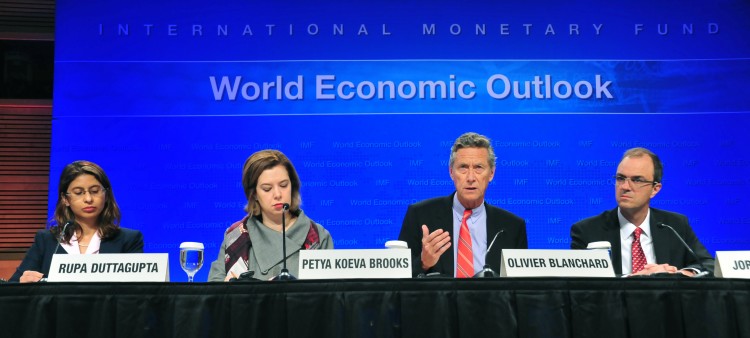
“The global economy has entered a dangerous new phase. The recovery has weakened considerably, and downside risks have increased sharply,” said Olivier Blanchard, director and economic counselor at the IMF, during a press briefing, published on the IMF website.
In a 241-page report, the IMF said that consumers and organizations have curtailed their purchasing habits. Purchasing power has been affected by high unemployment and hoarding of cash by companies and financial institutions refusing to feed funds back into the private sector.
“Growth, which had been strong in 2010, decreased in 2011,” said Blanchard in the press briefing.
This year’s economic rehabilitation was affected negatively by the Japanese earthquake, the euro zone debt crisis, and the U.S. oversized federal deficit.
The world worries about Europe’s, Japan’s and the U.S. government’s inability to deal with high debt burdens. Corporate and financial sectors are clueless what the next day will bring, beyond more expensive regulations, and thus sit tight.
The IMF toned down its World Economic Outlook forecast for global growth in 2011 and 2012 by 1 percent, down from the 5 percent in 2010.
The IMF projections assume that Europe will be able to act swiftly concerning Greece, Italy, and other heavily indebted nations. At the same time, the IMF based its forecasts on the assumption that U.S. policymakers will be able to come to grips with reality and take action instead of continuing to bicker.
Policymakers must bite the bullet by reducing the public debt, not hesitate to cut the budget without stalling growth, improve the equity of its financial sector, and shrink the budget deficits, with fingers pointed at the United States.
Blanchard calls for a rebalancing act that has to be cooperative between the public and private sectors, which means governments, corporations, and consumers.
Rebalancing demands that governments curtail regulations that could hinder growth and reduce spending to a minimum; corporations open their coffers, start capitalizing their companies, and hire the unemployed to improve purchasing power; and firms begin to increase their purchasing activities.
“What is needed to sustain growth is that households and firms increase their demand as fiscal deficits are being rolled back,” Blanchard said.
Economic Growth Affected by Financial Regulations
“The cumulative impact of regulatory reforms now underway in the financial services industry is adding to the headwinds that the global economy faces at a time when economic growth—notably in the United States, Japan and in Western Europe—is already disappointingly weak,” according to a press release from the Institute of International Finance Inc. (IIF), rolling out its most recent economic analysis on the subject matter of financial regulatory reform.
The report suggests that recently developed financial regulations, not just in the United States, but worldwide, which address the problems that hastened the last economic upheaval, although relevant, are curtailing the financial industry’s ability to react to market forces and bringing with them an unsustainable cost that negatively affects job growth.
The overall effect could include on the average a 3.5 percent increase in interest rates, which could decrease industrial output by 3.2 percent over that period, given the cost of borrowing.
The IIF suggests that regulators balance the need for regulatory requirements, which definitely are needed, with market realities and cost factors.
Developing regulations that would fit all countries is unrealistic. Mostly it will depend on the given country’s need for financing, the existing regulatory environment, and the trading activities, be they export or locally oriented.
“The research found that the impact of regulatory reforms will vary significantly in different leading advanced economies, depending in part on the extent to which these economies depend on bank finance and the scale of capital raising to be undertaken in these countries,” according to the IIF press release.
 Friends Read Free
Copy
Facebook
Tweet
Friends Read Free
Copy
Facebook
Tweet