
The U.S. and Israel launched a massive attack against Iran on Feb. 28 that killed regime leader Ali Khamenei and dozens of other senior officials.
At least six U.S. soldiers were killed during Operation Epic Fury, and the Trump administration predicted the conflict will last several weeks.
Strikes from the U.S.-Israeli operation and retaliatory attacks from Iran caused airspaces across the region to close, which stranded thousands of travelers, including Americans.
Both Americans and lawmakers in Washington are divided on the execution and future of the conflict.
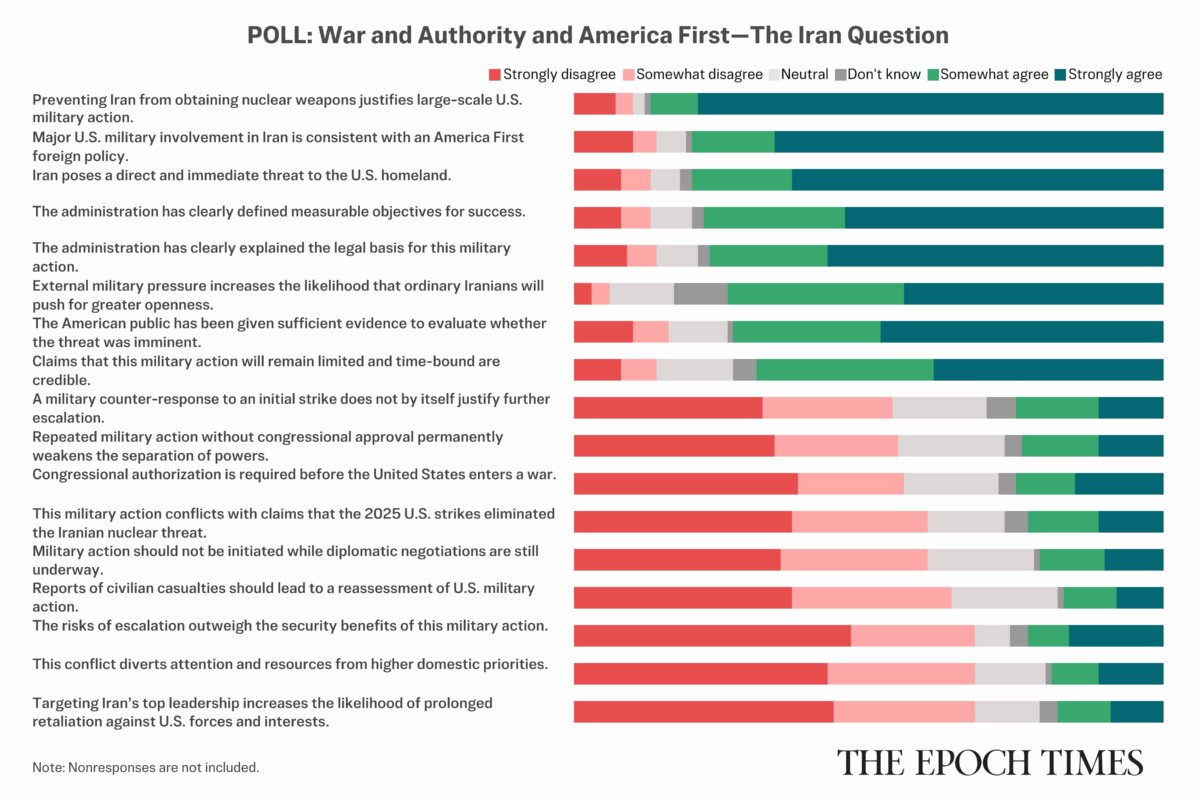
We asked readers to weigh in on the conflict, and even though a large number of survey-takers agreed that preventing Iran from obtaining nuclear weapons justified a large-scale U.S. military action, they were mixed on whether congressional authorization was needed.
Congressional Authorization
The House of Representatives and Senate voted down resolutions that would have mandated congressional authorization for the conflict.
Survey takers had a mixed reaction to how involved lawmakers on Capitol Hill should have been. A quarter (25 percent) of survey respondents said congressional authorization was required before the United States entered a war, while 56 percent did not think it was needed, and 16 percent remained neutral or mixed on the issue.
Nearly a quarter (24 percent) of folks surveyed agreed that repeated military action without congressional approval permanently weakened the separation of powers, while 55 percent disagreed, and 18 percent were neutral/mixed.
Threat to America
Trump alleged Iran was two weeks away from having a nuclear weapon. Exactly 80 percent of poll takers agreed that Iran posed a direct and immediate threat to the U.S. homeland; 13 percent did not.
The survey showed that 87 percent think that preventing Iran from obtaining nuclear weapons justifies large-scale U.S. military action while 10 percent disagreed.
Nearly a quarter (23 percent) agreed the risks of escalation outweighed the security benefits of this military action while 68 percent disagreed.
Foreign Policy
Nearly 24,000 Americans who were in the region have returned to the United States since the operation began. But some Americans’ efforts to get home safety did not come easily due to airspace closures, travel requirements, and flight cancellations.
Exactly 80 percent of survey participants agreed that major U.S. military involvement in Iran is consistent with an America First foreign policy, while 14 percent disagreed.
Just over 20 percent of the sample group said military action should not be initiated while diplomatic negotiations are still underway, while 60 percent disagreed.
When asked if this conflict diverted attention and resources from higher domestic priorities, 68 percent of survey takers disagreed, 19 percent agreed, and 12 percent remained neutral.
Military Action
Trump urged the Iranian regime to surrender “unconditionally” while Israeli Prime Minister Benjamin Netanyahu told Iranian citizens to step up and take their country back.
When asked if the administration has clearly explained the legal basis for this military action, 77 percent of survey takers agreed while 14 disagreed.
Over 75 percent of survey respondents say the Trump administration has clearly defined measurable objectives for success.
Exactly 73 percent of respondents agree the American public has been given sufficient evidence to evaluate whether the threat was imminent.
When asked if this military action conflicts with claims that the 2025 U.S. strikes eliminated the Iranian nuclear threat, 60 percent disagreed, nearly a quarter of poll takers agreed, and the rest remained neutral.
Iran’s Future
Nearly 70 percent of survey-takers agreed that claims Iran’s military action will remain limited and time-bound are credible, while 13 percent remained neutral and 14 percent disagreed.
When poll participants were asked if reports of civilian casualties should lead to a reassessment of U.S. military action, 64 percent disagreed, 17 percent agreed, and the rest remained neutral.
The Iranian regime has attacked 12 countries and targeted civilians throughout the region since the conflict started, according to CENTCOM Commander Adm. Brad Cooper.
The Pentagon said this will not be an endless war, but War Secretary Pete Hegseth said on March 5 that America’s stockpiles of defensive and offensive weapons would allow the conflict to rage on “as long as we need to.”
“Iran is hoping that we cannot sustain this, which is a really bad miscalculation for the [Islamic Revolutionary Guard Corps] in Iran,” Hegseth said during a press conference on March 5. “You see, there’s no shortage of American will here.”
Separately, on the same day, the Senate Armed Services Committee said there was an urgent need to increase military unmanned vehicle production, training, and use.
Exactly 68 percent of survey respondents disagreed that targeting Iran’s top leadership increased the likelihood of prolonged retaliation against U.S. forces and interests, while 18 percent said it did.
A quarter (25 percent) of the sample group agreed that a military counter-response to an initial strike does not by itself justify further escalation, while 54 percent of respondents disagreed.
Nearly 75 percent of people who took the survey agreed that external military pressure increased the likelihood that ordinary Iranians will push for greater openness.
This Epoch Times survey received responses from 4,209 people.
 Friends Read Free
Copy
Facebook
Tweet
Friends Read Free
Copy
Facebook
Tweet