
Republicans on Capitol Hill are pushing a voter reform plan supported by President Donald Trump that would require proof of citizenship when registering to vote and photo identification when casting a ballot in person or via mail.
The Safeguard American Voter Eligibility Act—dubbed the SAVE America Act—passed the U.S. House Feb. 11 in a nearly party-line vote, as Democratic Rep. Henry Cuellar (D-Texas) joined Republicans to advance it.
But many Democrats have criticized the act. The House Rules Committee’s ranking member, Rep. Jim McGovern (D-Mass.) said Feb. 11 that it is “already illegal for noncitizens to vote in federal elections.”
We asked readers to weigh in.
Photo ID
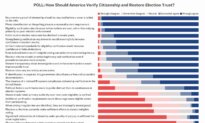
The SAVE America Act has garnered significant support from Epoch Times readers, according to the latest poll.
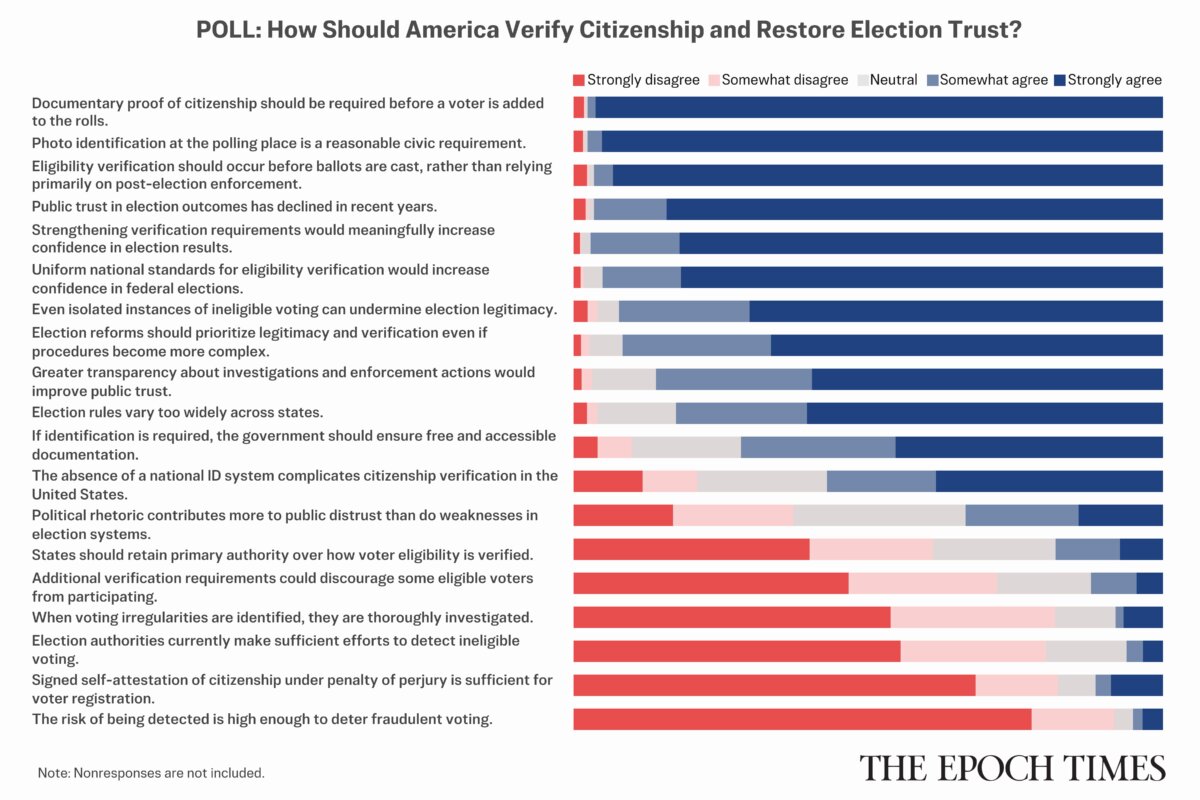
An overwhelming number of readers thought that proof of citizenship should be required for a voter to be eligible.
Just over 95 percent of participants polled agreed that photo ID at a polling place is a “reasonable civic requirement.”
The support for voter ID came as over 96 percent of those surveyed agreed that public trust in election outcomes has declined in recent years.
Eligibility
The Save America Act aims to ensure that “only citizens are registered to vote in elections for federal office” and they must have documentary proof of U.S. citizenship.
Proof of citizenship could be a REAL ID, valid U.S. passport, military ID card, government-issued photo ID card, or certified birth certificate.
More than 93 percent of survey respondents suggested that a voter’s eligibility should be verified before ballots are cast as opposed to relying on post-election enforcement.
Over 82 percent of survey-takers did not think that a signed self-attestation of citizenship under penalty of perjury is sufficient for voter registration.
When polled readers were asked if they thought election authorities currently make sufficient efforts to detect ineligible voting, 55 percent strongly disagreed, 25 percent slightly disagreed, 14 percent were neutral/mixed and the rest agreed.
Only 8 percent of people polled thought voting irregularities were “thoroughly investigated” when identified while 28 percent slightly disagreed and 54 percent strongly disagreed.
Over 70 percent of people polled do not think “additional verification requirements could discourage some eligible voters from participating.”
Verification
There are 36 states with laws that require voters to show some form of ID at the polls, according to the National Conference of State Legislatures.
Tennessee and Georgia have strict photo ID requirements, while New York and California do not require an ID to vote.
Readers had mixed opinions about whether states should retain “primary authority over how voter eligibility is verified.”
They also had different reactions to whether they thought the absence of a national ID system would complicate citizenship verification in the United States.
Over 92 percent of survey respondents do not think that “the risk” of being detected is high enough to deter fraudulent voting.
Poll participants mostly agreed that “greater transparency about investigations and enforcement actions would improve public trust.”
And 97 percent of the sample group thought that “strengthening verification requirements would meaningfully increase confidence in election results.”
While 82 percent of readers agreed that the election rules vary too widely across states, over 95 percent agreed that the public’s confidence in the system would increase if the federal government set “uniform national standards” for eligibility verification.
Those surveyed were mostly in agreement with the statement: “If identification is required, the government should ensure free and accessible documentation,” with 71 percent agreeing, 19 percent neutral and 10 percent disagreeing.
Public Distrust
Trump spent years alleging that the 2020 presidential election between him and former President Joe Biden was rigged, but his efforts to overturn the election results have failed in every state.
Readers have mixed opinions on who is to blame for public distrust in the voting system.
Only 33 percent suggested political rhetoric caused more public distrust than the voting process, as 30 percent remained neutral or mixed, and the rest disagreed.
Over 90 percent of people polled thought “election reforms should prioritize legitimacy and verification even if procedures become more complex” and agreed that “isolated instances of ineligible voting can undermine election legitimacy.”
This survey showed the poll results of 3,634 Epoch Times readers.
 Friends Read Free
Copy
Facebook
Tweet
Friends Read Free
Copy
Facebook
Tweet