

As urban America flirts with socialism, many of our South American neighbors are now going in the opposite direction: shrinking government, opening markets, balancing budgets, and prioritizing growth and stability.
South America’s political map looks considerably different from what it was only a few years ago, now that Argentina, Ecuador, Paraguay, Chile, Bolivia, Peru, and Colombia are governed by conservative leaders. And the market-oriented reforms they have put in place have yielded positive results to date, delivering economic stability and growth.
In Argentina, libertarian Javier Milei won the presidential election in 2023, campaigning on radical reductions in government spending and deregulation. In Paraguay, Santiago Peña was elected in 2023, pledging socially conservative politics and market-oriented reforms.
In 2025, José Antonio Kast became president of Chile, pledging economic liberalization and a crackdown on crime. Rodrigo Paz became president of Bolivia that year, ending two decades of socialist rule.
And in June of this year, Keiko Fujimori’s right-leaning Fuerza Popular won the presidency in Peru, pledging economic stability and security. Simultaneously, Abelardo de la Espriella, a conservative nationalist who campaigned on reducing government, reviving economic growth, and fighting drug cartels, took the reins in Colombia.
Early Success
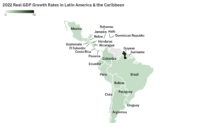
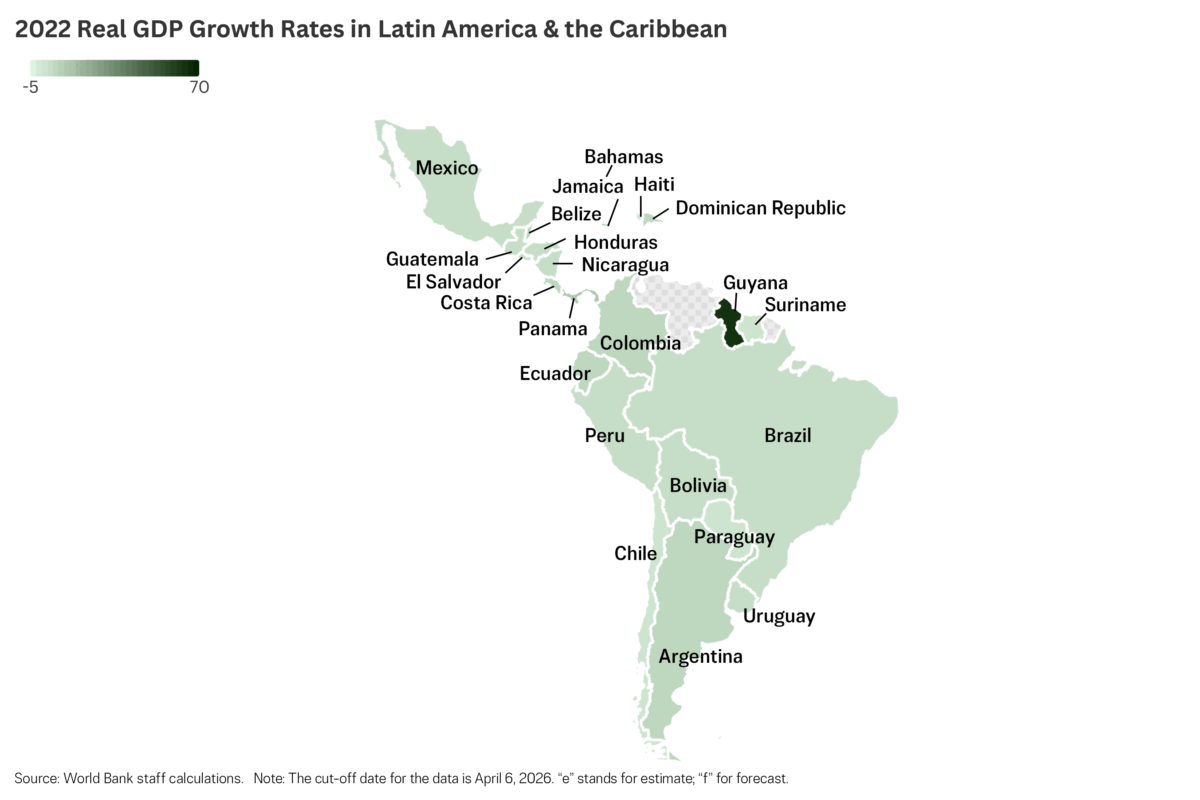
To date, the economic results of these reforms have been promising. According to World Bank data, much of South America is now experiencing stronger growth and a more positive economic outlook than many Western countries.
Paraguay’s gross domestic product is projected to grow by 4.4 percent this year. Argentina is projected to grow 3.6 percent, following growth of more than 4 percent in 2025.
Peru, Colombia, Chile, and Ecuador are all seeing projected growth above 2 percent this year, in line with expectations of 2.2 percent GDP growth for the United States and well ahead of the 1.1 percent average GDP growth rate within the European Union.
In addition, the sovereign debt ratings of Argentina, Paraguay, Ecuador, and Uruguay were upgraded over the past several years. Paraguay and Uruguay achieved investment-grade ratings at a time when many European nations, including France, Estonia, Lithuania, and Latvia, were downgraded by Standard & Poor’s due to “lagging regional growth rates.” The United States was likewise downgraded from AAA by Fitch in 2023, by Moody’s in 2025, and by Standard & Poor’s in 2011, due to escalating national debt.
So far so good, but South America has been here before.
During the 1980s and 1990s, many Latin American nations pursued privatization, trade liberalization, fiscal reform, and freer markets. And while these policies helped tame inflation and alleviate debt crises, they were less successful in eliminating poverty or inequality, often leaving wealth concentrated among a minority of elites.
This provided an opportunity for left-wing populists who campaigned on greater state control, wealth redistribution, expansion of social programs, and more political power for the poor and indigenous groups. Starting in 1998, the so-called “Pink Tide” brought left-wing governments to power in Venezuela, Bolivia, Ecuador, Argentina, Brazil, Uruguay, and Chile.
In extreme cases such as Venezuela, a lucrative oil infrastructure with the world’s largest known reserves was nationalized, then subsequently mismanaged, pilfered, and left to rust by government officials and affiliates. Hyperinflation ensued, and Venezuelans descended into poverty.
Radical Reforms Versus Incremental Change
Today, the pendulum is swinging back to the right.
Argentina, led by president and chainsaw-wielding economist Milei, captured headlines for rapidly dismantling the administrative state. When Milei became president in 2023, Argentina was suffering from years of chronic fiscal deficits, annual inflation above 200 percent, and a deluge of pesos printed by the country’s central bank to fund government spending.
Milei cut government expenditures by 30 percent in 2024, and within a year Argentina achieved its first budget surplus since 2010.
“It’s difficult to overstate what has happened there,” Peter Earle, senior director of research at the American Institute for Economic Research, told The Epoch Times.
“Milei came into office with an economy in which the government was effectively monetizing fiscal deficits and inflation was accelerating towards genuinely destabilizing levels.
“The initial adjustment was undeniably painful. There was a short, sharp rise in poverty, then the initial stabilization, and then the trajectory reversed and inflation collapsed.”
Argentina’s economy grew by 4.4 percent in 2025, according to INDEC, the country’s national statistics agency. In May, Fitch Ratings upgraded Argentina’s sovereign credit rating from CCC+ to B-, citing improved fiscal balances, strong progress on economic reforms, and increased foreign-exchange reserves. In July, Moody’s likewise upgraded Argentina’s rating from Caa1 to B3, with a positive outlook.
Simultaneously, a less dramatic transition is underway in other South American nations. Paraguay in particular stands out as a country that has moved incrementally toward free markets and fiscal responsibility, avoiding the “shock therapy” of radical reforms.
“While Argentina gets the publicity because the starting conditions were catastrophic and Milei was undeniably theatrical, Paraguay demonstrates what happens when relatively orthodox policy is sustained rather than introduced in an emergency,” Earle said.
“[Paraguay has] maintained comparatively low taxes, a high degree of macroeconomic discipline, and a business-friendly posture, all while pursuing reforms that involve government efficiencies and maintaining property rights.”
The World Bank, in its April economic update on Latin America, stated that Paraguay “continues to outperform the regional average, supported by strong agricultural exports, expanding electricity generation, and a stable macro framework.”
In December 2025, Standard & Poor’s upgraded Paraguay from BB+ to BBB-, stating that “the track record of macroeconomic stability and pro-market policies has strengthened Paraguay’s economic resilience and prospects for more consistent growth.”
Previously, Moody’s upgraded Paraguay to Baa3 from Ba1; both the agency and the World Bank now rate Paraguay as investment grade.
Other South American nations are showing that the way back from socialism can include many different paths.
“In Chile, and in a certain way Peru, the economic reform process took place in a rather abrupt way,” Johns Hopkins University economist Steve Hanke told The Epoch Times.
While in the short run the reforms generated “a period of some severe economic hardships” in those countries, that has not been the case in Uruguay and Paraguay, “which went through a relatively smooth process of stabilization and liberalization,” he said.
“The lesson is that stabilization and liberalization can take place without a major transitory economic crisis, and ideally, they should,” he said.
Hanke was an economic adviser to former Venezuelan President Rafael Caldera, a former adviser to reforming nations in Latin America and Europe, and is currently special adviser to Congressman Antonio Ecarri at the National Assembly of Venezuela.
Liberalization Versus Stability
Whether by incremental or radical means, successful liberalization requires more than simply paring back the administrative state.
“When looking at reforms, it’s important to distinguish between economic liberalization policies, like deregulation, privatization, and so forth, and macroeconomic stabilization policies,” Hanke said.
“Successful liberalization requires both. Indeed, stability might not be everything, but everything is nothing without stability.”
Latin American countries have struggled to achieve liberalization and stability simultaneously, Hanke said. In recent decades, this has held the region back in terms of productivity and living standards.
Stability requires, among other things, containing inflation.
In Argentina, Milei was able to bring inflation down from 211 percent at the time he took office to 31 percent within two years, the lowest level since 2018. Forecasts project a further decline to 20 percent for 2026, but the rate remains persistently high.
In certain cases, Hanke recommends that countries scrap their national currencies and replace them with a more stable currency like the dollar or the euro.
Panama, Ecuador, and El Salvador have done so, swapping their currencies for U.S. dollars, but most other South American countries kept their national currencies in place, Hanke said. When countries fail to tame inflation, residents move savings and investment abroad to preserve their value.
“The capital flight magnitudes are staggering,” he said. “For example, capital flight in Argentina amounts to over 60 percent of each dollar of foreign debt that Argentina incurs.”
Achieving not only smaller but also more effective government is part of the puzzle.
“Freedom requires more than simply low tax rates,” Earle said. “It also requires governments to perform narrow but indispensable functions, like security, maintaining courts, contract enforcement, protection of property, all that sort of thing.”
Wealth Inequality, Narrow Mandates
Then there’s the Achilles’ heel of liberalization in South America: wealth inequality.
A 2025 World Bank report stated that Latin American countries rank “among the most unequal in the world.”
The bank reported that the top 20 percent of households in Latin America received 54 percent of total income, while the poorest 20 percent received only 4 percent. By comparison, in all other regions of the world except Sub-Saharan Africa, the top quintile earned 40 to 43 percent of income, while the bottom quintile received 8 to 9 percent.
And even though poverty is declining, a recent market study by Mastercard found that Latin America’s middle class remained “financially fragile.”
“A lost contract in an informal job, an illness that generates unexpected expenses, or a climate-related disruption can erode savings or emergency funds,” the report said. “The pandemic made this fragility even more visible: 14 million people slipped back into vulnerability in a single year.”
Much of the electoral success of conservatives in South America was a reaction to the failures of the left-wing governments that preceded them. However, the mandate to pursue reforms is thin in many cases.
Right-wing candidate Espriella beat his leftist rival Iván Cepeda in Colombia’s recent presidential election by less than one percentage point. Likewise in Peru, conservative candidate Fujimori won the presidency by a margin of fewer than 50,000 votes in a close runoff election.
Although market-oriented reforms have succeeded in reducing inflation and achieving growth, unless those benefits reach a sufficiently broad base, countries may be tempted to swing back to the left.
“The question is not whether free-market reforms can stabilize economies; we have growing evidence that it works,” Earle said. “The question is now, can the reforms generate enough visible improvement quickly enough to generate a political constituency?”
 Friends Read Free
Copy
Facebook
Tweet
Friends Read Free
Copy
Facebook
Tweet