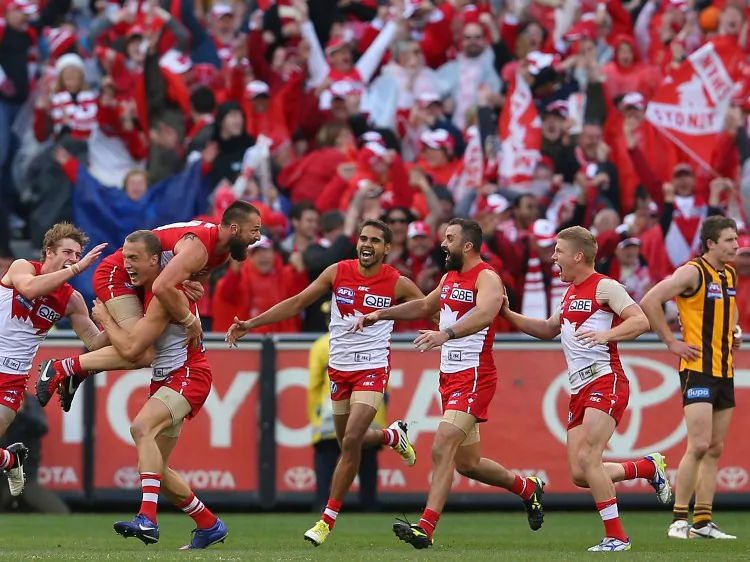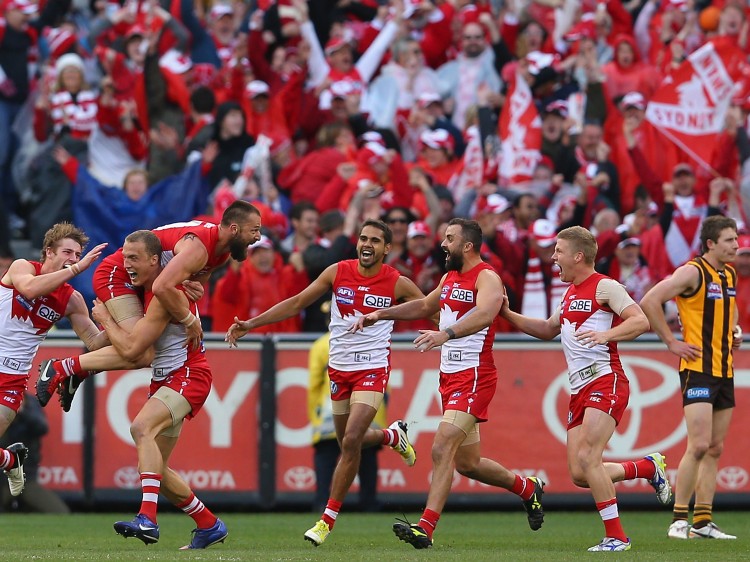
Just one day had elapsed after the Sydney Swans became the 2012 Premiers when the Australian Football League heralded in a new and controversial era—the commencement of free agency, with the movement of former No. 1 draft pick Brendan Goddard making headlines.
2012 Grand Final
The Sydney Swans triumphed over the Hawthorn Hawks in a thrilling Grand Final on Saturday Sept. 29.
Witnessed by 99,683 at the Melbourne Cricket Ground, the game was one of changing fortunes.
The Hawks led the first quarter, 4 goals 5 behinds (29) to 1.4 (10), having had most of the play, while Sydney were on the back foot for most of the term needing to defend. Hawthorn didn’t make the most of their chances and this was to prove costly.
From the start of the second quarter, Sydney took control. They piled on eight unanswered goals to lead by 28 points in the third quarter. Hawthorn then kicked five unanswered goals to regain the lead. However, Sydney scored with a settling goal for another lead change before Hawthorn missed again to score a behind. Entering the last quarter, Sydney led by 1 point.
In the fourth quarter, with 10 minutes remaining, scores were tied. Similar to the first quarter, the Hawks were remarkably wasteful. The game was still in the balance when, with 39 seconds left, Nick Malceski snapped a goal to seal the game: Sydney 14.7 (91) to Hawthorn 11.15 (81).
In that term, the Hawks had kicked two goals and five behinds, while the Swans kicked four, two. Hawthorn, who were the league’s best attacking and free-flowing team for the season, had only themselves to blame for their inaccuracy under the ultimate pressure of a Grand Final.
It has been said that a good defense will beat a good attack in AFL. Some could argue that this was once again proven as Sydney showed throughout the Grand Final why they were the best defensive team of the season. Statistically, Hawthorn won in every category except tackles, where Sydney won 109 to 83. It was one area that the Swans had dominated from the start of the game.
Player Movement Period
With the Grand Final over and many players already having had injury correction surgery, the attention in the AFL switched to recruitment and trade.
Currently, the controversial free agency movement stage is underway for the first time in the history of the league. Conjecture remains over most of the blush of the 34 players who were eligible in this first year of free agency, with many remaining with their current club.
While a player draft (in place since 1981) and player salary cap (1987) helped to equalize teams, 2012 marks the commencement of free agency in the AFL. With no cap on management spending, however, the wealthier clubs can provide better training facilities and support, making them more attractive to many players.
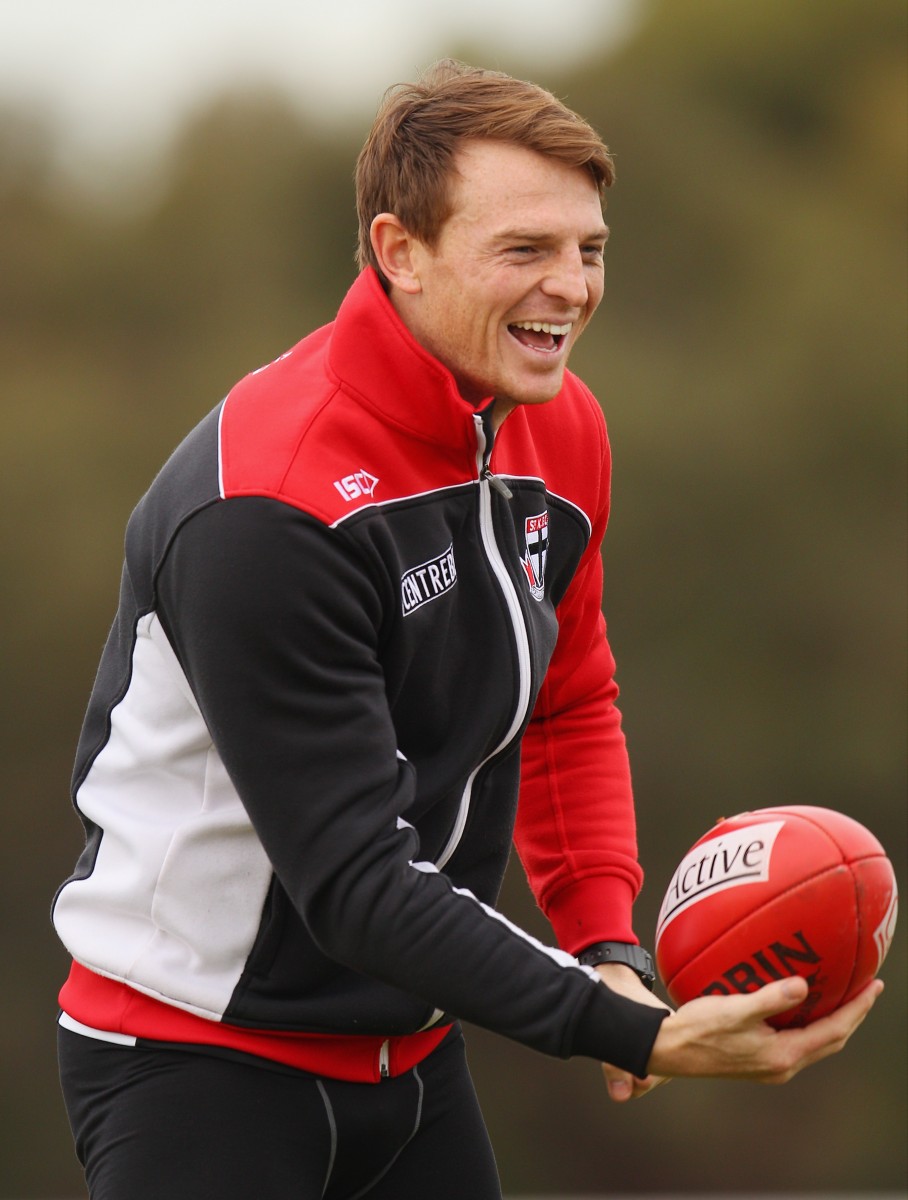
Several deals have been done since the free agency period opened on Monday (Oct. 1) with the most notable being the signing of the now former-St Kilda Saints midfielder star Brendon Goddard by the Essendon Bombers on the first day.
Since the announcement that the AFL would begin free agency, there has been a lot of speculation on who would retain or lose whom and the impact it will have on the game.
When the AFL gave licenses to expansion clubs, the Gold Coast Suns (2011) and Greater Western Sydney (2012), with permission to sign one uncontracted player from each of the other 16 clubs, they had in effect agreed to free agency.
The AFL, with it’s unique combined draft and salary cap systems had held out from accepting free agency as there have been concerns that free agency will favor the financially stronger clubs. But once the precedent had been set with the expansion clubs, they established an unrestricted and restricted free agency system.
While some people remain optimistic that it will simply allow players to move from club-to-club easier, others like former Sydney coach Paul Roos, are not.
“It’s a sad day for football,” Roos said on Fox Footy’s TV program On The Couch on Monday (Oct. 1).
Roos was speaking following the signing of 28-year-old Goddard to Essendon for four years on a rumored $725,000 per year.
“I think we’re seeing what we suspected,” Roos said. “Better clubs getting better and lesser clubs getting attacked.
“How are the lesser clubs going to replace the good players?”
The AFL will compensate clubs that have lost free agents, with draft picks. But it is unlikely that such compensation will be commensurate with the value and quality of a player.
While there will always be others of the Goddard ilk that clubs are unable to, or unwilling to, retain, the overall impact will only truly be assessed once free agency has settled in over the coming years. In the meantime, however, clubs (and their fans) will be hoping that they can come out on top in the deals.
The player movement and recruitment period commenced on Monday (Oct 1) and will run until Dec 11; with free agency beginning Oct 1 to Oct 19, it includes the unique father-son recruitment, player trade period and pre-season and rookie drafts.
During this period, some clubs will have begun their pre-season training, while others who were finalists may start later in December or January 2013.
Meanwhile, the Western Bulldogs and Port Adelaide Power will play in an exhibition match at the Oval in London on Nov 3 on their way to pre-season training camps in Europe.
The Epoch Times publishes in 35 countries and in 19 languages. Subscribe to our e-newsletter.
 Friends Read Free
Copy
Facebook
Tweet
Friends Read Free
Copy
Facebook
Tweet