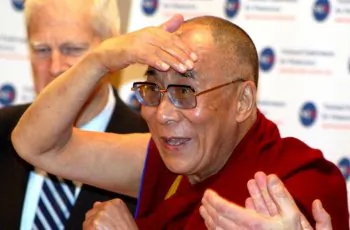
WASHINGTON—The National Endowment for Democracy presented the Democracy Service Medal to the Dalai Lama in a packed auditorium at the Library of Congress on Feb. 19. After accepting the medal, the Dalai Lama gave a talk about the value of democracy.
Before the ceremony got underway, Opening the ceremony was James Billington, Librarian of Congress who thanked the Dalai Lama for his “witness of freedom of speech and knowledge on which all libraries depend.”
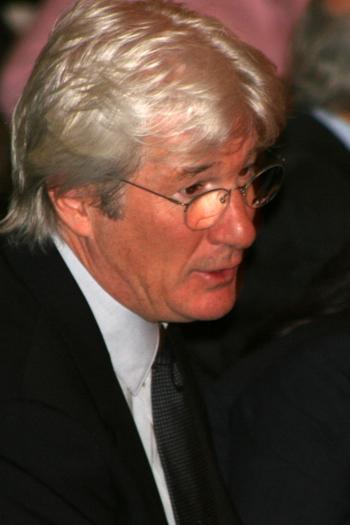
Actor Richard Gere, present in the audience, was acknowledged for his humanitarian work on behalf of the Tibetan people as chair of the “International Campaign for Tibet,”, and speaker for human rights, cultural preservation and helping disadvantaged communities worldwide. Gere responded with a respectful hand gesture of pressing both palms together at the level of his chest.
The Dalai Lama began with the words: “I did not learn the value of democracy through education but through experience.”
His address was an elaboration on that very experience. The Tibetan leader’s humbleness and good humor came across through his broken English. His conclusions invariably begin with a strong, ‘So!’ a word he uses quite often. To compensate for his limited command of English, the Dalai Lama would pause and use his hands to gesture, endeavoring to persuade his listeners to consent to his reasoning.
“Firstly when I was young Buddhist monk, I feel a rather stupid young monk; never pay attention about study, just only for play.
“During ceremony I sat on a throne but in real daily life [was] completely mixed with these people.”
By his open nature, the Dalai Lama was able to come into contact with ordinary people, street people/workers, who treated him as an equal and friend which he said was a source of joyfulness for him.
That way he was able to learn about the injustices in society and “a lot of gossips about leaders and regimes.” He heard a lot of complaints from these “ordinary poor people,” and about the system, which he related in a whisper, as if passing on what he heard.
“There [was] a lot of injustice or drawbacks. Not as bad as [communist] Chinese say but still bad,” he said about the society he remembers from his youth.
 Friends Read Free
Copy
Facebook
Tweet
Friends Read Free
Copy
Facebook
Tweet