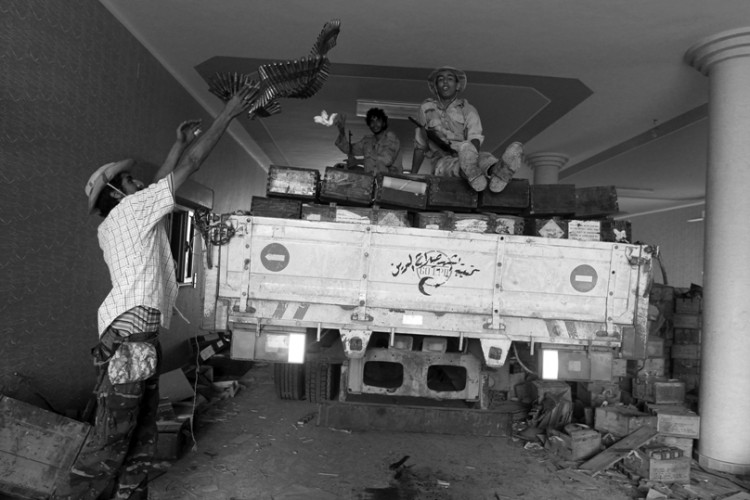
Both before and after the death of Gadhafi, and before the declaration of the full liberation of Libya by the Libyan National Transitional Council (NTC), worrying reports surfaced about huge stockpiles of weapons left unguarded. The concerns are that these may end up in the hands of armed groups within, our outside Libya, or even spread to other restive areas in the region. According to some reports, many weapons have already disappeared.
On Nov. 1, the U.N. Security Council unanimously adopted a resolution urging the Libyan interim authorities to take action against the proliferation of arms left behind by Gadhafi’s army. The resolution authorized a committee to develop a proposal detailing how to prevent these weapons from falling into the hands of terrorists and militants.
Pieter Wezeman, senior researcher of the arms transfer program at the Stockholm-based think tank SIPRI welcomed the resolution and expressed hope that it will lead to further action from both European countries and the United States to prevent more weapons from disappearing. In October, the United States pledged $40 million and sent a number of experts to Libya to help secure and destroy weapons. Canada has pledged CA$10 million ($9.7 million).
“At least up until last week, there were images available of people who were walking around in arms depots where there was clearly no proper security, and where they could take boxes of weapons without any supervision. There is a lot of work to do,” Wezeman told The Epoch Times in a phone interview Wednesday.
A report by Human Rights Watch (HRW) Oct. 25, also describes how a HRW team witnessed the plunder of two unguarded sites near Sirte, which contained small arms, surface-to-air missiles, aerial weapons, plus tank and mortar rounds.
According to Wezeman, there are mainly two groups of weapons that are a source for concern: the first is small arms, such as assault rifles and machine guns, which are not such a threat individually, but become an issue if they are widely spread and reach armed groups in the area, especially the al-Qaeda in the Islamic Maghreb.
The second is the more advanced weaponry such as man-portable, surface-to-air missiles, or MANPADS, which were also highlighted as a threat in the U.N. resolution. These can be used to down civilian passenger aircraft and potentially cause huge casualties. In 2002, someone tried to shoot down an Israeli passenger jet leaving Kenya, presumably with a MANPAD.
The older systems were not as reliable and as easy to use as the newer ones that the Russians had sold to Libya in recent years, but a number of them could be combined for a salvo effect to compensate for this, Weseman explained. Reportedly, hundreds of these older systems may already have disappeared in Libya. The HRW team in Sirte also identified at least 14 empty crates that had contained SA-24 missiles, one of Russia’s most advanced surface-to-air missiles.
Next … Sheer Quantity
 Friends Read Free
Copy
Facebook
Tweet
Friends Read Free
Copy
Facebook
Tweet