LOS ANGELES—Victims and witnesses of the 1989 Tiananmen Massacre shared the way they saw and experienced the demonstrations, the massacre, and the long-term effect it has had on the Chinese psyche at a commemoration held by the Visual Arts Guild. Two contemporary rights defenders, Ai Weiwei and Zhao Lianhai, both currently detained in China, were honored at the event.
The Visual Artists Guild Annual Award Dinner commemorated the 22nd anniversary of the Tiananmen Massacre. The audience was filled with who’s who in the world of human rights activism and reporting, including representatives from Amnesty International, Human Rights Watch, and other notables.
Human Rights Award to Ai Weiwei and Zhao Lianhai
One of those recognized was Ai Weiwei. The world-renowned artist/activist is currently detained by the Chinese Communist Party (CCP) for his political expressions, which include a recent video (Without Fear or Favor by Ai Weiwei on TED) regarding his opinions on the Internet, freedom of speech, and a discussion about the media and his desire to help China to become a more democratic country.
Zhao Lianhai was also recognized for his efforts in bringing to light the melamine-tainted milk scandal in 2008. Zhao was sentenced by the CCP to 2 1/2 years in prison after he set up a website, Kidney Stone Babies, to advise parents of the toxic milk after his own child suffered from kidney illness from the tainted dairy. He was released on medical parole last December, then again taken into custody on May 26, apparently because of his public demand for the release of Ai Weiwei that same week.
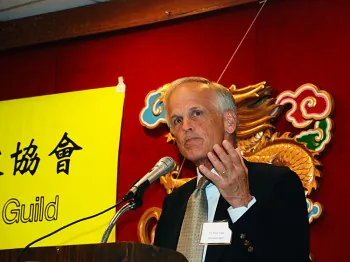
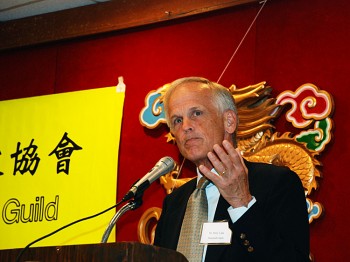
The keynote speaker, Perry Link, Ph.D., a professor of Comparative Literature and Foreign Languages at UC Riverside, is one of the West’s top experts on China, its language, culture, and people. Link has also translated major documents for the Chinese democracy movement and is one of the editors of the Tiananmen Papers. He was present in China when the Tiananmen Massacre occurred.
Dr. Link’s opening remarks were on China’s oppressed dissidents and rights lawyers. “I feel inadequate standing here with these true heroes who you are honoring tonight,” he said.
Mass Chinese Amnesia
Link spoke at length about the Chinese people’s amnesia when it comes to massive Communist Party abuses in China. In 1989, he helped dissident astrophysicist Fang Lizhi reach safety at the U.S. Embassy in Beijing and later translated an article written by Fang for the New York Review that shocked him. The title read, “The Chinese Amnesia: The Technique of Forgetting,” which seemed like a farce after Tiananmen Square, considering the violent outcome.
Link noted that the Tiananmen massacre probably set a record for the number of witnesses to such a disaster when one includes the TV audience that saw the carnage on Tiananmen Square. “What do you mean forget? How could this be?” he asked.
Fang discussed how in 1957, tens of thousands protested during the “Anti-Rightist” movement at the same location, but only billy clubs were used by the police to break it up.
“And by 1979, when the Democracy Wall people came along,” said Link, “they had forgotten; they didn’t know that much about what had happened in 1957. Then in 1989 in Tiananmen, Wang Dan and the young leaders knew but not very clearly what had happened ten years earlier at the Democracy Wall. So Fang predicted, that, too, would be forgotten, and I thought he was nuts.”
But Link translated the article anyways. “And in the end he was right,” he said. The Chinese people had also forgotten about June 4.
“Not that you’ve forgotten, or I have, or he has, or the people who were there,” Link continued. “But the younger generation in China doesn’t know about it.”
“If they’ve known about it,” he said, “they have this very vague impression, it’s distorted by the government’s view, and now everybody’s into making money and pursuing individual careers, and the ghosts of Tiananmen are in the streets—for what? Forgotten, right?”
Dr. Link then explained that during the Tiananmen protests, similar large demonstrations were taking place around the entire country. This was significantly different from earlier protest movements.
“Why did they use real ammunition and kill people [this time]? They wanted the message to get out: ‘All you other guys shut up. No more fussing.’ And it worked—the whole country was in deep depression for about three years, and now as it’s worked its way out of depression, it still has this radioactive fear of touching that topic.”
Read More… The Chinese regime had no issues of amnesia…
 Friends Read Free
Copy
Facebook
Tweet
Friends Read Free
Copy
Facebook
Tweet