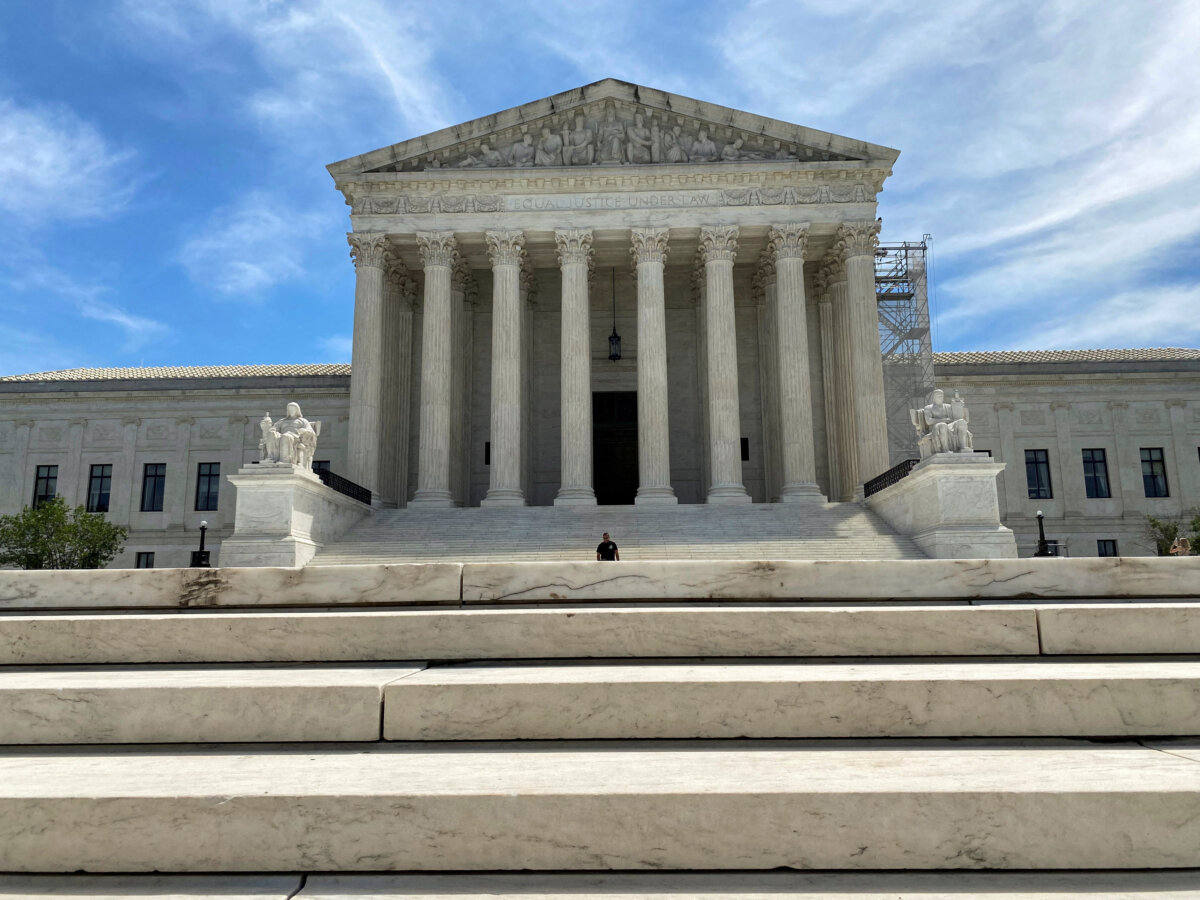

This December, the Supreme Court has scheduled oral arguments over hot-button issues like campaign spending, the death penalty, and President Donald Trump’s ability to fire people.
Here is a breakdown of the cases.
The Firing of Rebecca Slaughter
In March, Federal Trade Commission (FTC) member Rebecca Slaughter received a letter in which Trump said her “continued service on the FTC is inconsistent” with his administration’s priorities.
Slaughter sued, alleging that Trump violated not only federal law but Supreme Court precedent.
The Supreme Court will hear that case on Dec. 8.
Pro-Life Donors
In 2023, New Jersey Attorney General Matthew Platkin and other attorneys general accused pregnancy centers of misleading consumers.
In attempting to investigate potential legal violations, Platkin subpoenaed a group of faith-based pregnancy centers collectively known as First Choice Women’s Resource Centers.
First Choice has alleged that Platkin’s subpoena unconstitutionally chills its association with donors’ speech by seeking information about them. The organization brought a lawsuit under 42 U.S.C. Section 1983, which allows private entities to sue governmental agencies in federal court over violations of their civil rights.
What followed was a complicated trail of litigation that questioned state authority and ultimately, whether First Choice would ever be able to bring a challenge in federal court.
The Supreme Court is expected to address those issues and others during oral argument on Dec. 2.
Campaign Spending Limits
The high court will soon hear a case that may impact the 2026 midterm elections by judging whether the First Amendment allows Congress to limit coordinated spending between political committees and candidates.
The case, known as National Republican Senatorial Committee (NRSC) v. Federal Election Commission (FEC), originated with Republicans, including then-Senate candidate JD Vance.
They focused on the Federal Election Campaign Act, which imposes a series of limits on political spending—including on coordinated expenditures between both parties and candidates.
Vance and the NRSC said those restrictions violated their First Amendment rights, specifically because the FEC sought to enforce them in a way that would limit their advertising activities.
The case comes before the court on Dec. 9.
The Sidewalk Preacher’s Suit
Another case, Olivier v. City of Brandon, involves the First Amendment but in a less direct way. Under Section 1983, Americans can sue governments for violating their First Amendment and other constitutionally protected rights.
During oral argument on Dec. 3, the high court is expected to hear arguments over how and when convicts can use that law.
Christian street preacher Gabriel Olivier was arrested in 2021 for protesting—including calling passersby names like “Jezebel”—outside a concert venue.
The City of Brandon, Mississippi, said he violated its ordinance requiring protesters to carry out their demonstrations in a designated area.
Olivier pleaded no contest to the charges, was fined, and received a suspended sentence of 10 days.
It wasn’t until after his sentencing, however, that he filed a civil suit under Section 1983, asking courts to declare the city ordinance violated the First and 14th Amendments.
The suit was dismissed by lower courts because of a previous Supreme Court precedent, Heck v. Humphrey, which said plaintiffs cannot bring claims under Section 1983 if they “would necessarily imply the invalidity of a prior conviction.”
Olivier appealed to the Supreme Court, arguing he was not looking to overturn his previous conviction but just wanted protection from future prosecutions.
IQ and the Death Penalty
Joseph Clifton Smith was sentenced to death for murdering a man in 1997. But after a Supreme Court decision in 2002, Smith alleged that his death sentence was unconstitutional because he was mentally disabled.
That decision, in a case known as Atkins v. Virginia, held that executing a mentally disabled criminal was “cruel and unusual punishment.”
Smith’s case has led the Supreme Court to review how lower courts are supposed to weigh multiple IQ scores in order to determine if someone has an intellectual disability.
Although all five of Smith’s IQ scores were higher than 70, four were low enough that the margin of error made it possible that his actual score was lower than 70.
A panel of appellate judges said that in order to use IQ to maintain the death penalty, the state had to have evidence strong enough to foreclose the possibility of his actual IQ being lower than 70.
Alabama and the Trump administration sought Supreme Court review, arguing that the appeals court was requiring too much and that courts should consider the cumulative effect of multiple IQ scores.
—Stacy Robinson; Sam Dorman
BOOKMARKS
Indiana’s Republican state representatives have unveiled the draft of a new congressional map that may give their party an advantage in all nine districts. Check out Jacob Burg’s latest report to see how the lines were drawn.
The White House on Monday confirmed that the United States conducted a follow-up strike on alleged nautical drug runners in September, after a first strike left two survivors clinging to wreckage. “Presidentially designated narco-terrorist groups are subject to lethal targeting in accordance with the laws of war,” White House press secretary Karoline Leavitt said.
Rep. Greg Murphy (R-N.C.) said giving Americans a $2,000 cut of the tariff revenue could lead to “really astronomical” costs. “I think we need to worry about taking some of this money and actually paying down our debt,” he said in a recent interview on Fox Business.
Donald Trump took control of the G20 forum on Dec. 1 and is promising reforms after boycotting its latest meeting. Read about his plans for the next summit, set to take place in Miami, in Jill McLaughlin’s latest report.
Sen. Tim Kaine (D-Va.) wants to halt any U.S. military action in Venezuela, and is considering another congressional resolution to do so. His two previous resolutions—in October and November—both narrowly failed in the Senate.
 Friends Read Free
Copy
Facebook
Tweet
Friends Read Free
Copy
Facebook
Tweet