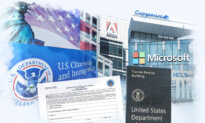

WASHINGTON—The Trump administration’s probe into alleged visa fraud has led to big news: Microsoft, Adobe, and several other tech firms have been suspended from a program that helps foreign workers get green cards.
What do the suspensions mean—and what could they signal for the future?
Vice President JD Vance and freshly confirmed Labor Secretary Keith Sonderling outlined their actions during an Oct. 8 press conference for the White House Anti-Fraud Task Force.
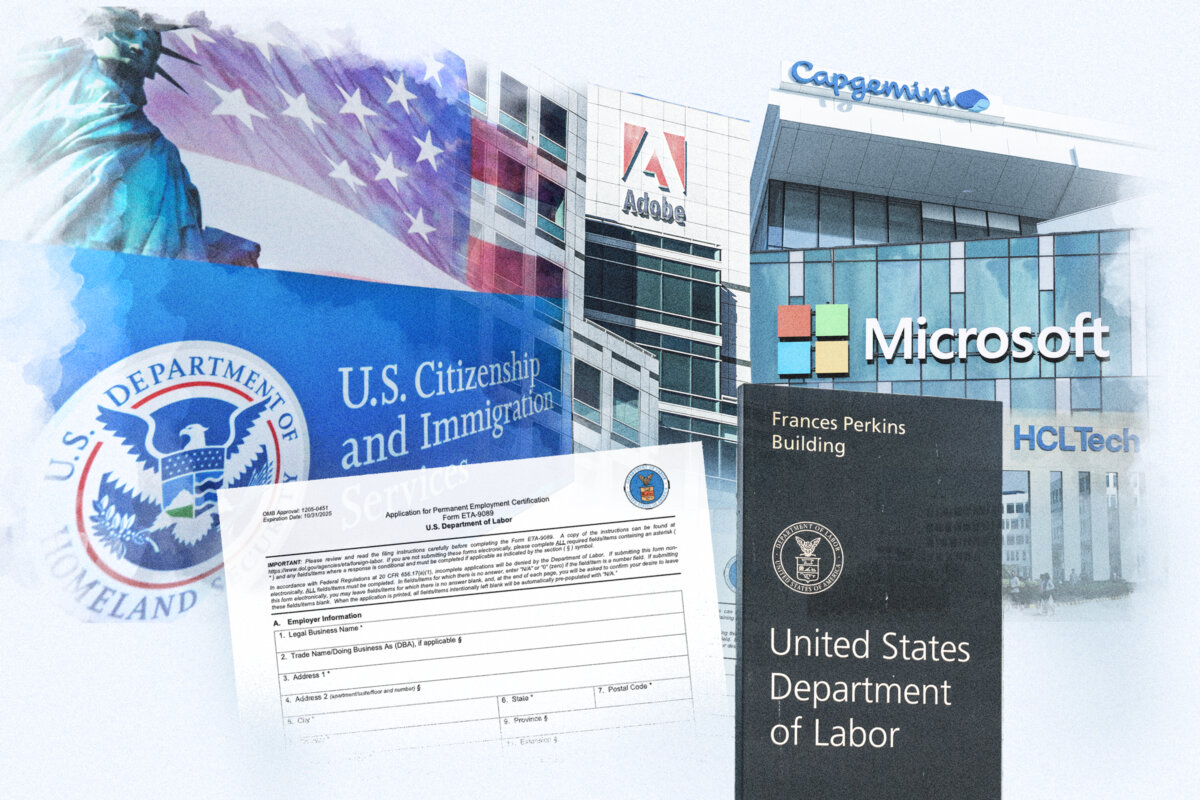
The officials announced that Adobe, Capgemini, Cognizant, HCL Technologies, Infosys, Microsoft, Tata Consultancy Services, and Wipro have been suspended from the permanent labor certification program known as PERM.
Employers typically use PERM to show that no qualified American workers are available for a role they want to fill with a foreign worker.
PERM is also the first step for foreign workers seeking a green card—permanent residency—based on their employment.
Sonderling said the companies have received more than 100,000 permanent labor certifications since 2009, along with 230,000 H-1B visa approvals. That temporary work visa, also common in tech, often comes before PERM.
A Labor Department official
The firms are among the top PERM filers, alongside Amazon, Apple, Intel, and others—with many operating in the tech world.
At the press conference, Sonderling said his department “will not accept any new or process any pending permanent labor certification applications involving these companies,” accusing them of taking hundreds of thousands of jobs from Americans.
“Something to this scale, as far as I’m aware, has never been done,” said a Labor Department official who spoke with The Epoch Times on condition of anonymity.
In a message to The Epoch Times, immigration attorney Jasmine Mines described the multi-firm suspension announcement as unprecedented.
She said it “signals that every employer sponsoring foreign workers must now treat immigration compliance as a front-line legal risk rather than an administrative task.”
Kevin Lynn, founder of U.S. Tech Workers, believes Vance “has picked the right fight.”
“I waited years to see this,” said Lynn, who is a critic of tech companies’ recruitment of foreign labor.
Effects and Ramifications
Under the law, the initial suspensions last for up to 180 days. They can also be extended.
Vance said the Microsoft suspension “is going to last as long as it needs to.”
The Labor Department did not respond by publication time to a question from The Epoch Times about how long the suspensions are expected to continue.
Mines, the founder of Mines Law Firm, PC, noted that something big still hasn’t happened to the companies the Trump administration is investigating for alleged visa fraud.
“A suspension is not a verdict,” said Mines. “Debarment, the actual penalty, is a separate step.”
Loren Locke, immigration lawyer
Debarment—an option if agencies or the courts find fraud or related violations—would ban those employers from the program for up to three years.
A Labor Department list shows just two companies, neither of which are among the suspended firms, currently debarred from PERM.
Loren Locke, an immigration lawyer who served as a U.S. State Department consular officer, said Microsoft’s suspension “feels like it must have been designed in a back room to not actually hurt Microsoft that much.”
For one thing, she said, it does not directly affect the H-1B.
Those working under that visa can typically hold them for up to six years, giving them time to negotiate the new terrain. PERM can enable H-1B workers to extend those visas indefinitely.
She added that if she were a Microsoft employee approaching the end of that period without a labor certification, she might start looking for another employer.
Locke said that while the administration has enacted other policies that created friction for companies seeking to hire H-1B workers, “that is totally separate from getting green cards for their H-1B workers.”
Those actions under Trump include a change to the H-1B lottery, a $100,000 fee for new visas that has been blocked in the courts, and a proposed rule from the Department of Homeland Security that would mandate a $103,665 fee for a vast swath of H-1B petitions.
Brad Smith, president, Microsoft
During the press conference, Vance condemned Microsoft’s use of the H-1B program, saying it applied for thousands of visas amid recent layoffs affecting thousands of workers.
In an Oct. 8 statement, Microsoft defended its hiring practices, saying its workforce is overwhelmingly American and that most of its H-1B filings are renewals for existing employees.
Microsoft President Brad Smith pushed back on Vance’s accusations that the company was abusing the program, calling it “completely off base.”
“The vast majority of both the visa applications and green card applications were not for new employees but for people who had already been working at Microsoft,” Smith told Politico on Oct. 14, citing a backlog at U.S. Citizenship and Immigration Services.
He also said the administration’s moves risked seriously undermining the United States’ tech sector for years.
Viktoria Bloomberg, founder of immigration law firm Bloomrich Law Firm, PC, told The Epoch Times in a message that Microsoft’s numbers warrant scrutiny in any effort to establish that American workers were displaced.
“At the same time, concerns about discriminatory recruitment practices are legitimate,” she added.
Multiple companies targeted by the Trump administration have faced lawsuits alleging bias against non-Indian and non-South Asian employees.
Cognizant was found liable for intentional discrimination in 2024 by a California jury.
An appeals court dismissed a similar lawsuit against Infosys in 2026.
Jasmine Mines, immigration attorney
Harmeet Dhillon, the assistant attorney general for the Civil Rights Division of the Justice Department, has also led PERM-related enforcement actions, including a $3.2 million settlement with OpenAI and an OpenAI subsidiary.
The possibility of legal action against the companies named on Oct. 8 hangs over the visa fraud investigations.
At the press conference, Attorney General Todd Blanche said that the path forward “depends on the case.”
“There are criminal laws that make a lot of this conduct not only illegal but a violation of [federal] criminal laws,” he told reporters.
He suggested the investigations could culminate in settlements or, in some cases, criminal charges, adding, “I can’t forecast one in particular.”
Mines anticipates some serious short-term consequences.
“Expect frozen cases, anxious employees, and compliance reviews at companies that were not named,” she said.
Lynn predicted the suspensions will lead to “more opportunities for Americans.”
The Future
Lynn, though heartened by the administration’s recent actions, hopes it goes further.
He called for intensified audits of companies that use H-1B visas most heavily.
The Labor Department’s Office of the Inspector General directed a question from The Epoch Times about prospective audits of the suspended companies to the Labor Department. The department did not respond to audit-related questions by publication time.
Lynn also proposed that the Labor Department create an electronic bulletin board for the jobs employers are seeking to fill with PERM workers. He thinks this would enable more American workers to learn about those positions and apply for them.
Vice President JD Vance
At the Oct. 8 press conference, Vance questioned the way those positions are currently advertised in the labor certification process.
“Maybe they’ll put an advertisement in a small-town newspaper. They’ll go out there and say that we have advertised for a position with our company, and nobody is responding to it,” the vice president said.
Locke said that while she agrees the current recruitment standard is outdated, those newspaper advertisements are required by law.
“If they don’t like it, why are they blaming the employers for doing it when the employers are following the legal requirement and don’t have a way out of it?” she asked.
The Labor Department’s process mandates placing PERM advertisements in two Sunday editions of a newspaper “of general circulation in the area of intended employment.”
In addition to the newspaper advertisements, employers must place a job order with a state workforce agency—in Texas, for example, the Texas Workforce Commission. They must also choose three other recruitment approaches from a suite of approved options.
Locke said that, in the current process, employers advertising jobs “have to drill down into what they really need in their offered role.”
Lynn questioned that specificity, saying that employers tailor the requirements to disqualify everyone but the worker they want.
Miguel Bethencourt of Rumbo Immigration, an immigration planning firm, told The Epoch Times in a message that “there are real questions about how the labor market test works in practice.”
“A companywide freeze, though, falls on individual workers with pending cases rather than on the recruitment practices under investigation,” he added.
The Labor Department did not respond to questions about the proposed electronic bulletin board or a possible modernization of recruitment by publication time.
While both Bloomberg and Mines believe a Democratic takeover in Congress in the midterm elections could spur additional oversight, neither expects the suspensions to be reversed as a result.
“The more immediate check may come from the courts, where affected companies or workers could argue that an open-ended suspension lacks support in the record or goes beyond what the regulation allows,” Mines said.
The Labor Department did not respond to a question about potential litigation stemming from the suspensions.
 Friends Read Free
Copy
Facebook
Tweet