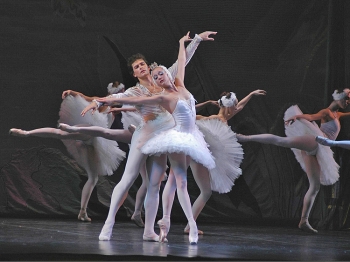
Though the principal dancers possessed great technique, they lacked expressiveness in their steps. Ruslan Mukhambetkaliev’s turn as Prince Siegfried was stiff and without passion—his dancing simply felt too rehearsed.
Ekaterina Egorova’s clean execution made for an elegant and beautiful Odette, but her dancing similarly failed to elicit much visceral reaction within. It looked too much like they were going through the motions without conveying the emotions their characters felt.
Nevertheless, there were several redeeming factors. Didar Sarsembaev’s jester was playful and full of comic relief, his challenging leaps and jumps delighting the audience throughout the show. The evil sorcerer Von Rothbart was convincingly danced by Evgeny Rudakov, whose ominous presence led us to apprehend his every entrance.
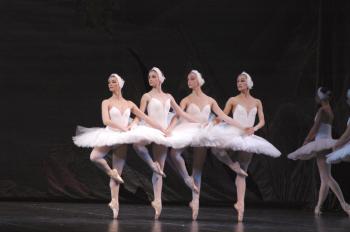
Though Prince Siegfried and Odette’s pas de deux generally fell short on chemistry, the pas de quatre of the swans was charming and executed well. Egorova, along with Maria Klyueva, Ekaterina Pankovskaya, and Samat Abdrakhmanov, deserved their warm rounds of applause.
Another highlight of the ballet was the presentation of princesses to Prince Siegfried at the beginning of Act 3. The celebration at court opens with the Spanish dancers, who dance with great sass and energy.
When Odile makes her entrance, the atmosphere is foreboding and haunting. The princesses are then presented to the prince, each displaying her distinctive dance. None of them captivate the prince, however, until Odile arrives to dance with him. Egorova performs her Odile with a subtle contrast to Odette—here, her elegance is purposeful and deliberate. She looks and dances just like Odette, until she steals a teasing glance at Prince Siegfried while spinning. At that moment, we know she is not the real Odette.
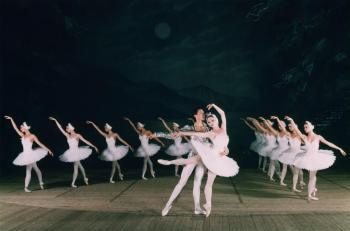
But in the scene that follows, when Prince Siegfried finds Odette with the swans, Mukhambetkaliev disappoints once again with his lack of expression. The moment loses its power. Ballet is as much about acting as about dancing, and when the dancers fail to embody their characters’ emotions, the scene completely falls flat.
Toward the finale, there is one moment that is particularly moving. Odette forgives the prince for his betrayal, but he must defeat the sorcerer to break the spell. As Prince Siegfried battles Von Rothbart, Odette blocks the prince from Von Rothbart’s blow, revealing her unrelenting love for the prince.
This production by choreographers Marius Petipa and Lev Ivanov opted for the ending of the first 1877 performance, with Prince Siegfried defeating Von Rothbart and breaking the spell. The prince and Odette are reunited in happiness.
Tchaikovsky’s composition is undoubtedly genius, but sadly, the production did not have live orchestration. One can only lament the loss in the finale, when the music rises to a climax as the prince fights the sorcerer amid a violent storm.