



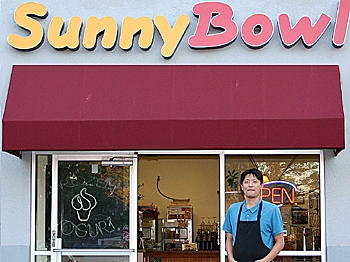
The owner, Daniel Choi, ran a Korean restaurant in Hawaii for ten years. He came to California for his children’s education. His restaurant in Hawaii was a full-blown Korean restaurant that had many kinds of Korean dishes. But here in the California, he found himself in a difficult situation. The kitchen was small, and the cost of preparing Korean dishes was high. A typical Korean meal usually has five or six side dishes. These are called banchan and they require food items that are typically labor-intensive and expensive to serve. He thus decided to specialize in just this one dish, bibimbop.
Bibimbop is a very popular Korean dish that basically has five or six kinds of cooked vegetables, chicken, or beef with eggs on top and rice underneath. The dish is topped with hot gochujang sauce and sesame seed oil. Gochujang is a spicy fermented chili and soybean paste. This is one of the fundamental sauces used in Korean cooking. This is the sauce that gives Korean food a red color. One has to mix the ingredients together well with the sauce to get the full effect. It is healthy, delicious, and a quick eat. It has some similarities to Chinese fried rice, which also has rice, chopped veggies, and, sometimes, meat.
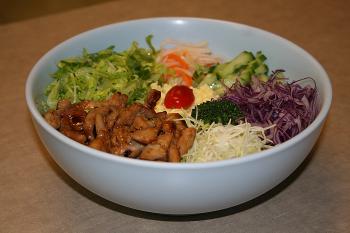
Choi found that Americans, especially in California, love salad. So he came up with a salad-style bibimbop. He says many customers say: “Wow, we love it!” Most of his customers are computer engineers from the area. Most of them have heard about his restaurant through reviews posted on the Internet. During lunch hour, he usually gets about 100 customers.
Bibimbop comes with miso soup and kimchee.
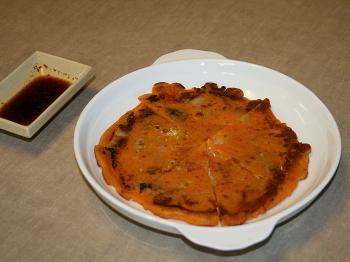
Choi decided to make the menu very inexpensive to give better value.
Bibimbop costs from $4.54 to $7.34. For most dishes if you add 92 cents you can get a larger portion. But the regular portion is usually enough for most people.
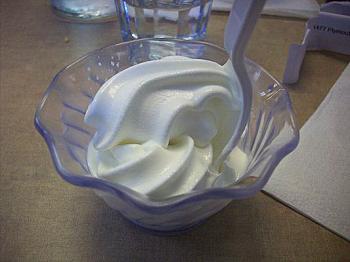
The restaurant is small, and during lunch the hassle for making change wasted a lot of time. So he rounded the menu to $6, which includes tax.
This comes with a frozen yogurt dessert, miso soup, and kimchee. Less than a year after opening, his business has picked up tremendously, he says. He thinks that the Bay Area can support four more Sunny Bowls, perhaps ones in Oakland, Fremont, Sunnyvale, and San Francisco. So his long-term plan is to open four more restaurants.
This is not actually authentic Korean food. It's a kind of fusion. For instance, all the vegetables in the Korean dishes are cooked. This bibimbop is similar to a salad: the vegetables are all raw and very finely shredded to make it fun to eat and digest. In traditional bibimbop, the eggs are usually cooked sunny side up. Here, they are scrambled.
Whether you have eaten Korean food or not, check out this place. It will be a great introduction to the vast cuisine of Korea.
Sunny Bowl is located at 1477 Plymouth St. # C, Mountain View, CA 94043.
Hours: Monday through Friday 11:00 a.m. to 9:00 p.m.
Saturdays: 12:00 p.m. to 9:00 p.m.
Closed on Sundays.
Phone: 650-625-0361
