



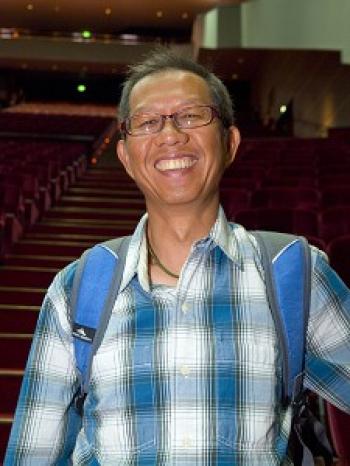
TAIPEI, Taiwan— At 10:25 on the evening of Feb. 25, the first show of the Divine Performing Arts (PDA) performances in Taipei ended in thunder-like applause from the audience. Introduced to the show by his ex-classmate, Mr. Yen Zhiwen, a Hakka composer, came to watch the art performance for the first time. He said, “It has been superb. Throughout the show, multimedia was utilized to present Chinese traditional culture. The combination has been excellent visually as well as auditorially.”
The “multimedia” mentioned by Mr. Yen includes using virtual images as backdrops, enabled by a high-tech synthesized motion picture, along with live performance by dancing artists. The combination of live performance and virtual imagery is seldom seen in Taiwan, according to Mr. Yen. He commented, “I am pretty impressed by it.”
Mr. Yen said the stories staged in the show were familiar to him, yet illustrating these stories through artistic presentations on the stage had made the show a fruitful art feast. “These stories, like Mulan [Mulan Joins the Battle], are all familiar ones to us. Most of us have read them before. Through music and dancing performances, the stories were supplemented with artistic flavors. In addition to refreshing ourselves by revisiting the story, we can also watch performing arts. This is why it is so fruitful.
”Sometimes we put these stories behind us because of familiarity. We might even think that they are simply stories that belong to the past.
“However, the DPA performance reminds us that these things do exist. That is, our morality and the principles of humans will never become obsolete. But we seldom have the opportunity to see these things now because everyone is talking about technology. Therefore, watching today’s performance is a unique experience.”
He explained his thought one step further. He said through education, these principles and ethics are kept in our mind, yet they are frequently buried by modern technology and media, etc. He criticized the general culture saying that instead of carrying programs about magnificent subjects, TV programs nowadays cover nothing but gossip, bloodshed, or hot issues.
“When I sat in the DPA performance tonight, however, I suddenly felt that these things will never disappear even if TV stations or media are not willing to cover them or have lost interested in them. On the contrary, our society and our lives still rely on these principles.
“No matter whether you have attended this show today, everybody should know that our lives are truly relying on these [ethics]. They are our roots. However, what we see and hear everyday is something quite different. Our hearts are fully occupied by many other matters. Watching the DPA performance today has helped push these foreign substances aside and helped reposition ethics to where they ought to be.”
Regarding the mingling of Chinese and Western music in the DPA performance, Mr. Yen observed that Western music outweighed its Chinese counterpart, yet the mix was handled very well. He commented, “The music of the DPA performance has brought conventional content to the modern time, and vice versa, it also applied Western modern content to traditional programs. With Oriental flavors reserved in the creation of DPA’s music, we do not sense the prominence of Western component.
“I think the scope of the program is very broad. It covers stories about loyalty, filial piety, and integrity. It has dances from China’s frontiers, including Tibet and Mongolia. Other programs, such as The Poet’s Vision are related to literature. Every program is so touching. Even those stories that we are very familiar with, such as Mulan, the feeling obtained from watching the show is quite different.”
After graduating from the Department of Fine Arts at the National Taiwan Normal University, Mr. Yen taught painting for three years. He went to Boston and studied in the Berkeley College of Music for a degree in modern music. He writes songs himself and is the founder of a 12-year-old music group. He calls himself a Hakka singer and spends most of his time in creating and singing modern Hakka songs.
Accepting the invitation of Mr. Hsiao-Hsien, a famous Taiwanese movie director, Mr. Yen produced the incidental music for Hou’s Hakka movie Good Men, Good Women in 1995. His music moved a Australian producer and a Japanese record company, both indicating their intention to buy the copyright for global publication.
For more information please visit DivinePerformingArts.org
