Thomas Chippendale (1718–1779) carved out his career as a master cabinetmaker and designer in 18th-century England. The Chippendale name is synonymous with exemplary style, design, and exquisite detail to this day. As an entrepreneur, he not only could design and make furniture, but could also decorate and fill a home with lavish custom furnishings and fittings—and this is what he did with world-renowned success.
Born in Otley in Yorkshire, in the north of England, Chippendale’s family came from a long history of woodworking. As such, the young Chippendale probably apprenticed with his father, with further training likely given by Richard Wood, a leading furniture maker in York, according to the Chippendale Society. In 1748, Chippendale went to London to start his own workshop, which may have employed 50 people, along with additional workers who worked outside the workshop or even from home.
In 1754, Chippendale published a catalog of his designs called “The Gentleman and Cabinet Maker’s Director.” It showcased his designs for clients and was intended as a style guide for gentlemen.
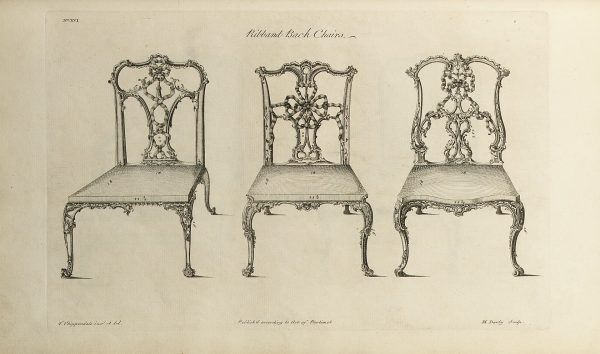 From “The Gentleman and Cabinet Maker’s Director,” three ribband-back chairs. Chippendale considered these chairs to be the best he had ever seen or made. (The Metropolitan Museum of Art, New York)
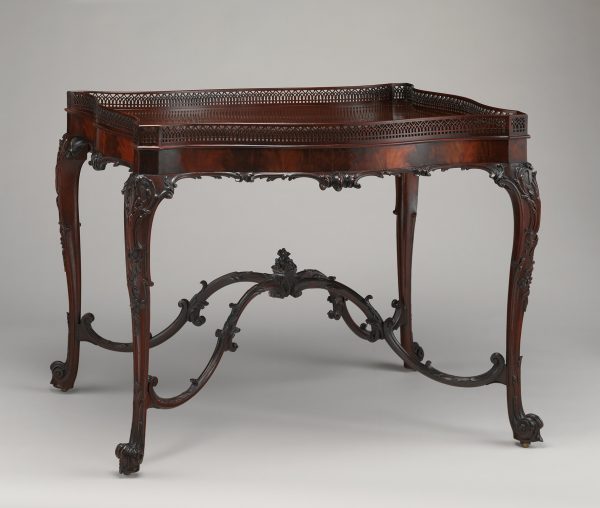 China table, circa 1755-60 by Thomas Chippendale. Mahogany, 28 1/4 inches high by 37 3/4 inches wide by 26 1/2 inches deep. Gift of Irwin Untermyer, 1964. (The Metropolitan Museum of Art, New York)
As part of Chippendale’s 300th birthday celebration, many special Chippendale exhibitions have been taking place throughout 2018. Two exhibitions, in particular, invite viewers to see some of the most important Chippendale collections in the world in their natural habitat, as it were: Harewood House and Paxton House.
Harewood House
Chippendale was commissioned in 1767 by Harewood’s owner, Edwin Lascelles, to completely fit and furnish his newly built home. According to Harewood House, Lascelles’s commission to Chippendale may have exceeded 10,000 pounds (about $13,164), making it an important commission.
The commission left no surface untouched; it included all manner of furniture and soft furnishings from floor to ceiling, and in-between, being careful not to overlook the smallest of details. Such a vast undertaking of interior design took Chippendale 30 years to complete. In fact, Chippendale didn’t see the finished Harewood House. When he died in 1779, his son Thomas Chippendale Jr. completed the job.
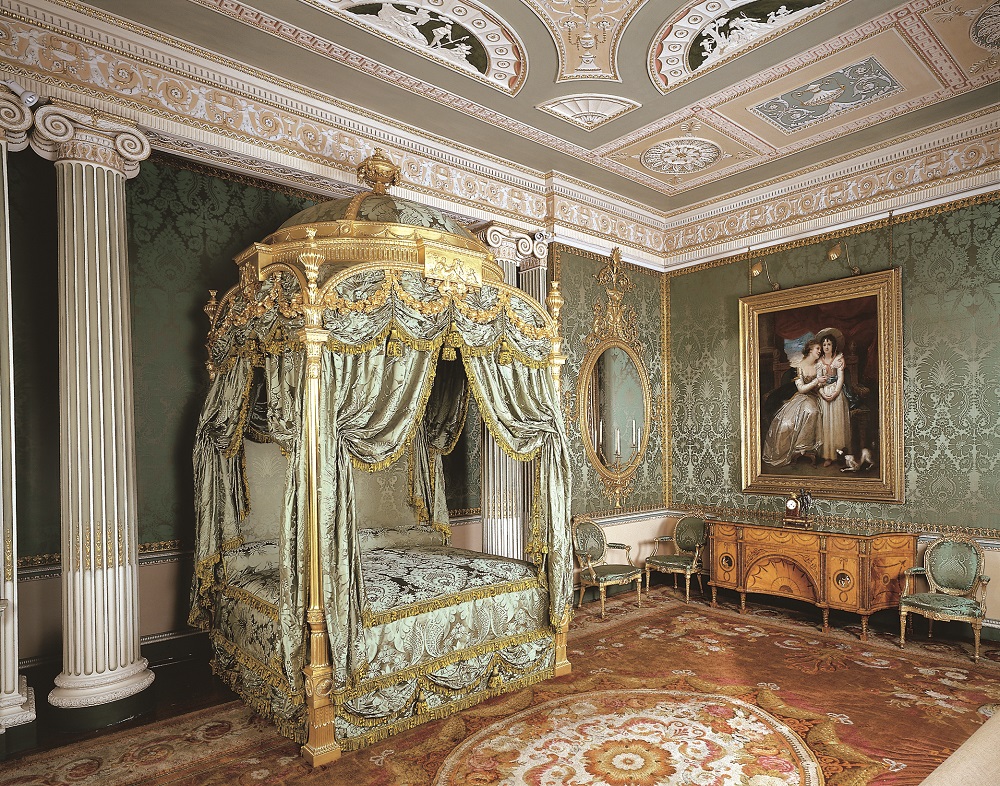
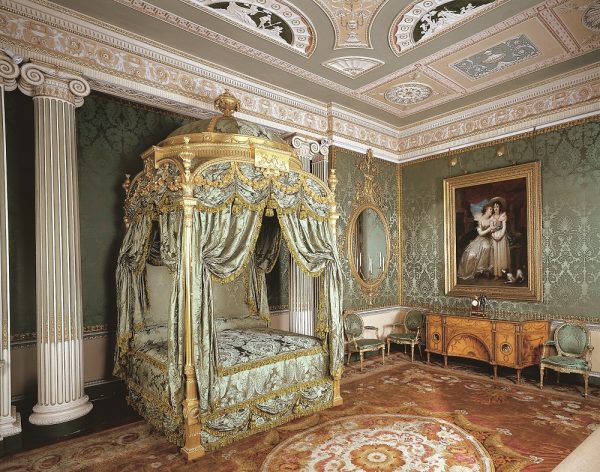 The 1773 State Bed at Harewood House, made by Chippendale, is one of the most expensive pieces he ever supplied. It’s gilded wood with intricately carved details and draped in green silk damask. (Harewood House)
Among the highlights in Harewood’s exhibition “Thomas Chippendale: Designer, Maker, Decorator” are the Diana and Minerva Commode, considered to be one of Chippendale’s masterpieces; a long-lost Chippendale mirror; and the leather-bound book “The Gentleman and Cabinet Maker’s Director,” containing Chippendale’s illustrations for sales and style purposes.
“Thomas Chippendale: Designer, Maker, Decorator”
Harewood House
Near Leeds in Yorkshire, England
Through Sept. 2, 2018
Paxton House
Chippendale developed his “Paxton Style” of furniture after he and his son Thomas Chippendale Jr. took a commission from Scottish patrons Patrick and Ninian Home, for their Paxton House between 1774 and 1791. Compared to his early designs, Chippendale’s “Paxton Style” was pared down to suit the Homes’ taste. Ninian Home described this new neoclassical style as “neat and substantially good.”
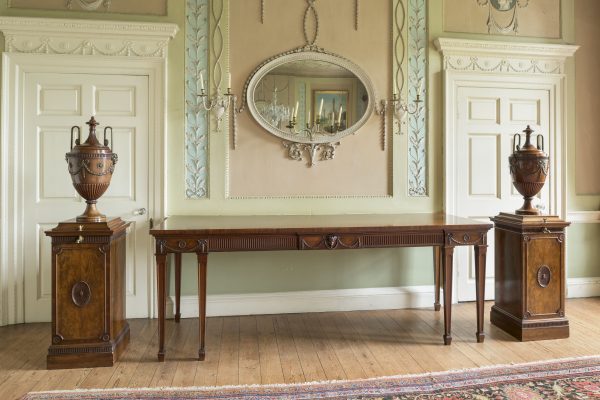 A Chippendale sideboard, circa 1773, in the dining room at Paxton House. (John Hammond)
The exhibition not only showcases the originally commissioned pieces but also displays other outstanding pieces of furniture from private and public Chippendale collections.
“The Paxton Style, Neat and Substantially Good”
Paxton House
Berwick-upon-Tweed, in the Scottish Borders, UK
Through Aug. 28, 2018
The Metropolitan Museum of Art in New York
The Metropolitan Museum of Art in New York City explores the designs in Chippendale’s book “The Gentleman and Cabinet Maker’s Director.” The Met has a first edition on display.
Three chairs represent Chippendale’s influential impact: one from Chippendale’s London workshop; one circa 1769 made by a Philadelphia craftsman for Revolutionary War General John Cadwalader; and lastly a 1984 chair designed by architects Robert Venturi and Denise Scott Brown. Another room shows Chippendale’s original drawings.
The exhibition aims to draw out the various styles of Chippendale’s enduring influence and body of work.
“Chippendale’s Director: The Designs and Legacy of a Furniture Maker”
The Met
New York
Through Jan. 27, 2019
To find more celebrations for Chippendale’s 300th birthday, go to Chippendale300.co.uk