“Winter is an etching, spring a watercolor, summer an oil painting, and autumn a mosaic of them all,” wrote American author Stanley Horowitz. For centuries, poets and writers have given voice to the seasons, and painters have immortalized them in color.
Mr. Horowitz’s autumn mosaic is here. Cool, crisp blue skies illuminate our lunchtime strolls. The leaves are turning to fire, and falling like flaming teardrops—a tree’s curtain call as it nears the end of the year.
The father of American landscape painting, Thomas Cole (1801–1848), lauded nature and all its gifts. In his influential January 1836 “Essay on American Scenery” for The American Monthly he wrote: “He who looks on nature with a ‘loving eye,’ cannot move from his dwelling without the salutation of beauty; even in the city the deep blue sky and the drifting clouds appeal to him.”
When we attune ourselves to nature we align ourselves with the true, the good, and the beautiful.
We can appreciate fall firsthand through a walk, but we can also embrace the season through great autumnal art. Using Cole’s logic, every landscape painting must be a “salutation of beauty,” pictured through an artist’s “loving eye.”
American painter Thomas Moran (1837–1926) saw the importance of painting the country’s landscape:
“Before America can pretend to a position in the world of art it will have to prove it through a characteristic nationality in its art, and our artists can only do this by painting their own country, making use of all the technical skill and knowledge they may have acquired in the schools of Europe and the study of the past.”
Early Autumn in the Catskills
Romantic artist Cole idealized the landscape, turning ordinary scenes into sublime paintings. He especially loved the Hudson River Valley spanning New York to New Jersey.
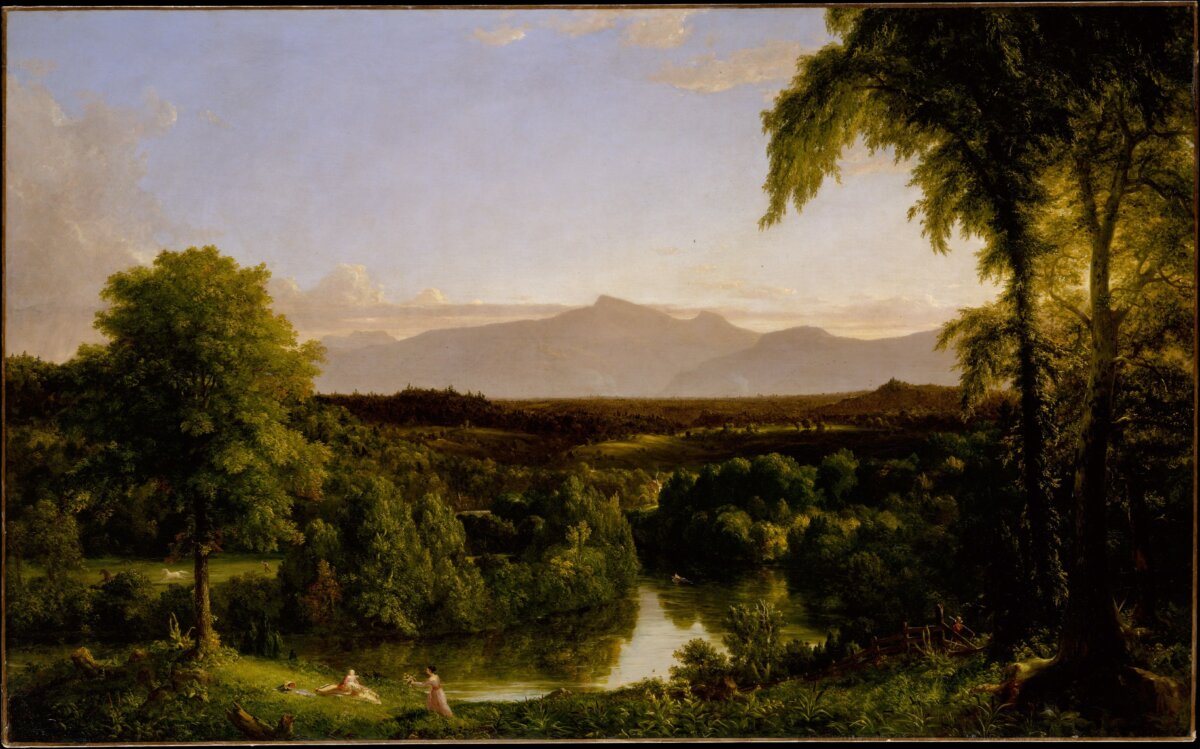
In “View on the Catskill—Early Autumn,” Cole depicts summer’s last hurrah—a landscape on the cusp of autumn, near his home in the town of Catskill. He shrouded the distant Catskill mountains in mist, and covered the land in myriad greens aglow with the autumnal sun. Some leaves have turned to auburn and gold. In the foreground, a hunter hides by a bridge, and a mother clutching wildflowers runs to her baby, who has just woken up from a nap. In the middle ground, a man chases two horses, while another man rows a boat on the Catskill Creek. In the center, smoke billows from a couple of houses, further signs of life in the valley.
Cole painted “View on the Catskill—Early Autumn” between 1836 and 1837, when he was finalizing “The Course of Empire,” a series of five paintings demonstrating the rise and fall of man: “The Savage State,” “The Arcadian or Pastoral State,” “The Consummation of Empire,” its “Destruction,” and “Desolation.” By 1837, the Canajoharie and Catskill Railroad carved up the landscape seen in a “View on the Catskill—Early Autumn.”
Autumn in Pennsylvania
Moran continued painting in the tradition of those before him. His style first reflected Cole’s Hudson River School, especially in his earlier works such as autumn scenes of Pennsylvania.
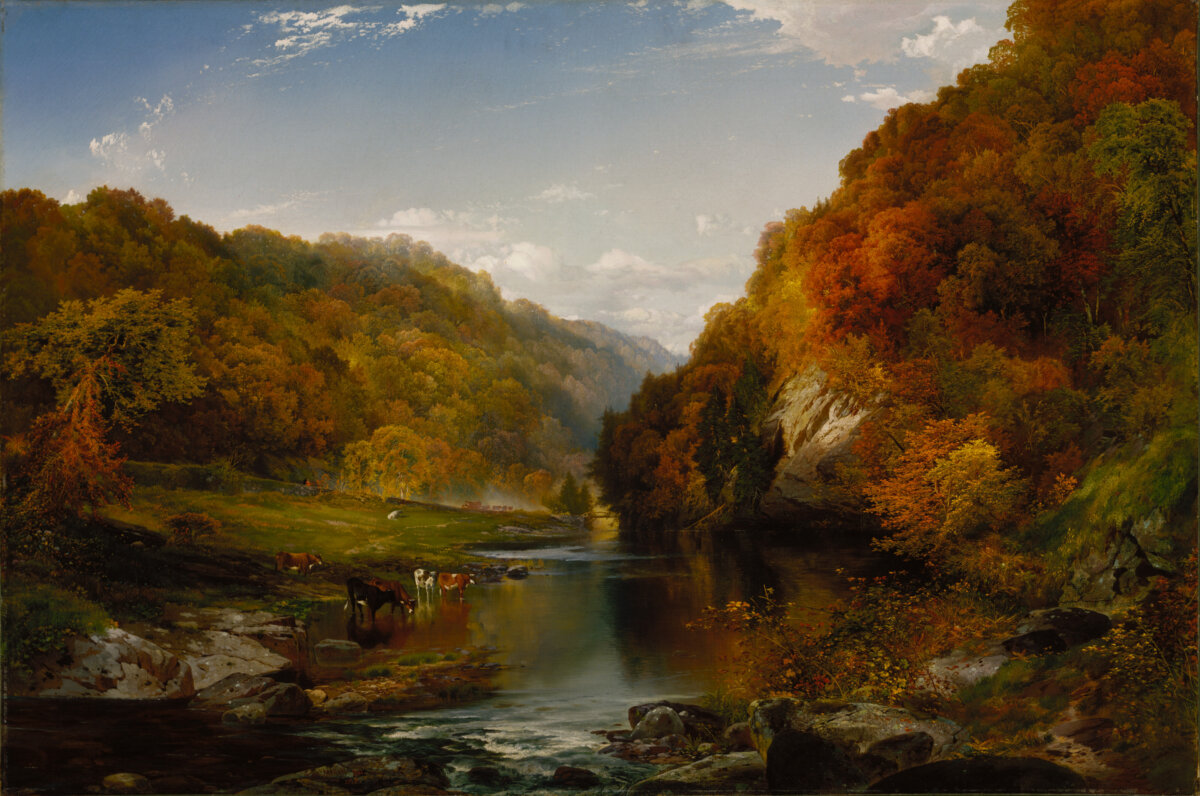
A peaceful pastoral scene plays out in Moran’s “Autumn Afternoon, the Wissahickon,” in northwest Philadelphia, Pennsylvania. Autumn trees and a rocky crag tower over the valley as cattle quench their thirst in the creek, and a wagon is about to disappear in a distant cloud of dust. Seeing the still water calms the soul and aids contemplation.
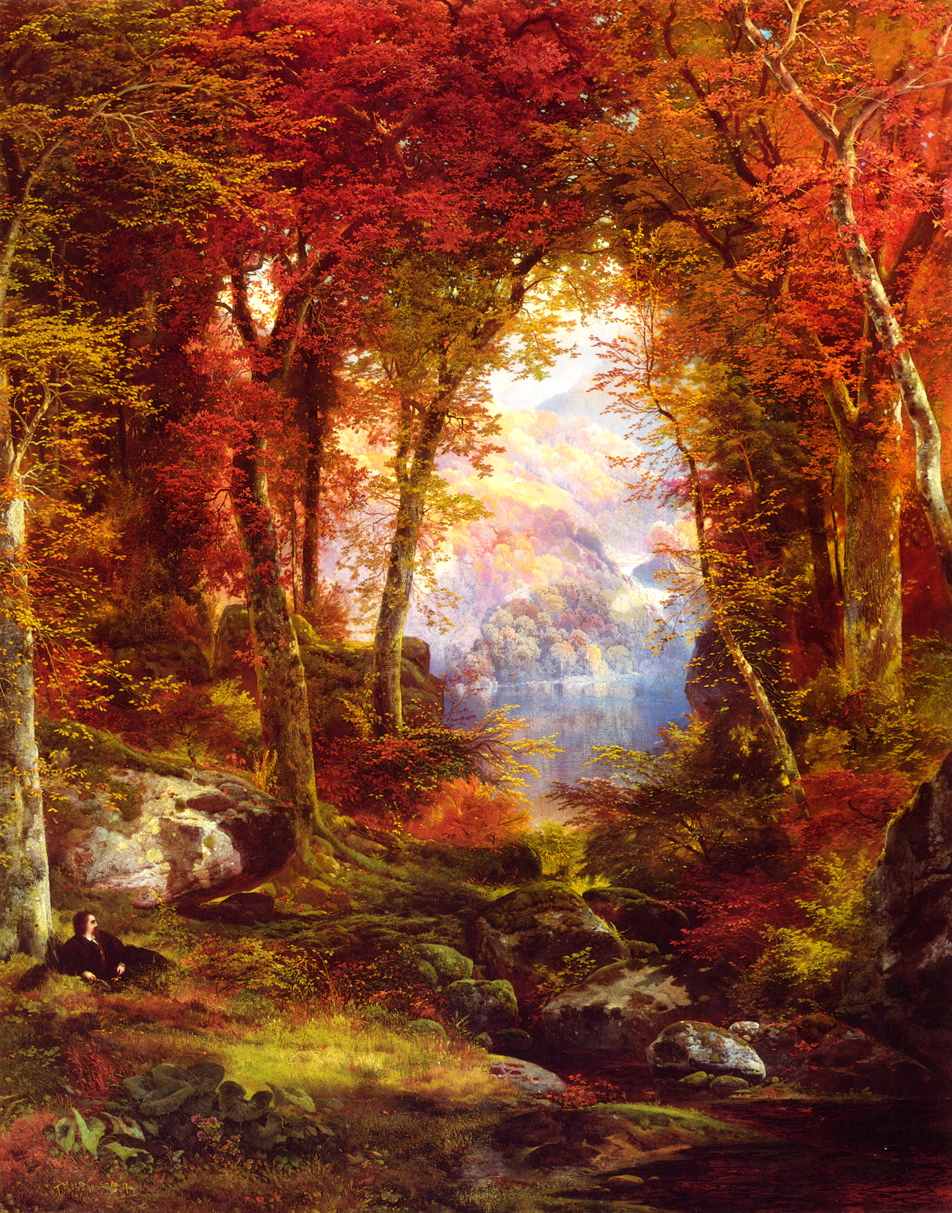
Moran’s painting “Under the Trees” celebrates the riotous colors of the season, or what poet William Cullen Bryant calls autumn: “The year’s last, loveliest smile.” On the left, a man, who could be the artist himself, lays on a bank and gazes through the fiery trees to the otherworldly lake beyond.
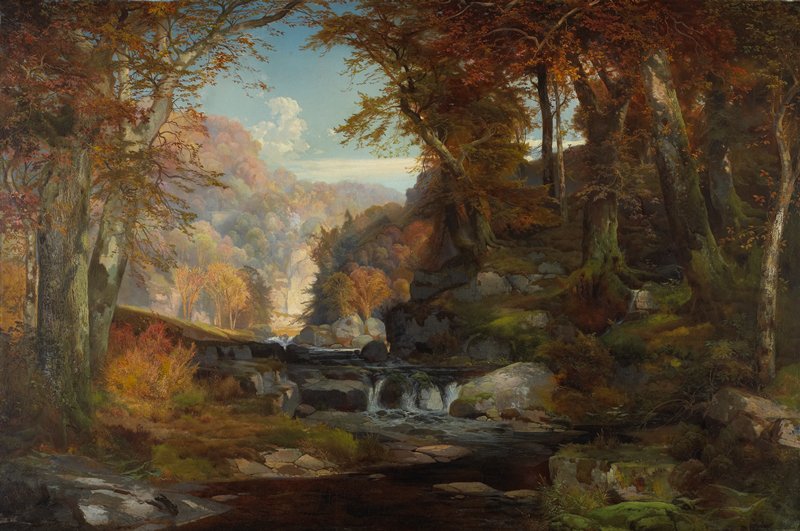
In “A Scene on the Tohickon Creek: Autumn” (a tributary of the Delaware River, in Bucks county, southeast Pennsylvania), Moran paints the paradox of autumn. Gold, amber, and scarlet leaves set the cool, shady creek alight. One can almost feel the biting breeze that whistles its way through the creek, and the whitewater rapids in the distance, which the area is famed for. Soon, the valley will lay dormant and the trees bare, and English poet William Wordsworth’s words will ring true:
Wild is the music
of autumnal winds
Amongst the faded woods.
Moran may be best known for painting the vast American West, along with his peers such as Albert Bierstadt, who were often referred to as Rocky Mountain School painters. When Moran painted the West, he was deeply influenced by English Romantic artist Joseph Mallord William Turner, painting in a more expressive and otherworldly style.
Art, a Great Panacea
Great writers, poets, and artists can pique our curiosity, and enrich our lives. Cole wrote in his “Essay on American Scenery” that “It is generally admitted that the liberal arts tend to soften our manners; but they do more—they carry with them the power to mend our hearts.”
In her poem “The Autumn,” English poet Elizabeth Barrett Browning administers such a panacea:
Go, sit upon the lofty hill,
And turn your eyes around,
Where waving woods and waters wild
Do hymn an autumn sound.
The summer sun is faint on them–
The summer flowers depart–
Sit still–as all transform’d to stone,
Except your musing heart.
Would you like to see other kinds of arts and culture articles? Please email us your story ideas or feedback at features@epochtimes.nyc