



NR | 1h 26m | Drama, Biopic | 1936
What does the 19th-century researcher of the immune system have in common with some 21st-century vaccine skeptics? A thirst for the truth. French scientist Louis Pasteur pioneered vaccinology; but unlike some scientists of his era, he was driven as much by humility over what he didn’t know as by confidence in what he did know.
Modern-day vaccine skeptics, like some of their predecessors, aren’t protesting vaccines per se. Instead, they’re wondering why so many modern-day scientists aren’t mimicking Pasteur’s old-world blend of courage, truth, faith, and humility. Director William Dieterle’s film fictionalizes Pasteur’s campaign to be heard in a culture that too hastily branded him a charlatan.
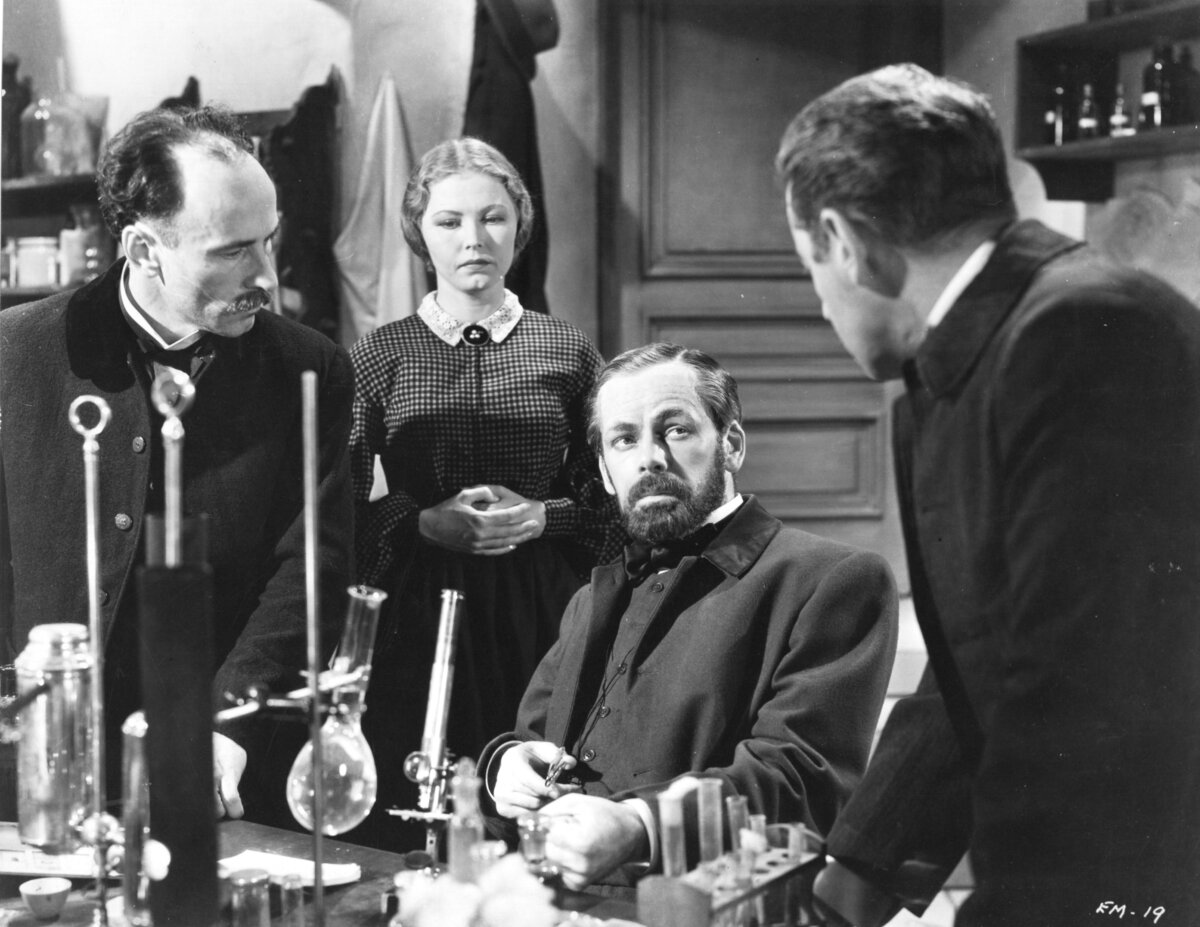
Parisian chemist and microbiologist, Pasteur (Paul Muni) dares to challenge prevailing scientific wisdom by arguing that germs cause disease, and that simple clinical precautions can prevent disease, even death. He insists on sterilization of surgical equipment, not just a surgeon’s hands. So, an entrenched, still medieval medical establishment, goaded by the likes of Dr. Charbonnet (Fritz Leiber) and Dr. Radisse, stirs up the wrath of Emperor Napoleon III against Pasteur, forbidding him to spread what they liken to witchcraft, not mere quackery.
Desperate to sustain his research, Pasteur and his devoted wife Marie (Josephine Hutchinson) flee Paris and settle down in the farming town of Arbois. In the wake of the Franco-Prussian War, across France, sheep start dying of anthrax.
Except in Arbois. There, thanks to Pasteur’s new vaccine, they survive. This earns him new votaries, including Radisse, British pioneer of antiseptic surgery Dr. Joseph Lister, and Charbonnet’s protégé, young Dr. Jean Martel. Charbonnet is unmoved.
Anthrax vanquished, Pasteur turns to tackling rabies. But this challenge threatens to be insurmountable when he’s confronted with a rabies-infected boy. Can he afford to try out untested techniques on humans, even if they’ve been proven with animals?
Even an otherwise sympathetic Radisse warns that Pasteur is a microbiologist, not a medical doctor, and runs the risk of imprisonment or execution if he tries to practice medicine without a license. It takes all of Pasteur’s willpower and the unstinting loyalty and support of Marie to persevere.
Scientific Temper Needs Humility
Dieterle experiments with a couple of film shots to bring his audience close to the science, including close-ups of images resembling microbes or blood cells, magnified under a microscope slide. His matter-of-fact screenplay cleaves to the humdrum language that doctors and researchers use in the corridors of clinics and labs.
Largely shorn of drama, the whole film has a clinical feel to it. And Dieterle doesn’t allow the already subdued soundtrack to intrude on key scenes, characters, or dialogue. Unsurprisingly, the film won an Oscar for Best Screenplay and Story and was nominated for Best Picture.
Muni’s riveting portrayal of an aging but righteously combative Pasteur, won him a Best Actor Oscar. Poignantly, he depicts the pathos of Pasteur’s tenacious and ultimately triumphant struggle against professional and societal ostracism.
In one scene, a Russian, Dr. Zaranoff (Akim Tamiroff), who has devoted his life to finding a cure for rabies, pleads with the medical academy as they debate plans to collaborate with Pasteur: “If Pasteur is not willing to come to us, let us go to Pasteur.” Charbonnet bristles. Surely, that would only heap humiliation on a medical establishment already affronted by Pasteur’s claims.
Profoundly, Zaranoff says, “Humility is a virtue, monsieur. Not only in those who suffer but in those who hope to heal.” That expression of humility mimics Pasteur’s own, when, after repeated failures in the lab, he reassures a junior colleague on the verge of despair that it “only shows how little we know about disease.”
What powers Pasteur’s mind-numbing work ethic is the fact that so many patients come to him with boundless hope and confidence, as if he’s cracked a law of nature when he’s developing mere theories. Pasteur critiques the aggrandizing ambition of the medical establishment, insisting, “The benefits of science … are not for science … they’re for humanity.”
Dieterle’s other hero is hidden in plain sight: Marie. It’s her rock-solid belief in Pasteur’s scientific integrity that supports him when he confronts ridicule and rejection.
Like her, it isn’t that Pasteur suspects that there’s a divine hand that heals, even if a human hand cures—he’s convinced of it. When a colleague rushes in with news that a patient has recovered, Pasteur doesn’t gloat. Typically, he exclaims, “Thank God!”
You can watch “The Story of Louis Pasteur” on Amazon Prime Video and DVD.
‘The Story of Louis Pasteur’
Director: William Dieterle
Starring: Paul Muni, Josephine Hutchinson
Not Rated
Running Time: 1 hour, 26 minutes
Release Date: Feb. 22, 1936
Rated: 4 stars out of 5
What arts and culture topics would you like us to cover? Please email ideas or feedback to features@epochtimes.nyc
