



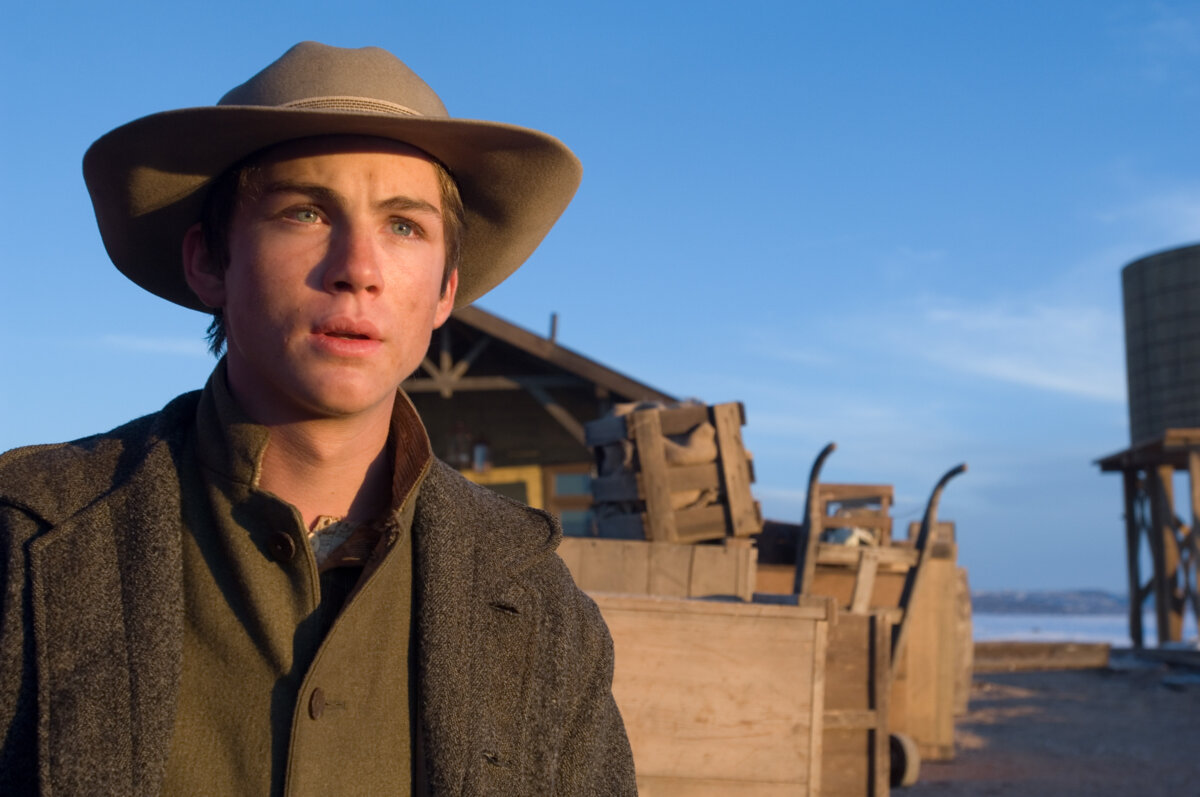
Through his picture-perfect Western “3:10 to Yuma” (2007), director James Mangold is saying that children, women, and men who shelter beneath the shade of subtle masculinity ought to be grateful, not hanker after the spectacular but shallow alternative.
Drought and debt force one-legged Civil War veteran and small-time rancher Dan Evans (Christian Bale) to join a posse. They’re out to find and put crooked but charming outlaw Ben Wade (Russell Crowe) on the 3:10 train heading to prison in Yuma. While Evans limps through this real-world manhunt, his wife Alice (Gretchen Mol), younger son Mark (Benjamin Petry), and older son William (Logan Lerman) find themselves in a manhunt of a different sort.
Alice and William, in particular, are compelled to confront contrasting manifestations of masculinity: Wade’s winsome smugness, his lapdog Charlie Prince’s (Ben Foster) sadism, and Evans’s quiet, conscientious courage. Watching them, William must choose the kind of man he wants to be, while Alice wonders about the kind of husband she’d rather have.
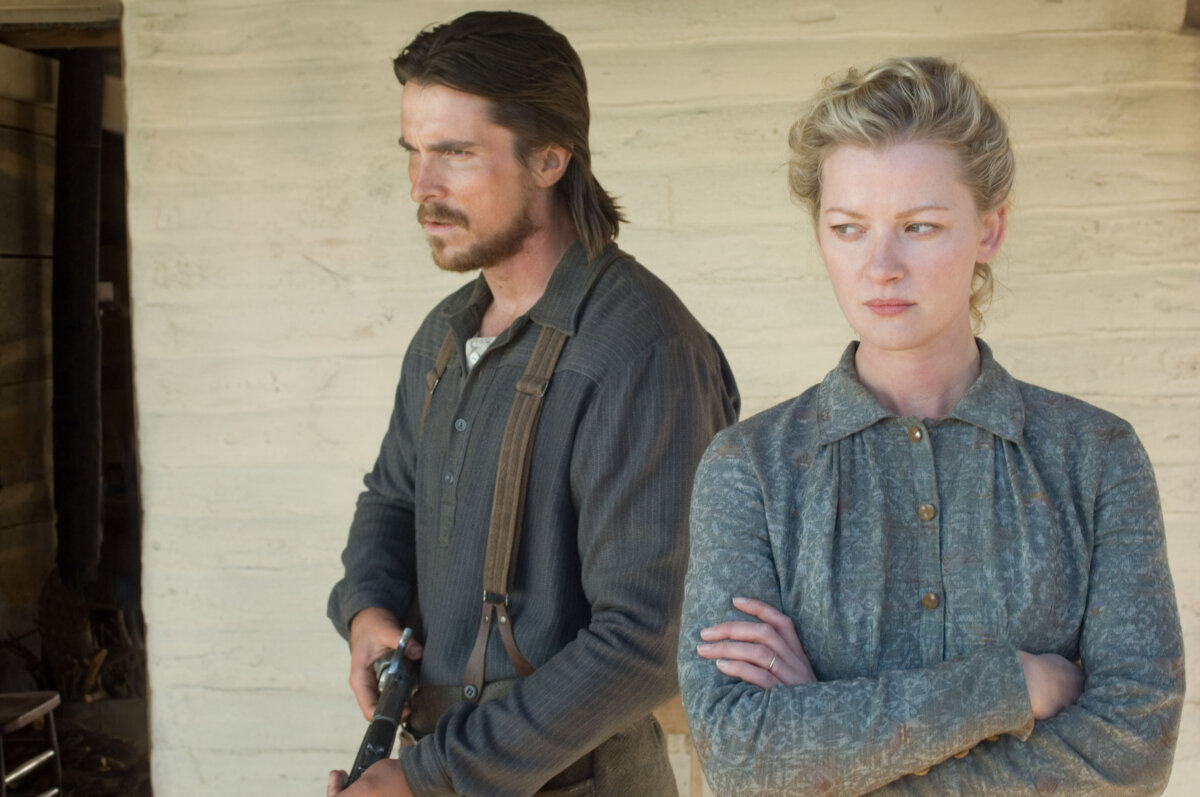
Willful Wife, Stubborn Son
To Alice, hobbling Evans is like half a man—nowhere near man enough for her. Her scorn seeps through to William, who figures that his father is an indecisive, risk-averse coward. But with his beloved family to protect and provide for, Evans can’t afford to be cavalier, even to impress his willful wife or stubborn son. He hopes that when William walks in his father’s shoes, he’ll understand. Contemptuous, William disabuses him of such notions as he says, “I ain’t ever walking in your shoes.”
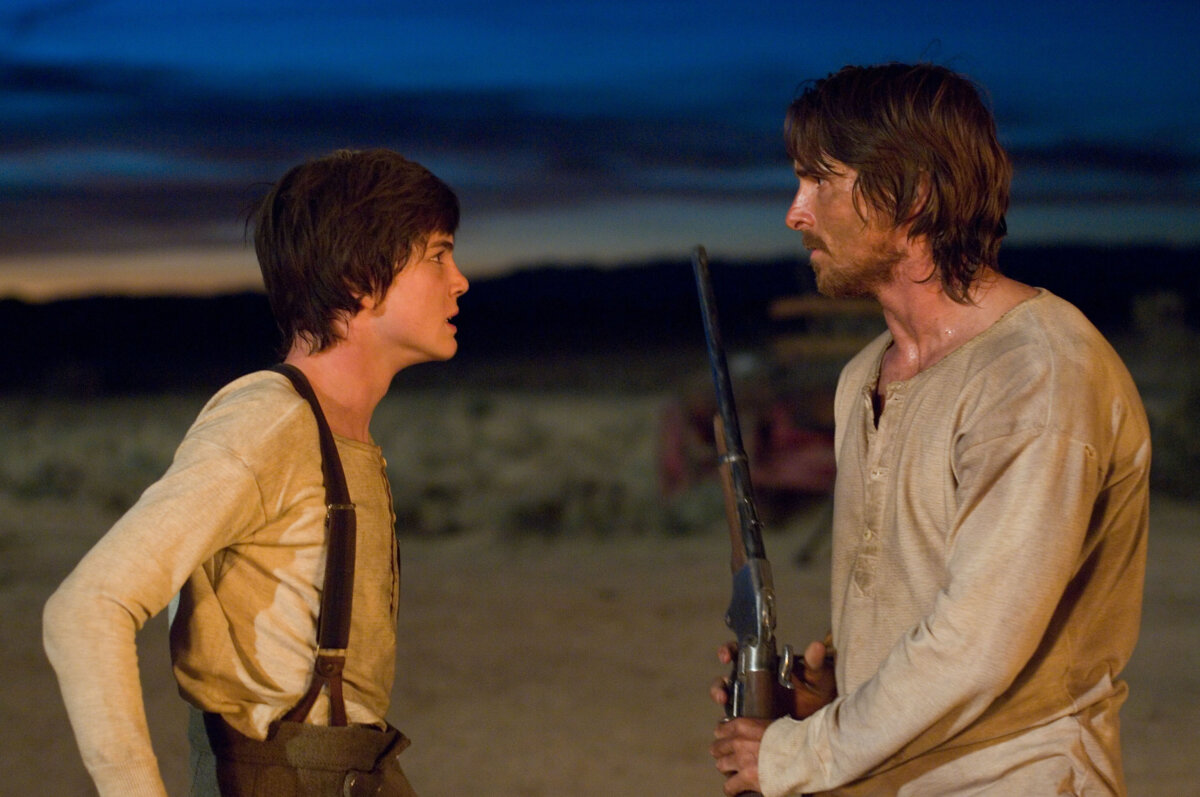
Charismatic as ever, Wade, briefly at the Evans household, is watched by a starstruck William and a blushing, mildly flattered Alice. Evans is teaching his sons to distinguish between being mad at someone and murdering someone. To him, if an aggressor is unjust, rage may be legitimate, but murder never is. To a smirking Wade, though, there’s no difference between killing a man and an animal. He sees himself and his crew as not much more than animals. Their instincts ought to overrule everything else: “It’s man’s nature to take what he wants,” Wade says.
See how William’s impetuousness plays out. It is through experiments (and mistakes) that boys learn to become men, sifting the calculated risk from the reckless.
Here, even able-bodied men end up turncoats. Through his actions, not words, one-legged Evans demonstrates that masculinity isn’t physicality alone. It’s a higher order of being, closer to a state of mind, and an expression of the will.
Yes, words matter. Evans warns William against using expletives like pretend pistons to puff himself up. Words get you only so far. Wade has words, too. He quotes the Bible to explain or justify himself. He sketches what catches his eye—a bird, a beautiful barmaid, a brave man. He can’t help it. He respects beauty, truth, and goodness. But he can’t show these values that are deep inside him, except on paper.
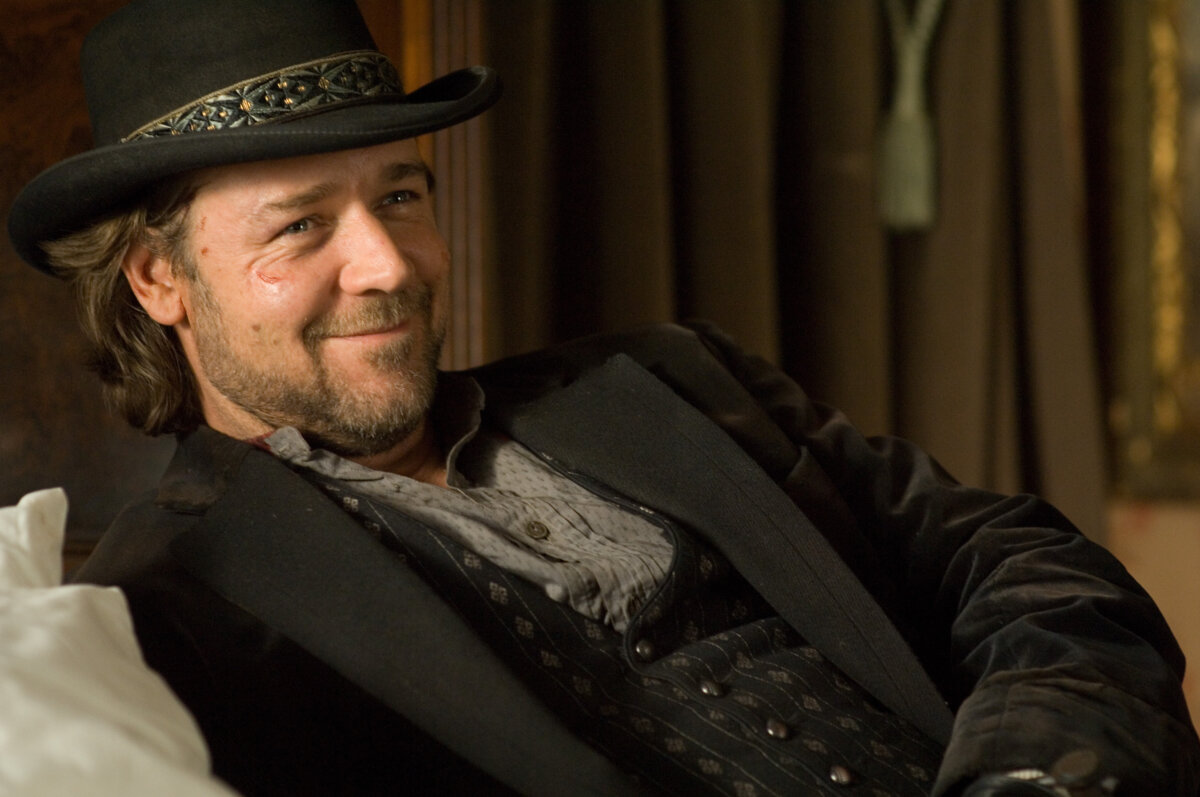
More than drawing his guns or his portraits, Wade relishes drawing attention to himself; bravado is a habit, feeding his self-centeredness. Like femininity, masculinity is defined by other-centeredness. Narcissism makes altruism a shadow of itself, robbing it of spontaneity.
Masculine Respect
It’s easy for boys to degenerate into caricatures of themselves as men. Staying masculine is hard work. It’s why masculine men demand, and deserve, respect; they’re giving it first. Hear the steel in Evans’s voice as he tersely tells Alice, “I’m tired of watching my boys go hungry. I’m tired of the way that they look at me. I’m tired of the way that you don’t.”
Women who can’t tell the difference between what’s masculine and macho struggle to respect the masculine in others because they loathe the feminine in themselves.
The film’s opening shot is at night. Little Mark’s asleep. Awake, William strikes a match, then gazes adoringly at a comic-book sketch of a man astride a rearing horse. The words “Deadly Outlaw” are plastered across the page.
They seem to invite the boy into a world where the man gets “what he wants” and allows nothing and no one to stand in his way. That’s Mangold explaining his film, as if willing the starry-eyed boy to see through the gimmicky mascot to the gutsy man.
These reflective articles may interest parents, caretakers, or educators of teenagers and young adults, seeking great movies to watch together or recommend. They’re about films that, when viewed thoughtfully, nudge young people to be better versions of themselves.
Check the Internet Movie Database website for plot summary, cast, reviews, and ratings; a review is also on The Epoch Times website.
You can watch “3:10 to Yuma” on Amazon Prime Video, Apple TV, and Hulu.
What arts and culture topics would you like us to cover? Please email ideas or feedback to features@epochtimes.nyc
