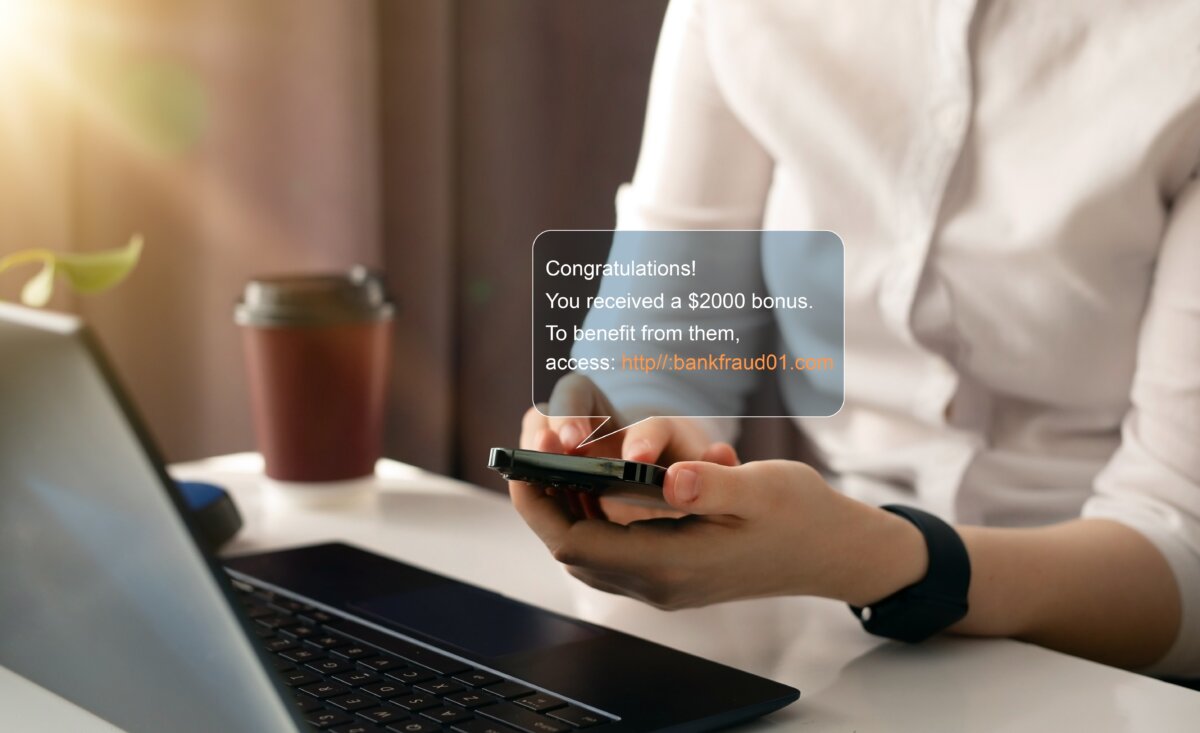
Your smartphone dings, and you look to see if your grandson has texted you back. Instead, you find a message from a toll road saying you owe money. What does this mean?
Toll road texts are just one of many ways that nefarious people try to scam you. The point is to scare you into giving your credit card number or, worse, your Social Security number, to the fraudster. There are many other scams that you need to watch out for that are even more aggressive when it comes to picking your pocket.
How Text Scams Work
According to the Federal Trade Commission, in 2024, consumers reported losing $470 million due to text scams. This amount is five times higher than what was reported in 2020.
Text scams, also known as “smishing,” are common tactics used by scammers to steal your personal information.
Fraudsters employ various types of messages, but they all follow the same pattern. You’ll receive a text from an unknown or “spoofed” number. But scammers use technology to make it look like the message is from a business or person you know. Common businesses that they mimic include the IRS, Apple, and Amazon.
The message always creates a sense of urgency. For example, they may claim you owe the IRS, and that your house is about to be seized, or that you won a sweepstakes and need to quickly claim your prize.
The scammer will then tell you to click on a link or call a number. These fraudsters are skilled in psychology and will convince you to respond without thinking.
You’ve probably received several scam texts. Here are the most popular.
UPS Missed Delivery Notification
This one takes advantage of the fact that more people are shopping online. The text might be from UPS, FedEx, or the U.S. Postal Service. A fake text is sent to you from a delivery service notifying you that a delivery was missed or needs to be rescheduled.
If you’ve just recently bought something online, you might be tempted to click the link. However, if you do, you’ll be asked to provide personal information and possibly make an advance payment to ensure the delivery of your package.
Toll Road Payment Scam
According to the Federal Communications Commission, it has received complaints about imposters sending texts claiming to be from a legitimate toll-payment company. The scam texts say that the recipient has an unpaid toll or owes an outstanding balance on their account. Sometimes, the text threatens to suspend your driver’s license if the toll isn’t paid.
The message often asks you to pay in non-standard ways, such as gift cards or wire transfers. The sender’s number is usually international, or there may be other phone numbers included as recipients.
Don’t click the link or call the phone number. Toll operators don’t use text messages for overdue amounts.
Phony Job Offer Text Scams
You need a job, and then, out of the blue, a text comes over your phone with a great opportunity. It’s remote, has a flexible schedule, and pays well. But you didn’t apply for the job, so how did they know you were available? You may also note that the text doesn’t mention your name.
The job usually offers $200 to $800 a day. Working only 30–60 minutes a week, you can earn at least $9,000 per month. In order to apply, they push you to another platform. They want to take the conversation to email, Telegram, or WhatsApp quickly.
Once they have you, they try to convince you to send them money as an application fee. You’ll never see that money or hear from them again. Or they may ask for your personal information, like a Social Security number and date of birth, to steal your identity.
This goes back to the old adage: If something seems too good to be true, it is.
New Billing Statement
If you receive a notification that your billing statement is ready or a “thank you for your payment” message, beware.
This is a common scam. If you believe you’ve done business with the company, but haven’t had any transactions recently, go to the company’s website and contact customer service.
Never click a link or call a number in the text. They’ll try to gather your passwords or other personal information. A legitimate company will never ask for those.
Account Needs to Be Reactivated
Even an innocent message can’t be trusted. If you receive one saying your account has been hacked, don’t respond. Instead, contact the company or bank’s fraud department and report the text. Don’t click the link or call the phone number on the text. They just want your institution’s passwords.
Family Member Needs Help
This one can be heartbreaking. You receive a text that a loved one is in trouble and needs money immediately. Don’t send the money. Instead, call your family member or friend and check on them. If they don’t answer, call someone close to them. Don’t send financial aid before verifying.
Fake Subscription Renewals
It’s easy to forget what subscriptions you’ve paid. But don’t fall for a text offering you a reduced rate on a subscription if you act now. If you’re interested, reach out to the company’s customer support to inquire about it.
Numerous Text Scams to Take Your Money
These are just a few of the more popular text scams. But just assume that if you receive a text that wants you to act or do something, it’s a scam. Never click on a link or call a number in a text message. Remember, every text scam will give a sense of urgency that will pressure you to act; don’t do it.
The Epoch Times copyright © 2025. The views and opinions expressed are those of the authors. They are meant for general informational purposes only and should not be construed or interpreted as a recommendation or solicitation. The Epoch Times does not provide investment, tax, legal, financial planning, estate planning, or any other personal finance advice. The Epoch Times holds no liability for the accuracy or timeliness of the information provided.