




I’ve always remembered how, back in high school, one of my friends collected tea tags from a particular brand that printed poetry quotations on one side of the tag. Her now-husband, who was trying to win her over at the time, started buying that brand of tea and saving the tag after each cup. After having collected a great many, he put the collection in my friend’s locker one day to surprise her.
In college, the now-husband of another friend who was fond of calligraphy, learned how to do calligraphy for her and painstakingly wrote out a passage from the Song of Songs, further embellishing it in gold leaf and framing it for her.
Genuine love is generative. It’s always creating, innovating, and seeking new ways of serving the beloved. These two instances of my friends in their courtships remind me of how much love spurs on the imagination, creating the greatest incentive to our creative faculty.
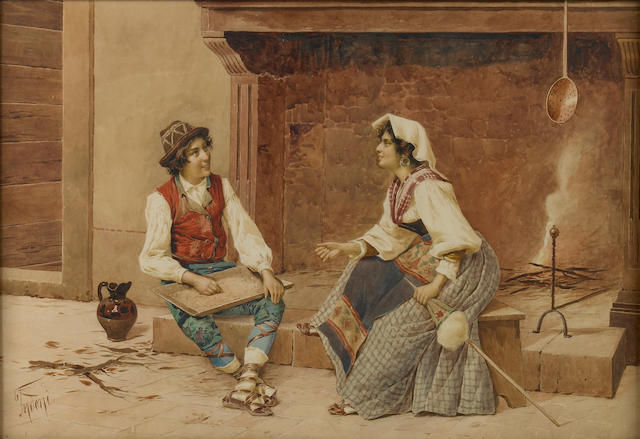
William Wordsworth made a similar observation on the nature of love, as shown in one of his poems. Written in 1802, it’s called “Among All Lovely Things My Love Had Been.” The simplicity of the poem’s language points to Wordsworth’s belief that in a less complex society, the passions of the heart could reach maturity.
His poetry dwells on scenes from everyday life in the countryside, where man lived closer to nature. Wordsworth observed that modern life was characterized by constant stimulation and ceaseless activity. He turned his focus to seeking encounters with the sublime in nature. He sought a more humanizing approach to poetry and life, borrowing scenes from rustic life and using accessible, everyday language to describe ordinary emotions.
This particular poem illustrates his philosophy well. Both individuals in the poem are sensitive to nature’s beauty and each other’s feelings. Wordsworth describes their love in simple, straightforward language. Lucy is attuned to her surroundings, taking note of the stars and flowers.
Glow worms are so scarce in this region that the speaker finds only one. While it seems excessive that the speaker would ride through a storm just to show his beloved a glow worm, the speaker considers it worthwhile to show his beloved a form of beauty she had never seen but had longed to behold.
Among all lovely things my Love had been;
Had noted well the stars, all flowers that grew
About her home; but she had never seen
A glow-worm, never one, and this I knew.
While riding near her home one stormy night
A single glow-worm did I chance to espy;
I gave a fervent welcome to the sight,
And from my horse I leapt; great joy had I.
Upon a leaf the glow-worm did I lay,
To bear it with me through the stormy night:
And, as before, it shone without dismay;
Albeit putting forth a fainter light.
When to the dwelling of my Love I came,
I went into the orchard quietly;
And left the glow-worm, blessing it by name,
Laid safely by itself, beneath a tree.
The whole next day, I hoped, and hoped with fear;
At night the glow-worm shone beneath the tree;
I led my Lucy to the spot, “Look here,”
Oh! joy it was for her, and joy for me!
In this account, Wordsworth reveals one of the characteristics of gratuitous love. Love defies sense and reason; it isn’t necessary for survival. Though there is an aspect of it that is more pragmatic and reasonable, longing to protect and provide for someone even beyond what is necessary, there is no utility in its expression. It spends time and effort on seemingly absurd, frivolous gestures to find expression in acts of service.
Love and beauty, precisely because they go beyond mere survival, give purpose and meaning to life. They are humanizing. They comfort the individual soul and draw it into communion with others. These qualities distinguish the human experience apart from that of lower lives.

Through Lucy’s experience of this particular source of beauty, the speaker experiences it again as if for the first time. The speaker, having seen a glow worm before, experiences hope, fear, and joy only on behalf of his beloved. Lucy’s desire to see a glow worm becomes the speaker’s own desire; the joy of one becomes the joy of the other because they feel as one.
The marvel of the poem, and of similar deeds in reality, is that the joy of the other person is the only recompense for these expressions of love. That joy is reward enough because it’s shared.
Wordsworth also shows that, even though this seems a trivial matter to put so much store in, it’s actually in the small, day-to-day occurrences that love is deepened and finds its greatest joys.
What arts and culture topics would you like us to cover? Please email ideas or feedback to features@epochtimes.nyc
